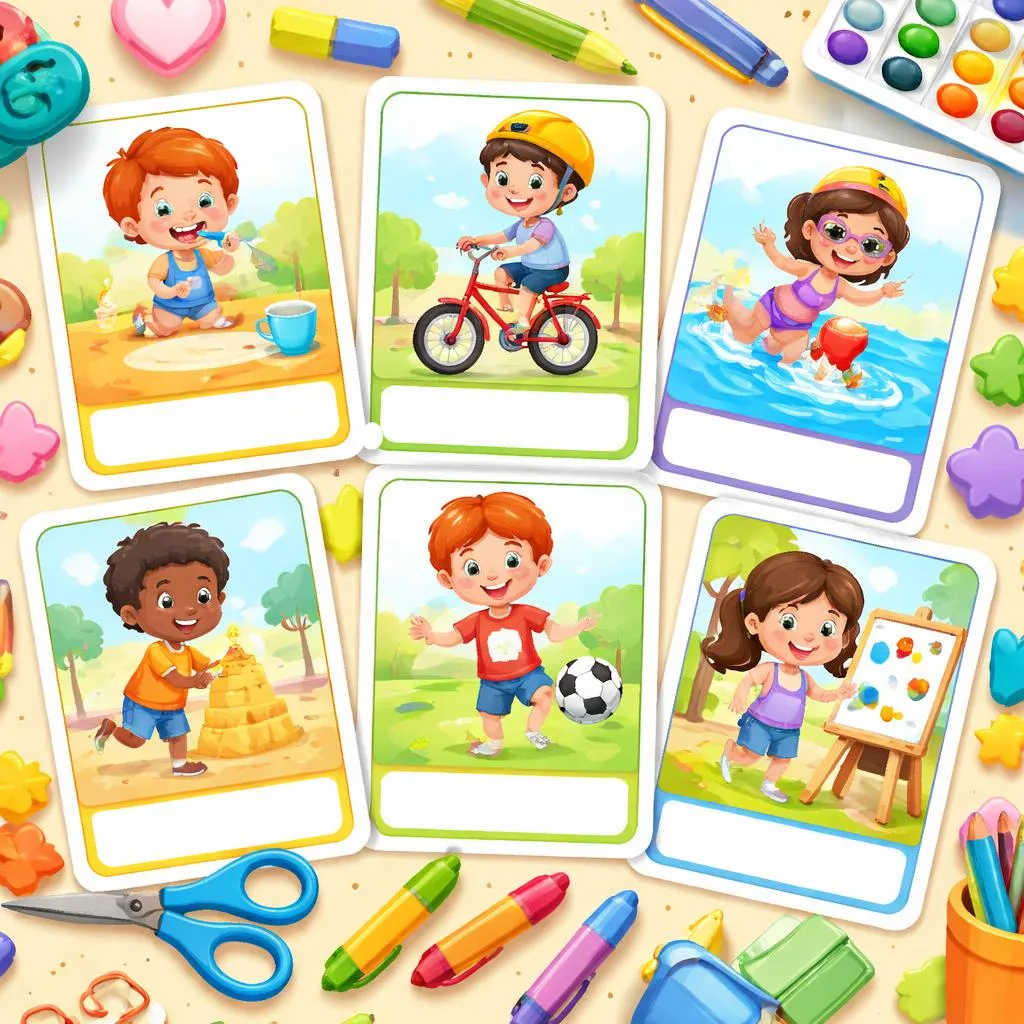

This is not the first set of verb cards to grab when teaching beginner students. However, this set provides 1- and 2-syllable action words that are useful for building vocabulary. This flashcard set mixes easy and more difficult verbs for teaching high beginner or intermediate language learners or mixed level classes. These concrete verbs can be acted out or mimed, but a few require that extra bit of context provided by the image. These verbs all have an intransitive meaning– they do not require an object– although some of the words can make sense both with or without an object. You can find transitive verbs in Actions Set D . The set contains only three irregular past tense verbs: dive/dove, fight/fought, swim/swam. This set of verbs pairs well with a lesson on adverbs or when practising 3rd person singular present tense.
Word list: argue, crawl, dive, fight, fish, knock, laugh, scream, shout, skate, ski, skip, smile, swim, wave, wrestle
Click here to download the full Action Flashcards – Set C PDF — free
By practicing with action verb flashcards, children can:
- Expand their vocabulary with common and useful action words.
- Improve their understanding of verbs that describe movements and activities.
- Develop listening and speaking skills by miming or acting out the verbs.
- Enhance memory and recall through visual association with images.
- Practice grammar concepts such as third person singular present tense and adverbs.
- Build confidence in using verbs in sentences and everyday conversation.
How to Teach Action Verb Flashcards with Flashcards
Parents and educators can use these action verb flashcards by first introducing the words one at a time, showing the picture and saying the word clearly. Encourage children to mimic the action shown on the card to connect the word with physical movement. Repetition and consistent practice help reinforce learning. For mixed-level groups, pair easier verbs with more challenging ones to keep all children engaged. Use the flashcards to prompt simple questions like “Can you swim?” or “What do you do when you laugh?” to promote speaking practice.
(1) Fun Action Verb Flashcard Games
Games such as “Charades” where children act out verbs without speaking, or “Simon Says” using the action verbs, make learning interactive and enjoyable. Another game is “Verb Matching,” where children match the verb word card with the correct picture card. These activities help solidify understanding by combining movement, listening, and speaking. Incorporating competitive or cooperative elements keeps motivation high and encourages participation.
(2) Example Sentences with Action Verbs
Using sentences helps children understand how verbs fit into everyday language. Examples include: “I like to skate on the ice,” “She laughs when she is happy,” and “They fight in the wrestling match.” Adding emotions or contexts, such as “He screams because he is scared,” helps children grasp different uses of verbs and express feelings alongside actions.
Free Action Verb Flashcards PDF Download
You can download and print the full set of action verb flashcards for free from the provided link. These printable cards are perfect for classroom use, home practice, or travel activities. Having physical cards allows children to handle and explore the words tactilely, which supports multisensory learning. The PDF includes colorful images and clear text to engage young learners.
FAQ about Action Verb Flashcards
Q: Are these verbs suitable for beginners?
A: Yes, the set includes simple 1- and 2-syllable verbs ideal for high beginner and intermediate learners.
Q: Can these verbs be used in sentences without objects?
A: Most verbs in this set are intransitive and do not require objects, making sentence formation easier for children.
Q: How often should children practice with these flashcards?
A: Daily short sessions of 10-15 minutes are effective for retention and gradual vocabulary building.
Q: Are there irregular verbs in this set?
A: Yes, three irregular past tense verbs are included: dive/dove, fight/fought, and swim/swam.
Q: What additional activities can support learning?
A: Role-playing, storytelling using the verbs, and combining flashcards with songs or videos enhance engagement and comprehension.