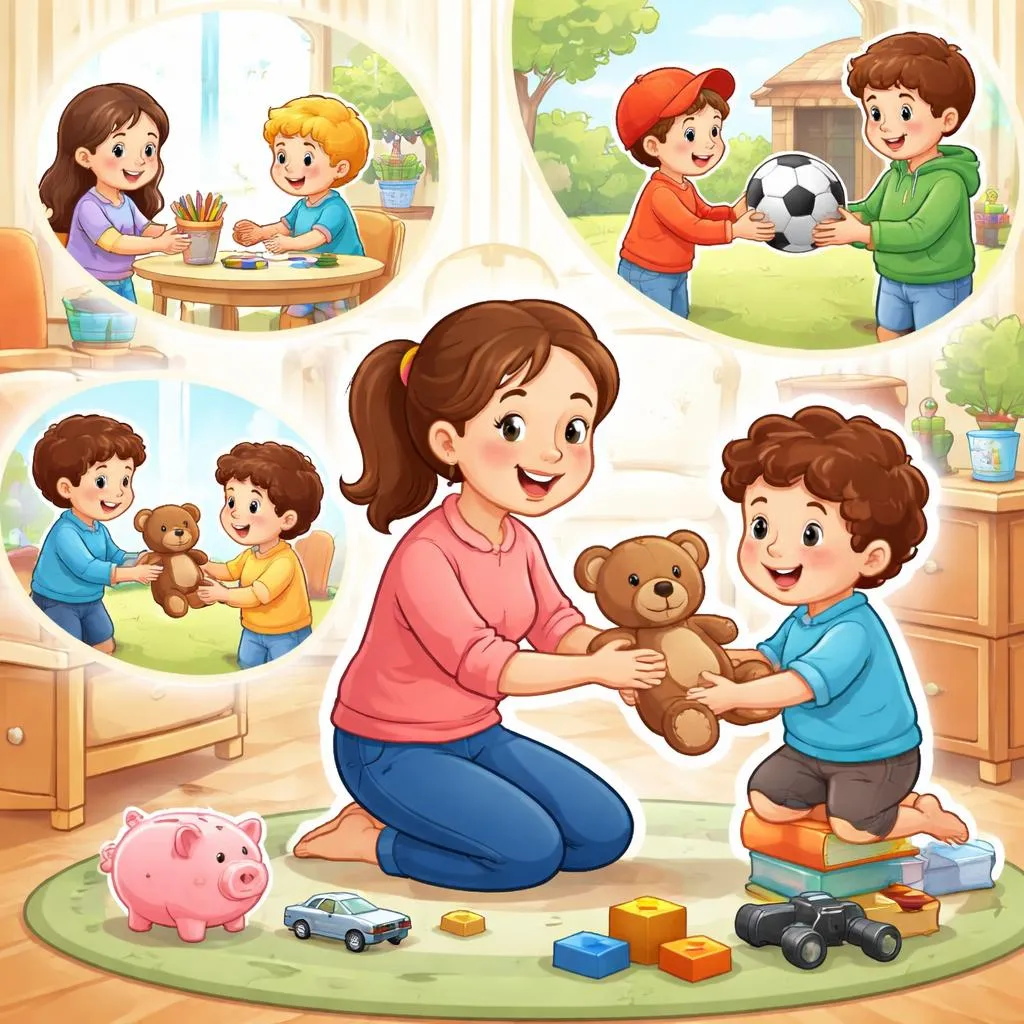

Taking something for a little while. Then giving it back. That is borrowing.
We do this every day. We borrow books. We borrow pencils. We borrow ideas.
Today we learn four words. “Borrow,” “borrower,” “borrowing,” and “borrowed.”
Each word shows a different part of the same action.
Parents and children can learn these words together. They help us talk about sharing.
What Does “Same Word, Different Forms” Mean?
One action can have many names. The action here is taking something temporarily.
“Borrow” is the verb. It names the action itself. “I borrow a cup of sugar.”
“Borrower” is a noun. It names the person doing the action. “The borrower returned the book.”
“Borrowing” is also a noun. It names the activity. “Borrowing helps neighbors share.”
“Borrowed” is an adjective. It describes the thing you take. “This is a borrowed pen.”
Same idea. Four different jobs. The heart stays the same.
Personal Pronouns Change Their Form
Pronouns shift depending on the sentence. “I” becomes “me.” “We” becomes “us.”
Our words shift depending on who does the action. And what we want to describe.
“I borrow” means I am doing it now. “I am a borrower” means that is my role.
“My borrowing” names my activity. “My borrowed book” describes the book.
Pronouns help us avoid repeating names. Our word family helps us avoid confusion.
When your child understands both, sentences become clearer.
From Verb to Noun to Adjective to Adverb – One Family, Many Words
“Borrow” is a verb. “Please borrow my hat for the party.” Action.
“Borrower” is a noun. “The borrower must return the toy.” Person.
“Borrowing” is a noun. “Borrowing requires trust.” Activity.
“Borrowed” is an adjective. “The borrowed bike needs a wash.” Describing word.
We have no adverb in this family. “Borrowingly” does not exist. That is fine.
Four members are plenty. They cover almost everything we need.
One Root, Many Roles – How Words Grow from Actions to Qualities
The root “borrow” comes from Old English “borgian.” It meant to give a pledge.
Long ago, borrowing meant giving something valuable as a promise. A ring. A tool. A coin.
Today the promise is your word. You say “I will give it back.” People trust you.
From that root, we grow new forms. Each form keeps the idea of trust.
“Borrower” trusts that they can give back later. “Borrowing” is the act of trust in motion. “Borrowed” items carry a silent promise.
Help your child see that borrowing is not just words. It is a social skill.
Same Meaning, Different Jobs – Is It a Verb or a Noun?
Look at “borrow” in a sentence. Ask: Is someone doing something? Or is it a name?
“I will borrow your crayons.” Action. Verb.
“Can I have a borrow of your pen?” This is casual. Some people use “borrow” as a noun. But it is better to say “loan.”
Now look at “borrower.” Always a noun. “The borrower has good manners.”
“Borrowing” is always a noun. “Borrowing from friends is common.”
“Borrowed” is always an adjective. “My borrowed sweater keeps me warm.”
Teach children to look at the end of the word. “-er” often means a person. “-ing” often means an activity. “-ed” often describes an object after an action.
Adjectives and Adverbs – When Do We Add -ly?
We do not add -ly to these words. No “borrowingly.” No “borrowedly.”
If you want to describe how someone borrows, use a separate adverb. “She borrows happily.” “He borrows carefully.”
The word family stays clean. Each member has one clear job.
For children, this simplicity is a gift. Fewer rules to memorize.
Focus on the verb and the adjective first. “Borrow” for action. “Borrowed” for things.
Then add the nouns. “Borrower” for the person. “Borrowing” for the activity.
Watch Out for Tricky Spelling Changes (Double Letters, y to i, and More)
Spelling here is easy. No double letters. No y to i changes.
“Borrow” adds “-er” to make “borrower.” Just add. Keep all letters.
“Borrow” adds “-ing” to make “borrowing.” Also just add. No dropping letters.
“Borrow” adds “-ed” to make “borrowed.” Add and go. Very simple.
Some verbs double the last letter. “Stop” becomes “stopping.” Not here.
Some verbs drop a letter. “Hope” becomes “hoping.” Not here.
This family respects its root. The root stays whole. New endings attach without trouble.
Praise your child when they notice this. “Hey, no tricky spelling!” That builds confidence.
Let’s Practice – Can You Choose the Right Form?
Try these sentences. Fill in the blank with borrow, borrower, borrowing, or borrowed.
May I _____ your red pencil for one minute? (action verb)
The _____ forgot to return the library book. (person)
This is a _____ dress from my cousin. (describes the object)
_____ from the bank costs interest. (activity or process)
Please _____ my umbrella. It is raining hard. (action verb)
A good _____ always gives things back on time. (person)
We used _____ money to buy the lemonade stand supplies. (describes the money)
_____ can teach children about responsibility. (activity)
Answers: 1 borrow, 2 borrower, 3 borrowed, 4 Borrowing, 5 borrow, 6 borrower, 7 borrowed, 8 Borrowing.
Notice that numbers 4 and 8 start with capital letters. That is because they begin the sentence.
The word itself does not change. Only the position changes.
Tips for Parents – Help Your Child Learn Word Families in a Fun Way
Use real life moments. You borrow sugar from a neighbor. Say “I am borrowing sugar.”
Your child borrows a toy from a friend. Say “You are a borrower now.”
Label things in the house. Put a sticky note on a borrowed item. Write “borrowed.”
Read library books together. Libraries are full of borrowing. Point to the borrower card.
Play a game. Take turns being the borrower. One person lends. One person borrows. Return the item with a “thank you.”
Talk about feelings. “How does it feel to be a borrower?” “How does it feel to lend?”
Teach the opposite word. “Lend” is what the owner does. “Borrow” is what the taker does.
Do not shame mistakes. If your child says “I lend your book,” gently say “You mean borrow. I lend. You borrow.”
Draw a picture of a borrowing circle. You lend to me. I borrow from you. Later I return.
Use a timer. Borrow a toy for five minutes. When the timer rings, return it. Say “The borrowing time is over.”
Celebrate when your child remembers. “You said borrower! That is exactly right.”
Remember that borrowing is a life skill. The words matter. But the behavior matters more.
Tomorrow you will hear “Can I borrow this?” You will smile. Your child is learning.
Soon they will say “I will be a good borrower.” That is a promise. That is growth.
Keep practicing. Keep talking. Keep borrowing and returning. Your child will learn words and values together.