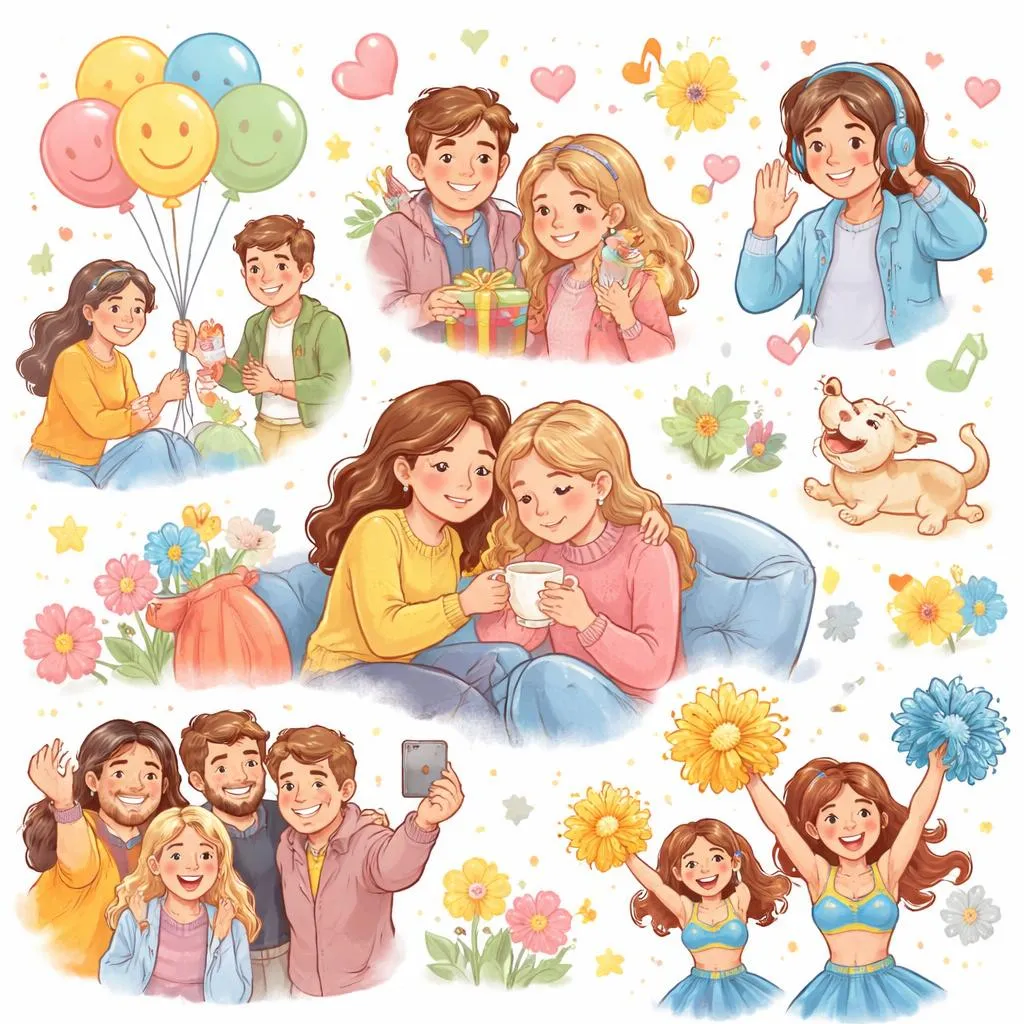

Your friend feels sad. You say “You can do it!” You clap. You smile.
That is cheering. Today we learn four words.
“Cheer,” “cheerful,” “cheering,” and “cheerleader.”
Each word shares the idea of happiness and encouragement. Each does a different job.
Parents and children can learn these words together. They help with kindness and support.
What Does “Same Word, Different Forms” Mean?
One quality takes different shapes. The quality here is giving happiness or being happy.
“Cheer” is a verb. “Please cheer your teammate.” Action.
“Cheer” is also a noun. “The crowd gave a loud cheer.” Shout of joy.
“Cheerful” is an adjective. “She has a cheerful smile.” Describes a person.
“Cheering” is a noun or adjective. “Cheering lifted the team’s spirits.” Activity. “The cheering crowd was loud.” Describes.
“Cheerleader” is a noun. “The cheerleader led the crowd in a chant.” Person.
Same root. Different endings. Different jobs. The joy stays the same.
Personal Pronouns Change Their Form
Pronouns change for grammar. “I” becomes “me.” “We” becomes “us.”
Our words change for role and description. “I cheer for my brother.” Action.
“You are cheerful today.” Describes. “Cheering helps everyone.” Activity.
“A cheerleader motivates the team.” Person.
Pronouns help us speak faster. Word families help us talk about encouragement.
When children know these four words, they express support and happiness clearly.
From Verb to Noun to Adjective to Adverb – One Family, Many Words
“Cheer” works as a verb. “Cheer for your favorite player.” Action.
“Cheer” also works as a noun. “A cheer went up from the stands.” Shout.
“Cheerful” is an adjective. “A cheerful person lights up a room.” Describes.
“Cheering” is a noun. “The cheering from the fans was loud.” Activity.
“Cheering” is also an adjective. “The cheering audience clapped.” Describes.
“Cheerleader” is a noun. “The cheerleader did a backflip.” Person.
We have no common adverb. “Cheerfully” comes from “cheerful,” but it is not in our keywords.
Five members. One word has two jobs (noun and adjective).
One Root, Many Roles – How Words Grow from Actions to Qualities
The root “cheer” comes from Old French “chiere.” It meant face or expression. A cheerful face looks happy.
People used to say “make a cheerful face.” Over time, “cheer” became the happiness itself.
From that root, we add “-ful” to make an adjective. “Cheerful” means full of cheer.
We add “-ing” to name the activity. “Cheering” is the act of shouting encouragement.
We add “-leader” to name the person. “Cheerleader” means one who leads the cheering.
Help your child see this pattern. Cheer is the joy. Cheerful describes a person. Cheering is the action. A cheerleader leads the action.
Same Meaning, Different Jobs – Is It a Verb or a Noun?
Look at “cheer” in a sentence. Ask: Is it an action? Or is it a shout?
“Please cheer for the team.” Action. Verb.
“We heard a cheer from the playground.” Shout. Noun.
Same word. Two jobs. Context tells you.
Now look at “cheerful.” Always an adjective. “What a cheerful room this is!”
“Cheering” can be a noun or adjective. “Cheering is good for morale.” Noun. “A cheering crowd.” Adjective.
“Cheerleader” is always a noun. “She wanted to be a cheerleader since kindergarten.”
Teach children to look at the word’s ending. “-ful” means adjective. “-ing” can be noun or adjective. “-leader” means person.
Adjectives and Adverbs – When Do We Add -ly?
We add “-ly” to “cheerful” to make “cheerfully.” This is not in our keywords but good to know.
“She smiled cheerfully.” Means in a cheerful way.
We do not add “-ly” to “cheer,” “cheering,” or “cheerleader.”
For children, focus on the main words. “Cheer” for action or shout. “Cheerful” for happy people or things. “Cheering” for the activity. “Cheerleader” for the person.
That is plenty for daily encouragement.
Watch Out for Tricky Spelling Changes (Double Letters, y to i, and More)
Spelling here is very kind. No double letters. No y to i changes.
“Cheer” adds “-ful” to make “cheerful.” Just add. Keep both e’s.
“Cheer” adds “-ing” to make “cheering.” Just add. Keep both e’s.
“Cheer” plus “leader” makes “cheerleader.” One word. Two e’s in “cheer.” Then “leader.”
No dropping letters. No changing vowels. This is a very regular family.
The only note: “cheerleader” has a double “e” in “cheer” and then “leader” with its own “e.” All good.
Practice with your child. Write “cheer.” Add “ful.” You get “cheerful.” Add “ing.” You get “cheering.” Add “leader.” You get “cheerleader.”
No tricks. Very clean.
Let’s Practice – Can You Choose the Right Form?
Try these sentences. Fill in the blank with cheer, cheerful, cheering, or cheerleader.
Please _____ for your sister at her concert. (action verb)
The crowd let out a loud _____ when the goal was scored. (noun, shout)
A _____ person makes others feel good. (adjective)
The _____ of the fans could be heard down the street. (activity)
My cousin is a _____ for the high school football team. (person)
What a _____ color yellow is! (adjective)
We heard _____ from the audience after the magic trick. (activity)
The _____ waved her pom-poms high. (person)
Answers: 1 cheer, 2 cheer, 3 cheerful, 4 cheering, 5 cheerleader, 6 cheerful, 7 cheering, 8 cheerleader.
Number 2 uses “cheer” as a noun meaning a shout of joy.
Number 4 and 7 use “cheering” as a noun meaning the activity of shouting encouragement.
Tips for Parents – Help Your Child Learn Word Families in a Fun Way
Cheer for small things. “You tied your shoe! Let me cheer for you.”
Point out cheerful things. “Look at the cheerful sunflowers.”
Make cheering sounds together. “Hooray! Yay! Go team!”
Talk about cheerleaders. Show a video of a real cheerleader at a game.
Play a game. “I will be the cheerleader. You do something. I will cheer.”
Draw a cheerful picture. Use bright colors. Write “cheerful” on it.
Read a book about encouragement. “The Little Engine That Could” has a cheering spirit.
Use the noun “cheer.” “Give a cheer for the cook!”
Do not correct every mistake. If your child says “cheerful” when they mean “cheer,” gently model the right word.
Celebrate when your child uses “cheerleader.” That is a fun, specific word.
Explain that a cheerleader leads the cheering. They do not just cheer alone.
Tomorrow you will cheer for a good breakfast. You will feel cheerful on a sunny day. You will hear cheering at a game. You might see a cheerleader on TV.
Your child might say “You are my cheerleader.” Your heart will swell.
Keep cheering. Keep finding cheerful moments. Keep making cheering sounds. Keep being a cheerleader for your child.
Your child will grow in language and in spreading joy. A little cheer goes a long way.