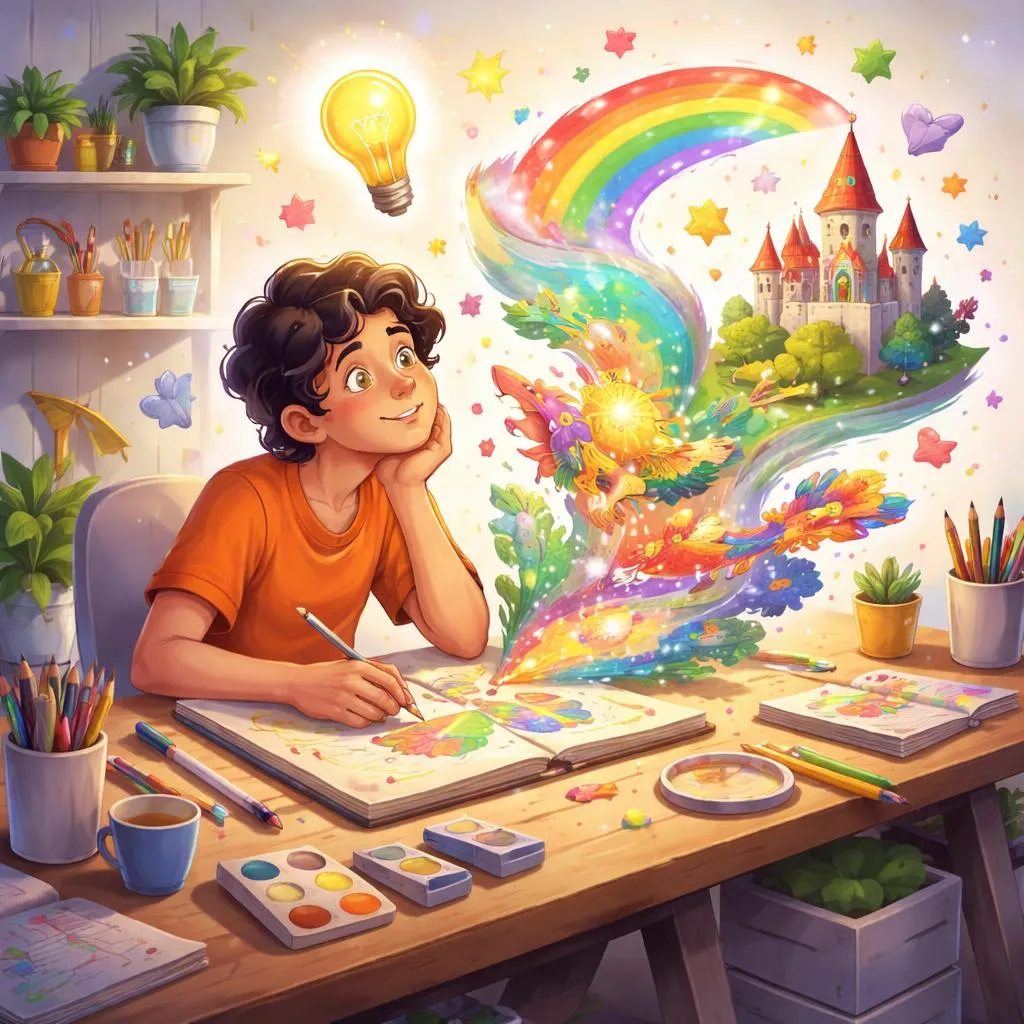

You take a blank paper. You pick up crayons. You make a new picture.
That is creating. Today we learn four words.
“Create,” “creation,” “creative,” and “creator.”
Each word shares the idea of making something new. Each does a different job.
Parents and children can learn these words together. They help with art and problem-solving.
What Does “Same Word, Different Forms” Mean?
One action takes different shapes. The action here is bringing something into existence.
“Create” is a verb. “Please create a card for Grandma.” Action.
“Creation” is a noun. “The snowman was a wonderful creation.” Thing made.
“Creative” is an adjective. “A creative person finds new solutions.” Describes.
“Creator” is a noun. “The creator of the app is a programmer.” Person.
Same root. Different endings. Different jobs. The making stays.
Personal Pronouns Change Their Form
Pronouns change for grammar. “I” becomes “me.” “We” becomes “us.”
Our words change for role and description. “I create with clay.” Present.
“This creation is beautiful.” Thing. “She is creative.” Describes.
“The creator signed her work.” Person.
Pronouns help us speak faster. Word families help us talk about making things.
When children know these four words, they express their artistic side.
From Verb to Noun to Adjective to Adverb – One Family, Many Words
“Create” is a verb. “Create a story about a friendly monster.” Action.
“Creation” is a noun. “The artist’s newest creation is a sculpture.” Thing.
“Creative” is an adjective. “Building with blocks is a creative activity.” Describes.
“Creator” is a noun. “Walt Disney was the creator of Mickey Mouse.” Person.
We have adverbs “creatively” (from creative) and “creatively” is common. “She draws creatively.”
But our keywords do not include the adverb. Focus on these four.
Four members. One verb, two nouns, one adjective.
One Root, Many Roles – How Words Grow from Actions to Qualities
The root “create” comes from Latin “creare,” meaning to make or produce. It is related to “crescere” (to grow).
From that root, we add “-ion” to make a noun. “Creation” means the thing created or the act of creating.
We add “-ive” to make an adjective. “Creative” means having the quality of creating.
We add “-or” to name the person. “Creator” means the one who creates.
Help your child see this pattern. Create is the action. Creation is the result. Creative describes the process or person. Creator is the maker.
Same Meaning, Different Jobs – Is It a Verb or a Noun?
Look at “create.” Always a verb. “Create your own game.” Action.
“Creation” is always a noun. “The cake was a delicious creation.” Thing.
“Creative” is always an adjective. “That is a creative way to solve the puzzle.” Describes.
“Creator” is always a noun. “The creator of the toy has a patent.” Person.
No word here plays two jobs. Each has one clear role.
Teach children to look at the endings. “-ion” noun (thing). “-ive” adjective. “-or” noun (person).
“Create” alone is the verb.
Adjectives and Adverbs – When Do We Add -ly?
We add “-ly” to “creative” to make “creatively.” This is a common adverb.
“She creatively solved the problem.” Means in a creative way.
We do not add “-ly” to “create,” “creation,” or “creator.”
For children, “creatively” is useful. “Think creatively” means think in new ways.
But our keywords do not require it.
Watch Out for Tricky Spelling Changes (Double Letters, y to i, and More)
Spelling has one small change. The final “e” in “create” drops before adding “-ion” and “-ive.”
“Create” minus “e” plus “ion” = creation.
“Create” minus “e” plus “ive” = creative.
For “creator,” keep the “e”? No. “Create” minus “e” plus “or” = creator. Yes, drop the “e.”
So the rule: Drop the final “e” for all endings: -ion, -ive, -or.
Practice with your child. Write “create.” Drop the “e.” Add “ion.” You get “creation.” Add “ive.” You get “creative.” Add “or.” You get “creator.”
No double letters. No y to i. Very clean.
Let’s Practice – Can You Choose the Right Form?
Try these sentences. Fill in the blank with create, creation, creative, or creator.
Please _____ a new password for your account. (action verb)
The sandcastle was an impressive _____. (noun, thing)
She is very _____. She turns boxes into spaceships. (adjective)
Who is the _____ of this wonderful game? (person)
We need to _____ a plan for the project. (action verb)
This painting is Picasso’s _____. (noun)
A _____ mind sees possibilities everywhere. (adjective)
The _____ of the website started it in her garage. (person)
Answers: 1 create, 2 creation, 3 creative, 4 creator, 5 create, 6 creation, 7 creative, 8 creator.
Number 3 and 7 use “creative” to describe a person’s mind or personality.
Number 6 uses “creation” to mean a specific work of art.
Tips for Parents – Help Your Child Learn Word Families in a Fun Way
Create something together. “Let us create a card for Daddy.”
Name your creation. “This Lego tower is your creation.”
Praise creative thinking. “That was a creative way to fix the toy.”
Call your child a creator. “You are the creator of this beautiful drawing.”
Play a game. You say a noun. Your child changes it to a verb, adjective, or person.
“Rainbow.” “Create a rainbow. A colorful creation. A creative artist. The creator of colors.”
Make a creation box with art supplies. Label it “Creation Station.”
Read a book about inventors. “The Most Magnificent Thing” by Ashley Spires.
Do not correct every mistake. If your child says “createful” instead of “creative,” gently say “We say creative.”
Celebrate when your child uses “creator.” That word has power.
Explain that everyone can be a creator. “You create stories, drawings, and even new games.”
Tomorrow you will create a shopping list. You will admire a lego creation. You will use creative thinking for a puzzle. You will be the creator of a fun afternoon.
Your child might say “I am the creator of this mess.” You will laugh together.
Keep creating. Keep naming creations. Keep thinking creatively. Keep being a creator.
Your child will grow in language and in imagination. Creation begins with a thought and a word.