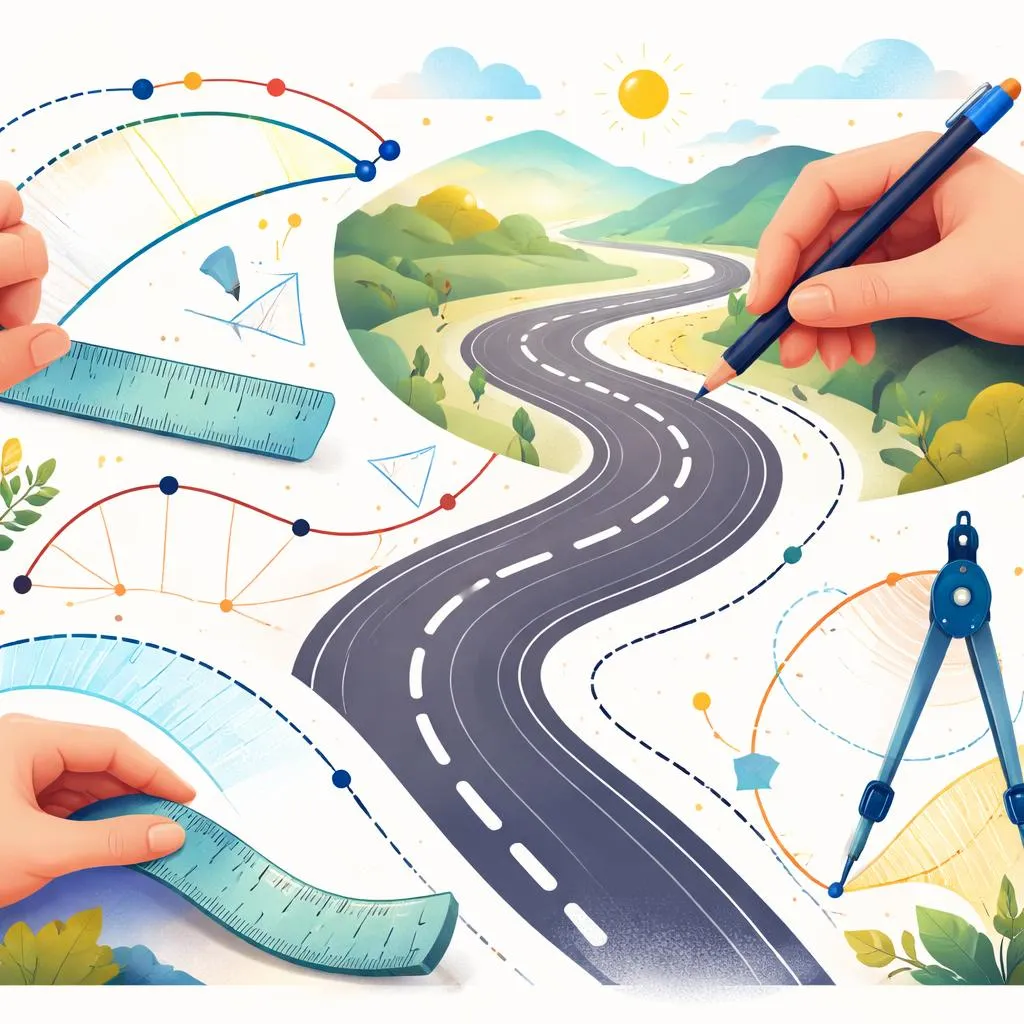

A straight line bends. A road turns left. A river snakes through a valley.
That is a curve. Today we learn four words.
“Curve,” “curvy,” “curving,” and “curvature.”
Each word shares the idea of a bend or arc. Each does a different job.
Parents and children can learn these words together. They help with math and art.
What Does “Same Word, Different Forms” Mean?
One idea takes different shapes. The idea here is bending without sharp corners.
“Curve” is a verb. “The road will curve to the right.” Action.
“Curve” is also a noun. “Draw a smooth curve on the paper.” Shape.
“Curvy” is an adjective. “A curvy road is fun to drive.” Describes.
“Curving” is an adjective or noun. “The curving path led to the lake.” Describes. “The curving of the branch was graceful.” Process.
“Curvature” is a noun. “The curvature of the Earth is visible from space.” Degree of bend.
Same root. Different endings. Different jobs. The bend stays.
Personal Pronouns Change Their Form
Pronouns change for grammar. “I” becomes “me.” “We” becomes “us.”
Our words change for role and description. “I curve the wire.” Action.
“This line is curvy.” Describes. “The curving river.” Describes.
“The curvature is slight.” Degree.
Pronouns help us speak faster. Word families help us talk about shapes and roads.
When children know these four words, they describe art and geography.
From Verb to Noun to Adjective to Adverb – One Family, Many Words
“Curve” works as a verb. “Curve the pipe so it fits.” Action.
“Curve” also works as a noun. “The curve in the track is tight.” Shape.
“Curvy” is an adjective. “Curvy lines are more interesting than straight ones.” Describes.
“Curving” is an adjective. “A curving staircase winds up the tower.” Describes.
“Curving” is also a noun. “The curving of the metal required heat.” Process.
“Curvature” is a noun. “The curvature of a circle is constant.” Measurement.
We have adverbs “curvily” and “curvingly” (very rare). Skip them.
Six meanings. Very useful for geometry.
One Root, Many Roles – How Words Grow from Actions to Qualities
The root “curve” comes from Latin “curvus,” meaning bent or crooked.
From that root, we add “-y” to make an adjective. “Curvy” means having many curves.
We add “-ing” to make an adjective or noun meaning “in the process of curving.”
We add “-ature” to make a noun meaning “the quality or degree of being curved.”
Help your child see this pattern. Curve is the action or shape. Curvy describes something with curves. Curving describes the action happening. Curvature is the measurement.
Same Meaning, Different Jobs – Is It a Verb or a Noun?
Look at “curve” in a sentence. Ask: Is it an action? Or is it a shape?
“The road curves here.” Action. Verb.
“That curve is too sharp for a bicycle.” Shape. Noun.
Same word. Two jobs. Context tells you.
Now look at “curvy.” Always an adjective. “A curvy vase is pretty.”
“Curving” is an adjective or noun. “The curving line.” Adjective. “The curving of the spine.” Noun.
“Curvature” is always a noun. “The curvature of the lens affects vision.”
Teach children to look at the endings. “-y” adjective. “-ing” adjective or noun. “-ature” noun.
“Curve” alone can be verb or noun.
Adjectives and Adverbs – When Do We Add -ly?
We add “-ly” to “curvy” to make “curvily.” Very rare. “The line goes curvily.” Skip it.
We add “-ly” to “curving” to make “curvingly.” Also rare.
For children, skip these adverbs. Focus on the main words.
“Curve” for action or shape. “Curvy” for description. “Curving” for ongoing bend. “Curvature” for measurement.
Watch Out for Tricky Spelling Changes (Double Letters, y to i, and More)
Spelling here is very regular. No double letters. No y to i changes.
“Curve” adds “-y” to make “curvy.” Drop the “e”? Yes. Curve → curv + y = curvy. Drop the “e” before adding “-y.”
“Curve” adds “-ing” to make “curving.” Drop the “e.” Curv + ing = curving.
“Curve” adds “-ature” to make “curvature.” Drop the “e.” Curv + ature = curvature.
So the rule: Drop the final “e” for all endings.
Practice with your child. Write “curve.” Drop the “e.” Add “y.” You get “curvy.” Add “ing.” You get “curving.” Add “ature.” You get “curvature.”
No double letters. Very clean.
Let’s Practice – Can You Choose the Right Form?
Try these sentences. Fill in the blank with curve, curvy, curving, or curvature.
The road will _____ to the left. (action verb)
A _____ line is more interesting than a straight one. (adjective)
The _____ staircase was beautiful but hard to climb. (adjective)
The _____ of the Earth’s surface is very slight. (noun, measurement)
Draw a smooth _____ from point A to point B. (noun, shape)
The _____ of the spine can cause back pain. (noun)
The _____ river wound through the valley. (adjective)
This tool helps you _____ the metal into a circle. (action verb)
Answers: 1 curve, 2 curvy, 3 curving, 4 curvature, 5 curve, 6 curvature, 7 curving, 8 curve.
Number 2 uses “curvy” as an adjective.
Number 3 and 7 use “curving” as an adjective describing a staircase or river.
Number 6 uses “curvature” as a medical term.
Tips for Parents – Help Your Child Learn Word Families in a Fun Way
Draw a curve on paper. “Watch me curve this line.”
Point to curvy things. “A snake’s body is curvy. A mountain road is curvy.”
Make a curving line with yarn or string. “This curving line goes like a wave.”
Explain curvature simply. “Curvature means how much something bends.”
Play a game. You draw a shape. Your child says “curve” or “straight.”
Roll a piece of paper into a tube. “See the curvature of the paper?”
Read a book about roads. “The Road Builders” shows curves.
Do not correct every mistake. If your child says “curve” for “curvy,” say “The road has a curve (noun). It is curvy (adjective).”
Celebrate when your child uses “curvature.” That is a sophisticated science word.
Explain that “curvature” is used in medicine, astronomy, and math.
Tomorrow you will curve a pipe cleaner. You will draw a curvy monster. You will see a curving slide at the park. You will wonder about the curvature of a rainbow.
Your child might say “My curvy drawing looks like a roller coaster.” You will agree.
Keep curving. Keep drawing curvy shapes. Keep noticing curving lines. Keep measuring curvature in your imagination.
Your child will grow in language and in spatial thinking. Curves are everywhere in nature and art. Words help us see them.