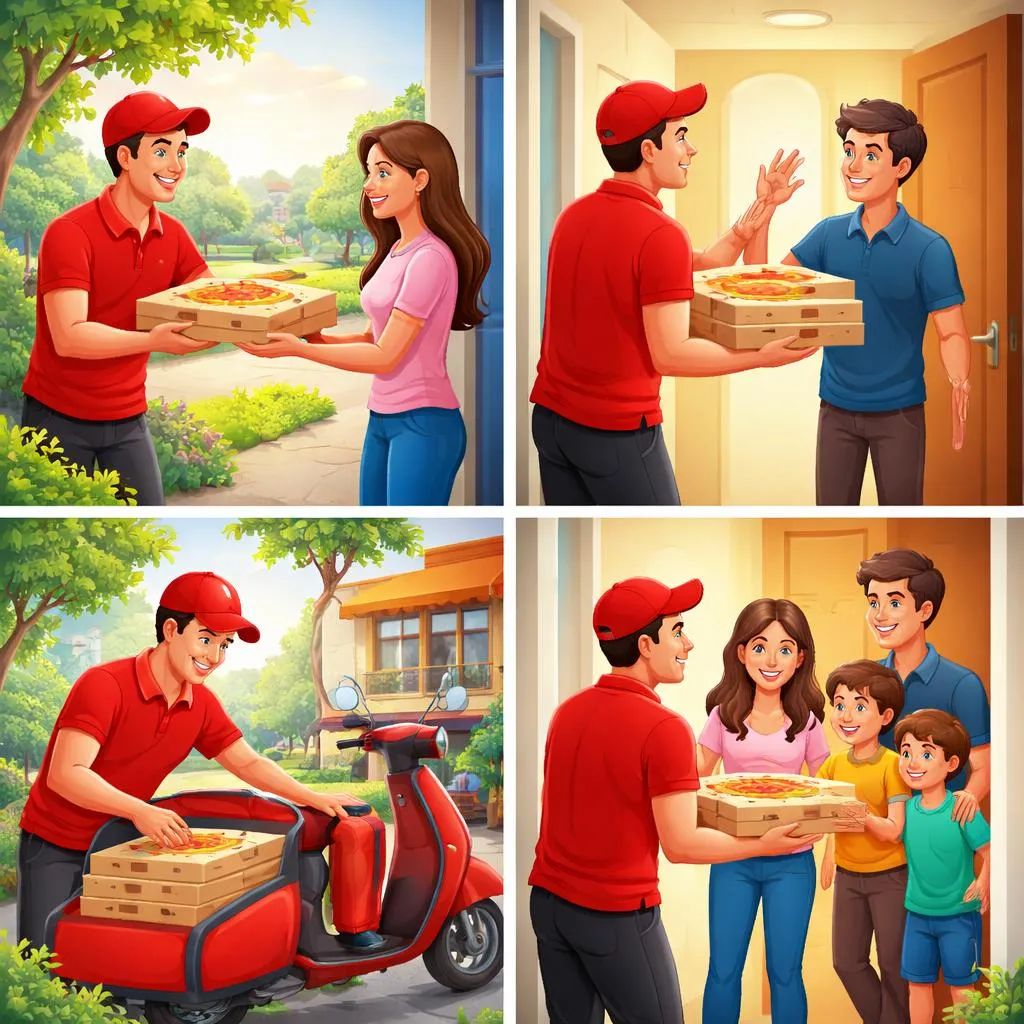

The doorbell rings. You open the door. A person hands you a package.
That is a delivery. Today we learn four words.
“Deliver,” “delivery,” “deliverer,” and “delivered.”
Each word shares the idea of bringing something to someone. Each does a different job.
Parents and children can learn these words together. They help with packages.
What Does “Same Word, Different Forms” Mean?
One action takes different shapes. The action here is taking something to a place.
“Deliver” is a verb. “Please deliver this note to the teacher.” Action.
“Delivery” is a noun. “The delivery arrived at noon.” Package.
“Deliverer” is a noun. “The deliverer smiled and waved.” Person.
“Delivered” is a past tense verb or adjective. “The mail carrier delivered the letter.” Past action. “The delivered goods.” Describes.
Same root. Different endings. Different jobs. The bringing stays.
Personal Pronouns Change Their Form
Pronouns change for grammar. “I” becomes “me.” “We” becomes “us.”
Our words change for role and time. “I deliver newspapers.” Present.
“The delivery is late.” Noun. “The deliverer knocked.” Person.
“She delivered it yesterday.” Past.
Pronouns help us speak faster. Word families help us talk about packages.
When children know these four words, they understand shipping.
From Verb to Noun to Adjective to Adverb – One Family, Many Words
“Deliver” is a verb. “Deliver the flowers to room five.” Action.
“Delivery” is a noun. “A delivery driver brought groceries.” Event.
“Deliverer” is a noun. “The deliverer of bad news.” Person.
“Delivered” is a past tense verb. “The baby was delivered safely.” Past action.
“Delivered” is also an adjective. “The delivered items are on the table.” Describes.
We have no common adverbs. “Deliveringly” is rare.
Five members. Very useful for online shopping.
One Root, Many Roles – How Words Grow from Actions to Qualities
The root “deliver” comes from Latin “deliberare,” but actually from “de-” + “liberare” (to free). Later it meant to hand over.
From that root, we add “-y” to make a noun. “Delivery” means the act of delivering.
We add “-er” to name the person. “Deliverer” means one who delivers.
We add “-ed” for past tense or to make an adjective meaning “sent.”
Help your child see this pattern. Deliver is the action. Delivery is the event. Deliverer is the person. Delivered means done.
Same Meaning, Different Jobs – Is It a Verb or a Noun?
Look at “deliver.” Always a verb. “Please deliver the package to my door.” Action.
“Delivery” is always a noun. “The delivery includes three boxes.” Event.
“Deliverer” is always a noun. “The deliverer was very friendly.” Person.
“Delivered” can be a past verb or adjective. “He delivered the speech.” Past verb. “The delivered message was clear.” Adjective.
Teach children to look at the endings. “-y” noun (delivery). “-er” noun (person). “-ed” past verb or adjective.
“Deliver” alone is the present verb.
Adjectives and Adverbs – When Do We Add -ly?
We do not add “-ly” to these words. No “deliverly.” No “deliveryly.” No “delivererly.”
If you want to describe how something is delivered, use a separate adverb. “It was delivered quickly.” “She delivered it carefully.”
This family stays simple. Focus on the verb and nouns.
Watch Out for Tricky Spelling Changes (Double Letters, y to i, and More)
Spelling here is very regular. No double letters. No y to i changes.
“Deliver” adds “-y” to make “delivery.” Keep the “er.” Deliver + y = delivery. (Drop the “e”? No. Deliver ends with “r.” Just add “y.”)
“Deliver” adds “-er” to make “deliverer.” Deliver + er = deliverer. (Contains “er” twice.)
“Deliver” adds “-ed” to make “delivered.” Just add.
No dropping. No vowel changes. Very clean.
Practice with your child. Write “deliver.” Add “y.” You get “delivery.” Add “er.” You get “deliverer.” Add “ed.” You get “delivered.”
No tricks.
Let’s Practice – Can You Choose the Right Form?
Try these sentences. Fill in the blank with deliver, delivery, deliverer, or delivered.
Please _____ this gift to Grandma’s house. (action verb)
The _____ came while we were at school. (noun, event)
The _____ of the mail has a blue truck. (person)
The pizza was _____ in thirty minutes. (past tense verb)
Our newspaper _____ is very reliable. (person)
The company guarantees next?day _____. (noun)
She _____ a beautiful speech at the wedding. (past tense verb)
The _____ package was left on the porch. (adjective)
Answers: 1 deliver, 2 delivery, 3 deliverer, 4 delivered, 5 deliverer, 6 delivery, 7 delivered, 8 delivered.
Number 5 uses “deliverer” as a noun for a person who delivers newspapers.
Number 8 uses “delivered” as an adjective describing the package.
Tips for Parents – Help Your Child Learn Word Families in a Fun Way
Deliver a note to another room. “Please deliver this to Daddy.”
Track a delivery. “Look, our package is out for delivery.”
Name the deliverer. “The Amazon deliverer drives a blue van.”
Use past tense. “Yesterday, the mail carrier delivered a card.”
Play a game. One person pretends to be a deliverer. The other answers the door.
Draw a delivery truck. Label “deliverer” and “delivery.”
Read a book about community helpers. “The Post Office Book” by Gail Gibbons.
Do not correct every mistake. If your child says “deliverer” for the action, say “The deliverer delivers. The action is deliver.”
Celebrate when your child uses “delivery” for the event. That is a specific noun.
Explain that a doctor can deliver a baby. That means help the baby be born.
Tomorrow you might deliver a message. You will watch for a delivery. You will thank the deliverer. You will open a delivered box.
Your child might say “I want to be a deliverer of happiness.” You will smile.
Keep delivering kindness. Keep noticing deliveries. Keep thanking deliverers. Keep opening delivered surprises.
Your child will grow in language and in appreciation. Deliveries bring things. Words bring understanding.