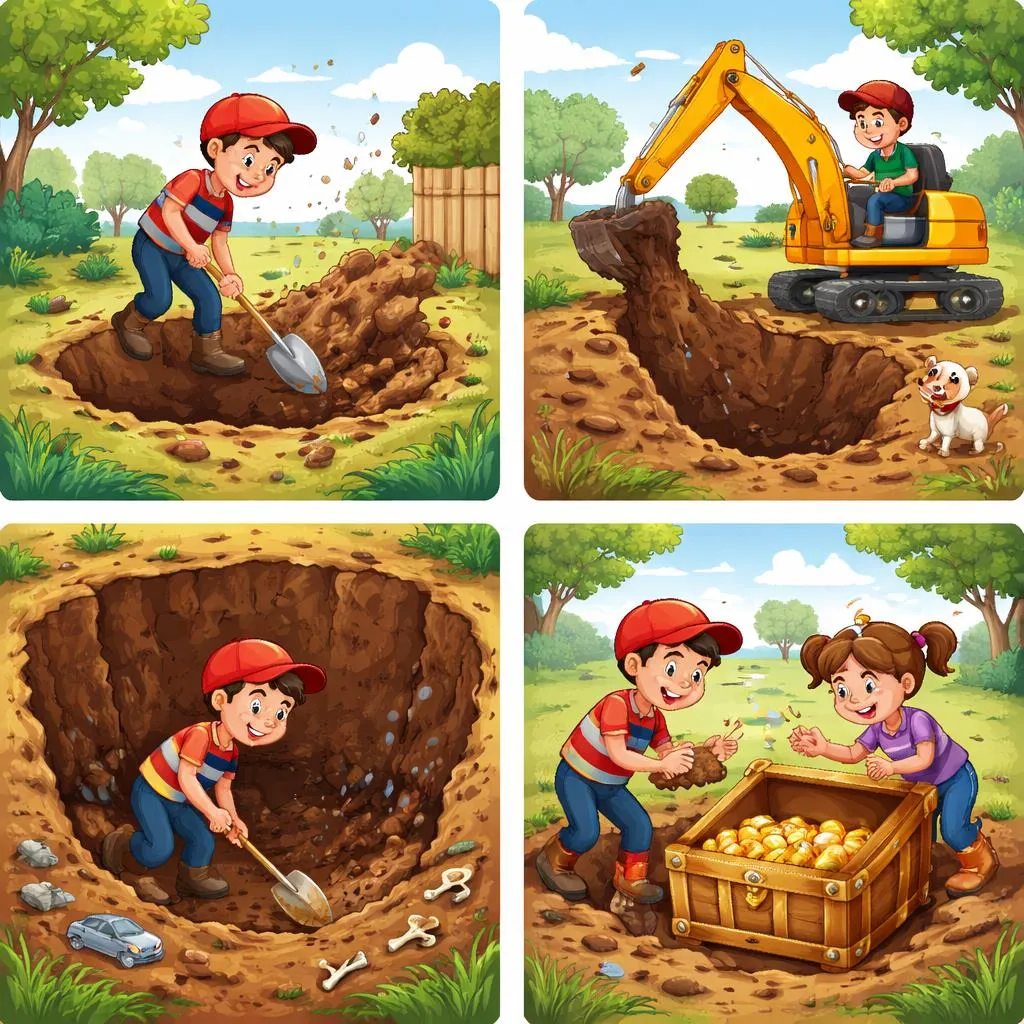

You take a shovel. You push it into the dirt. You move the soil.
That is digging. Today we learn four words.
“Dig,” “digger,” “digging,” and “dug.”
Each word shares the idea of breaking ground and moving earth. Each does a different job.
Parents and children can learn these words together. They help with gardening.
What Does “Same Word, Different Forms” Mean?
One action takes different shapes. The action here is removing earth.
“Dig” is a verb. “Please dig a small hole for the plant.” Action.
“Dig” is also a noun. “That hill has a steep dig.” Act of digging (rare) or archaeological dig.
“Digger” is a noun. “The backhoe is a powerful digger.” Tool or person.
“Digging” is a noun or adjective. “Digging for treasure is fun.” Activity. “The digging dog found a bone.” Describes.
“Dug” is a past tense verb or adjective. “He dug a trench.” Past action. “A dug well.” Describes.
Same root. Different endings. Different jobs. The scooping stays.
Personal Pronouns Change Their Form
Pronouns change for grammar. “I” becomes “me.” “We” becomes “us.”
Our words change for role and time. “I dig in the garden.” Present.
“The digger is loud.” Tool. “Digging is hard work.” Activity.
“He dug a hole yesterday.” Past.
Pronouns help us speak faster. Word families help us talk about construction.
When children know these four words, they describe sandbox play.
From Verb to Noun to Adjective to Adverb – One Family, Many Words
“Dig” works as a verb. “Dig a hole for the fence post.” Action.
“Dig” also works as a noun. “The archaeological dig found pottery.” Excavation.
“Digger” is a noun. “A digger is useful in construction.” Machine or person.
“Digging” is a noun. “Digging in the sandbox is fun.” Activity.
“Dug” is a past verb. “The dog dug under the fence.” Past action.
“Dug” is also an adjective. “A dug well provides water.” Excavated.
We have no common adverbs. “Diggingly” is rare.
Six meanings. Very useful for outdoors.
One Root, Many Roles – How Words Grow from Actions to Qualities
The root “dig” comes from Old English “dicgan,” meaning to dig. Old French “diger” also.
From that root, we add “-er” to name the tool or person. “Digger” means one who digs.
We add “-ing” to name the activity or to make an adjective.
“Dug” is the irregular past tense. (Not “digged.”)
Help your child see this pattern. Dig is the action. Digger is the tool or person. Digging is the activity. Dug means already done.
Same Meaning, Different Jobs – Is It a Verb or a Noun?
Look at “dig” in a sentence. Ask: Is it an action? Or is it an excavation?
“Dig a hole here.” Action. Verb.
“We visited a Roman dig.” Excavation. Noun.
Same word. Two jobs. Context tells you.
Now look at “digger.” Always a noun. “The digger scooped up dirt.”
“Digging” is a noun or adjective. “Digging is tiring.” Noun. “The digging kids.” Adjective.
“Dug” is past verb or adjective. “He dug a hole.” Past verb. “A dug basement.” Adjective.
Teach children to look at the endings. “-er” noun (tool or person). “-ing” noun or adjective. “-ug” (dug) past.
“Dig” alone can be verb or noun.
Adjectives and Adverbs – When Do We Add -ly?
We do not add “-ly” to these words. No “digly.” No “diggerly.” No “diggingly.”
If you want to describe how someone digs, use a separate adverb. “She digs quickly.” “He dug carefully.”
This family stays simple. Focus on the verb and nouns.
Watch Out for Tricky Spelling Changes (Double Letters, y to i, and More)
Spelling has one irregularity. The past tense is “dug,” not “digged.”
For adding endings: “Dig” adds “-er” to make “digger.” Double the “g”? Yes. Dig + er = digger. Double the final consonant when adding a vowel ending, if the verb has one syllable and ends with consonant-vowel-consonant. Dig: D-I-G (consonant-vowel-consonant). Double the “g.”
“Dig” adds “-ing” to make “digging.” Double the “g” as well. Digging.
“Dug” is different: change the vowel from “i” to “u” and keep “g.”
So the rule: Double the final “g” for “-er” and “-ing.” Use “dug” for past.
Practice with your child. Write “dig.” Double the “g,” add “er.” You get “digger.” Double the “g,” add “ing.” You get “digging.” Change “i” to “u” for past: “dug.”
Let’s Practice – Can You Choose the Right Form?
Try these sentences. Fill in the blank with dig, digger, digging, or dug.
Let us _____ a hole for the bean plant. (action verb)
The backhoe is a powerful _____. (tool)
_____ in the dirt can be messy but fun. (activity)
The dog _____ a hole under the fence yesterday. (past tense verb)
We visited an archaeological _____. (noun, excavation)
The _____ children were covered in mud. (adjective)
He _____ through the snow to find his keys. (past tense verb)
A _____ well is safer than an open pit. (adjective)
Answers: 1 dig, 2 digger, 3 Digging, 4 dug, 5 dig, 6 digging, 7 dug, 8 dug.
Number 3 starts with a capital letter because it begins the sentence.
Number 5 uses “dig” as a noun meaning an archaeological excavation.
Tips for Parents – Help Your Child Learn Word Families in a Fun Way
Dig in the garden. “Let us dig a small hole for this seed.”
Name the digger. “The shovel is a digger. You are a digger too.”
Talk about digging as an activity. “Digging in the sandbox is great play.”
Use past tense. “Yesterday, we dug a hole for the new bush.”
Play a game. You hide a toy in the sand. Your child digs to find it.
Read a book about construction. “Goodnight, Goodnight Construction Site” has diggers.
Draw a digger truck. Label “digger.”
Do not correct every mistake. If your child says “digged” for past tense, gently say “We say dug.”
Celebrate when your child uses “dig” as a noun. “Archaeological dig” is a grown?up phrase.
Explain that “dig” can also mean to like or understand. “I dig that song” means I like it. Slang.
Tomorrow you might dig in a garden. You will see a digger on a construction site. You will enjoy digging for buried treasure. You will find something dug up by a squirrel.
Your child might say “I dug a hole to China!” You will smile.
Keep digging. Keep naming the digger. Keep practicing digging. Keep using dug for the past.
Your child will grow in language and in love for the earth. Digging reveals what is hidden. Words help us discover.