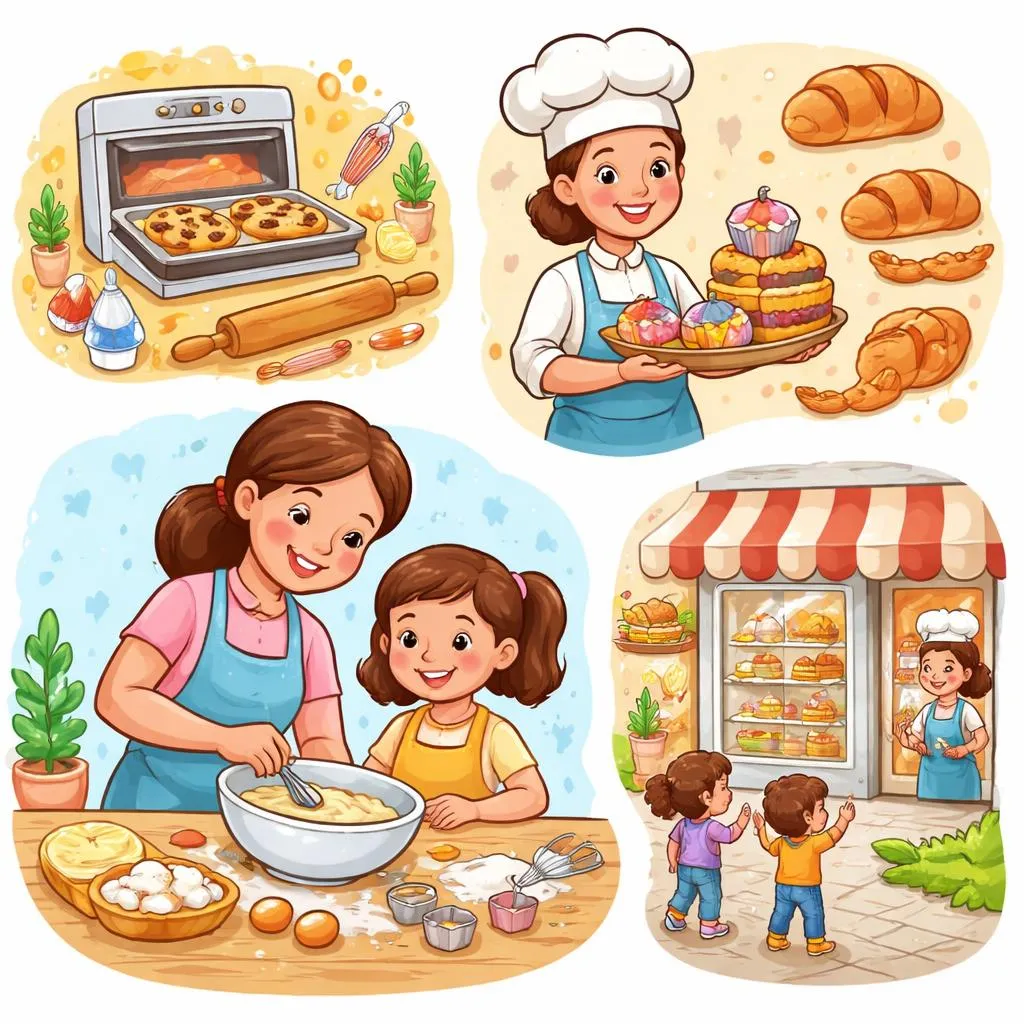

What Does “Same Word, Different Forms” Mean? One root word can grow into four delicious forms. “Bake, baker, bakery, baking” share one meaning. That meaning is “to cook in an oven.” Each form has a different job in a sentence. One word shows an action. One word names a person. One word names a place. One word describes the activity. Learning these four forms builds kitchen vocabulary.
Personal Pronouns Change Their Form This rule applies to pronouns like “we, us, our.” But word families work the same way for other words. “Bake” is a verb. “Baker” is a noun. “Bakery” is a noun. “Baking” is a verb form (present participle) or a noun. Each form answers a different question. What action? Bake or baking. What person? Baker. What place? Bakery.
From Verb to Noun to Adjective to Adverb – One Family, Many Words This family starts with the verb “bake.” You bake bread in the oven. You bake cookies for a party. From “bake,” we make the noun “baker.” “Baker” names the person who bakes. Example: “The baker woke up early to make muffins.” From “bake,” we make the noun “bakery.” “Bakery” names the place where baking happens. Example: “We bought a cake at the bakery.” From “bake,” we make “baking” as an activity. “Baking” names the process of making baked goods. Example: “Baking is my favorite rainy-day activity.”
One Root, Many Roles – How Words Grow from Actions to Qualities Think of a child making cupcakes. The child “bakes” the cupcakes. That is the verb. The child becomes a “baker.” That is the person noun. The place where they bake is a “bakery” (even a home kitchen). That is the place noun. The whole activity is “baking.” That is the process noun. The root meaning stays “to cook in an oven.” The role changes with each sentence.
Same Meaning, Different Jobs – Is It a Verb or a Noun? “Bake” is always a verb. It shows the action of cooking in an oven. Example: “We will bake a pie for dessert.” “Baker” is always a noun. It names a person who bakes. Example: “The baker wore a white apron.” “Bakery” is always a noun. It names a place that sells baked goods. Example: “The bakery smells like cinnamon.” “Baking” can be a verb or a noun. As a verb: “I am baking bread.” As a noun: “Baking requires patience.” Same family. Different jobs. Two nouns share the same root but mean different things.
Adjectives and Adverbs – When Do We Add -ly? This family does not have a common adjective or adverb. You could say “baked” as an adjective. Example: “baked chicken” or “baked bread.” But that is not part of this word family set. The -ly rule does not apply directly here. That is fine. Many word families have gaps. The important part is learning these four yummy forms.
Watch Out for Tricky Spelling Changes (Double Letters, y to i, and More) “Bake” has no double letters. It ends with a silent “e.” When we add “-er,” we drop the “e.” Bake – drop “e” – add er = baker. When we add “-ery,” we drop the “e” as well. Bake – drop “e” – add ery = bakery. When we add “-ing,” we also drop the “e.” Bake – drop “e” – add ing = baking. A common mistake is writing “baker” with the “e” still there (bakeer). The correct spelling drops the “e.” Another mistake is writing “bakery” as “bakary” (with an “a” instead of “e”). The correct spelling is b a k e r y – but wait, we dropped the “e.” Yes: bake – drop e – add ery = bakery (no “e” in the middle). It is b a k e r y? No – b a k e r y would have an “e” before “r.” Let us check: Bake (b a k e). Drop “e” – bak. Add “ery” – bakery (b a k e r y)? That puts the “e” back. The correct spelling is b a k e r y. So we do not drop the “e” for “bakery”? Yes, we do: bake – drop “e” – add “ery” = bakery. That gives b a k r y? No. This is confusing. The simple rule: bakery is spelled b a k e r y. The “e” stays for “bakery.” For “baker” and “baking,” drop the “e.” For “bakery,” keep the “e” then add “ry.” Memorize: bakery has an “e” before the “r.” Write slowly at first. The spelling takes practice.
Let’s Practice – Can You Choose the Right Form? Try these sentences with your child. Fill in the blank with bake, baker, bakery, or baking.
Let’s _______ cookies for the school fair.
The _______ wore a tall white hat.
We bought fresh bread at the _______.
_______ is a fun way to spend a rainy afternoon.
Can you _______ a cake for my birthday?
The _______ woke up at 4 am to make donuts.
That _______ sells the best croissants in town.
She loves _______ because the kitchen smells so good.
Answers:
bake
baker
bakery
Baking
bake
baker
bakery
baking
Go through each answer slowly. Ask your child why the word fits. Praise effort and yummy thinking. Keep practice short and sweet.
Tips for Parents – Help Your Child Learn Word Families in a Fun Way You can teach “bake, baker, bakery, baking” through daily life. Use the kitchen, trips to bakeries, and cooking together.
In the kitchen, say “Let’s bake muffins today.” Ask “What action will we do?”
While mixing batter, say “You are a baker right now.” Ask “What does a baker do?”
When you pass a bakery, point and say “That is a bakery.” Ask “What do they sell at a bakery?”
During baking, say “Baking takes time and patience.” Ask “Is baking a verb or a noun here?”
Play a “who works where” game. Write the four words on sticky notes. Say a sentence. Let your child hold up the correct word. Example: “Let’s bake a pie.” Child holds “bake.” “The baker makes bread.” Child holds “baker.” “We went to the bakery.” Child holds “bakery.” “Baking is fun.” Child holds “baking.”
Draw a four-part poster. Write “bake” with a picture of an oven. Write “baker” with a picture of a person with a mixing bowl. Write “bakery” with a picture of a storefront. Write “baking” with a picture of cookies on a tray. Hang it on the wall.
Use real baking as a lesson. Let your child measure flour. Say “You are assisting the baker.” After baking, say “Our baking turned out delicious.”
Keep each session under five minutes. Repeat games on different days. Children learn through playful cooking and tasting.
When your child makes a mistake, smile. Say “Good try. Let me show you again.” Use the correct word in a simple sentence. Then continue.
No need for grammar drills. No need for tests. Just warm examples and real kitchen fun every day. Soon your child will master “bake, baker, bakery, baking.” That skill will help them talk about food, jobs, and places with confidence.