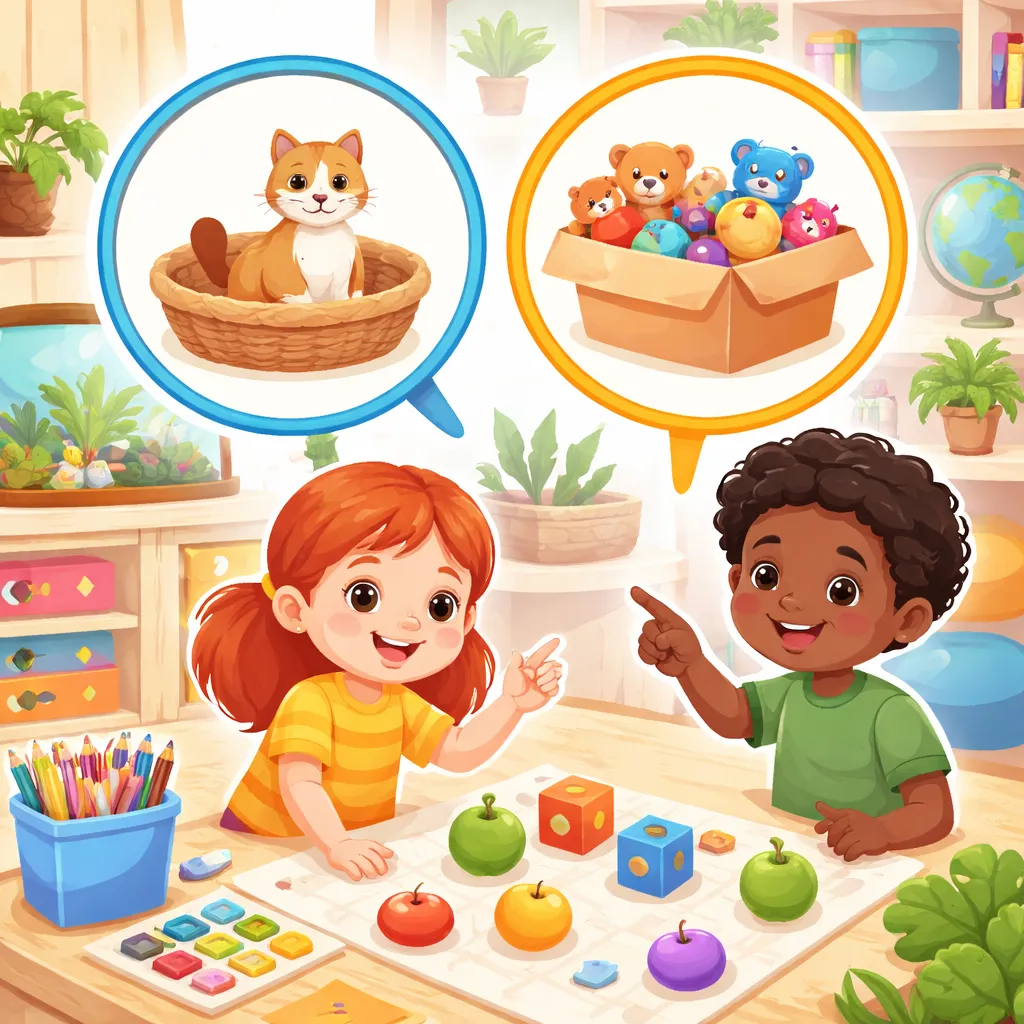

What Is 'There Is' and 'There Are'?
In English, the phrases "there is" and "there are" are commonly used to describe the presence of something in a specific location. These phrases are simple but very important for children to learn, as they help with making basic sentences. By understanding how to use "there is" and "there are," children can express themselves more confidently in everyday situations.
The difference between the two lies in whether the noun that follows is singular or plural. “There is” is used with singular nouns, while “there are” is used with plural nouns.
For example:
There is a cat in the garden. (singular) There are two dogs in the yard. (plural)
Both of these structures are essential for building basic English sentences and are a key part of early language development.
Rules of 'There Is' and 'There Are'
Here are some simple rules that will help children understand how to use these phrases correctly.
'There is' is used when talking about a singular object or thing. Example: There is a book on the table. 'There are' is used when talking about two or more objects (plural). Example: There are three pencils in the box. When the subject is a non-countable noun (like water or air), 'there is' is used. Example: There is milk in the fridge. In negative sentences, "there is" and "there are" change to "there isn’t" and "there aren’t". Example (singular): There isn’t a dog in the park. Example (plural): There aren’t any cookies left. For questions, the structure reverses. You put "is" or "are" before "there". Example (singular): Is there a pen on the desk? Example (plural): Are there books on the shelf? How to Use 'There Is' and 'There Are'
Let’s break down how to use "there is" and "there are" in a few simple steps.
Start with "there". This tells us that we’re talking about the presence of something. Use "is" or "are", depending on the number of things you’re talking about. Follow with a noun. This noun can be a person, object, or thing. Add details. Sometimes, we include more information about the location or other characteristics of the noun.
For example:
There is a tree in the yard. (singular) There are many stars in the sky. (plural) There is a toy on the floor. (singular) There are five pencils in the drawer. (plural)
In questions, we just switch the order:
Is there a bird in the tree? Are there cookies in the jar? Examples of 'There Is' and 'There Are'
To make things clearer, let’s look at some examples:
Singular (using "there is") There is a cat on the sofa. There is a ball in the yard. There is a book on the table. Plural (using "there are") There are two birds in the tree. There are many cars on the street. There are three chairs in the room. In questions Is there a dog in the garden? Are there four apples in the basket? In negative sentences There isn’t a book in the bag. There aren’t any people at the park.
These examples show how easy it is to use "there is" and "there are" in different types of sentences. Children can use these structures to describe things in their daily lives.
Common Mistakes
While learning these rules, children may make a few common mistakes. Here’s how to avoid them:
Confusing singular and plural nouns Mistake: There is two dogs. Correct: There are two dogs. Using "there is" with a plural noun Mistake: There is many people. Correct: There are many people. Forgetting the “s” in “there is” or “there are” when forming negative or questions Mistake: There no milk. Correct: There isn’t any milk. Using "there are" with non-countable nouns Mistake: There are water in the bottle. Correct: There is water in the bottle.
These mistakes are very common, but with practice, children will soon learn to get them right.
Comparison Between 'There Is' and 'There Are'
Although “there is” and “there are” are both used to talk about existence, the key difference lies in the number of things being discussed.
Use "there is" when you talk about one thing (singular). Use "there are" when you talk about more than one thing (plural).
Example:
There is a dog in the yard. (singular) There are three dogs in the yard. (plural)
Understanding this difference will help children create clear and accurate sentences.
Practice Exercises
Now that you understand the rules, let’s practice using "there is" and "there are" with these fun exercises. Write down your answers or say them out loud!
Fill in the blanks: () a book on the table. () many students in the classroom. () a dog outside. () three cats in the garden. (______) cookies in the jar. Answer the questions: Is there a pencil on the desk? Are there toys in the toy box? Is there a clock on the wall? Are there five chairs in the room?
These simple exercises will help reinforce what your child has learned.
Answers and Explanations
Here are the answers to the exercises:
Fill in the blanks: There is a book on the table. There are many students in the classroom. There is a dog outside. There are three cats in the garden. There are cookies in the jar. Answer the questions: Yes, there is a pencil on the desk. Yes, there are toys in the toy box. Yes, there is a clock on the wall. Yes, there are five chairs in the room.
These answers should make it easier to see how the structure works.
Learning Tips
To help children master "there is" and "there are," here are some practical learning tips:
Practice with real-life objects: Encourage children to look around and make sentences about what they see. For example, "There is a table," or "There are five apples." Use visual aids: Show pictures or use toys and objects to create fun exercises. This will make the learning process more interactive. Repeat often: The more children practice, the more comfortable they will become with these structures. Keep using "there is" and "there are" in daily conversations. Make it a game: Turn it into a game where children have to point to things in the room and make sentences using "there is" and "there are."
By consistently practicing and using these phrases, children will naturally build a strong understanding of how to express existence in English.