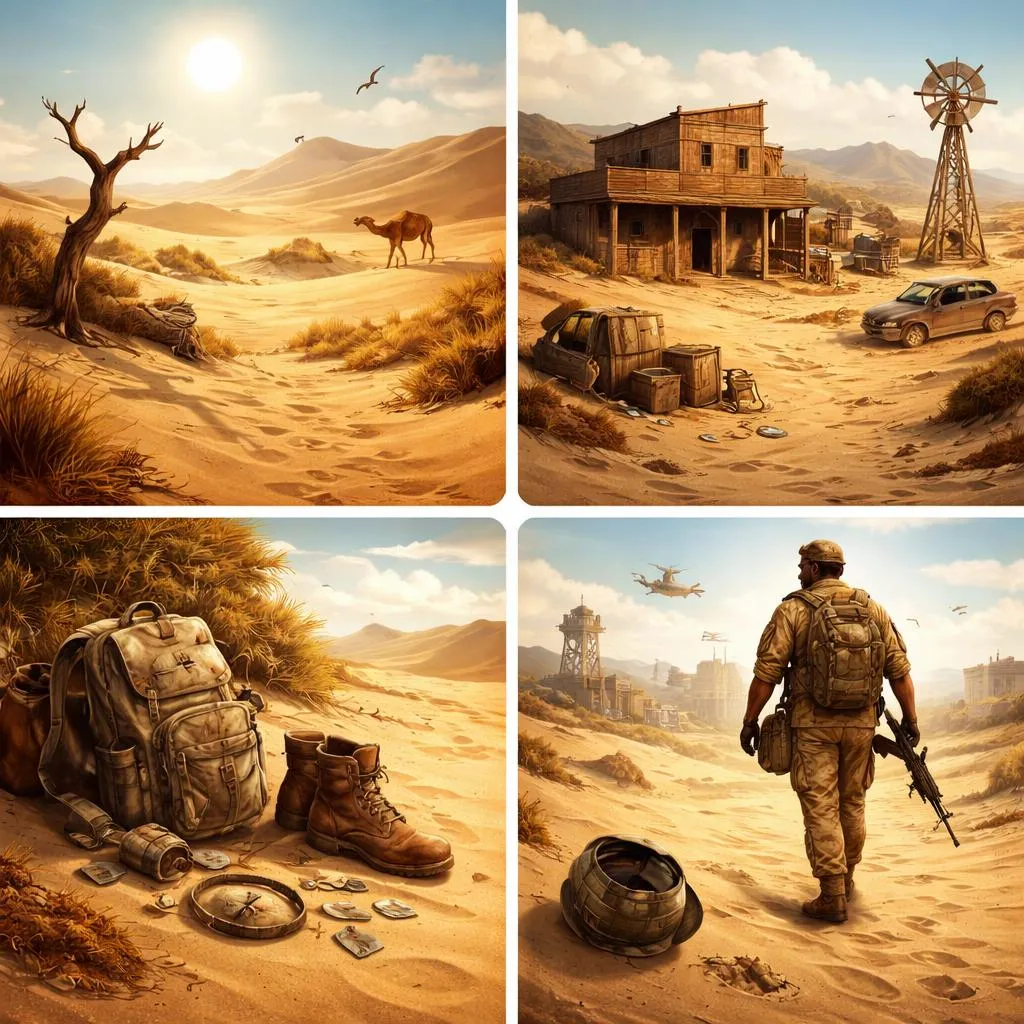

A dry, sandy place with no rain. That is a desert. Today we learn four words.
“Desert,” “deserted,” “desertion,” and “deserter.”
Each word shares the idea of emptiness or leaving behind. Each does a different job.
Parents and children can learn these words together. They help with geography and loyalty.
What Does “Same Word, Different Forms” Mean?
One idea takes different shapes. The idea here is abandoning or dry land.
“Desert” is a noun. “The Sahara is a hot desert.” Dry land.
“Desert” is also a verb. “Do not desert your friend.” Leave.
“Deserted” is an adjective or past verb. “The deserted town was quiet.” Empty. “He deserted his post.” Past action.
“Desertion” is a noun. “Desertion of a job is serious.” Act of leaving.
“Deserter” is a noun. “The soldier was a deserter.” Person who leaves.
Same root. Different endings. Different jobs. The emptiness or leaving stays.
Personal Pronouns Change Their Form
Pronouns change for grammar. “I” becomes “me.” “We” becomes “us.”
Our words change for role and description. “The desert is hot.” Noun.
“The building is deserted.” Describes. “Desertion is wrong.” Noun.
“The deserter ran away.” Person.
Pronouns help us speak faster. Word families help us talk about dry places and leaving.
When children know these four words, they understand stories of loyalty.
From Verb to Noun to Adjective to Adverb – One Family, Many Words
“Desert” is a noun. “Camels live in the desert.” Dry land.
“Desert” is also a verb. “Please do not desert the team.” Leave.
“Deserted” is an adjective. “A deserted street has no people.” Empty.
“Deserted” is also a past verb. “The crew deserted the ship.” Past action.
“Desertion” is a noun. “Desertion of duty is a crime.” Act.
“Deserter” is a noun. “A deserter escapes responsibility.” Person.
We have no common adverbs.
Six meanings. Very important for history and geography.
One Root, Many Roles – How Words Grow from Actions to Qualities
The root “desert” comes from Latin “deserere,” meaning to abandon. The noun “desert” (dry land) comes from Latin “desertum,” meaning abandoned place.
From that root, we add “-ed” to make an adjective meaning “abandoned” or a past verb.
We add “-ion” to make a noun meaning “the act of abandoning.”
We add “-er” to name the person. “Deserter” means one who abandons.
Help your child see this pattern. Desert is the dry land or the verb to leave. Deserted means empty. Desertion is the act. Deserter is the person.
Same Meaning, Different Jobs – Is It a Verb or a Noun?
Look at “desert” (verb) vs “desert” (noun). Same spelling. Different sounds. The noun (dry land) has stress on the first syllable: DES-ert. The verb (to leave) has stress on the second syllable: de-SERT.
“Don’t desert me in the desert.” Fun sentence.
Now look at “deserted.” Adjective or past verb. “The deserted house.” Adjective. “He deserted.” Past verb.
“Desertion” is always a noun. “Desertion is a serious charge.”
“Deserter” is always a noun. “The deserter was captured.”
Teach children to listen to the stress. And look at context.
Adjectives and Adverbs – When Do We Add -ly?
We add “-ly” to “deserted” to make “desertedly.” Very rare. Skip it.
We do not add “-ly” to “desert,” “desertion,” or “deserter.”
For children, skip adverbs. Focus on the nouns and adjectives.
Watch Out for Tricky Spelling Changes (Double Letters, y to i, and More)
Spelling has one note. “Desert” has one “s.” Not “dessert” (sweet food).
“Desert” adds “-ed” to make “deserted.” Just add.
“Desert” adds “-ion” to make “desertion.” Just add.
“Desert” adds “-er” to make “deserter.” Just add.
No dropping. No vowel changes. Very clean.
Practice with your child. Write “desert.” Add “ed.” You get “deserted.” Add “ion.” You get “desertion.” Add “er.” You get “deserter.”
Remember: one “s.” Two “s” means dessert.
Let’s Practice – Can You Choose the Right Form?
Try these sentences. Fill in the blank with desert, deserted, desertion, or deserter.
The Sahara is a hot _____. (noun, dry land)
Do not _____ your friends when they need you. (action verb)
The old hotel was completely _____. (adjective)
_____ of the army is a crime. (noun, act)
The _____ ran away during the night. (person)
The crew _____ the sinking ship. (past tense verb)
A _____ street at night can feel scary. (adjective)
The _____ was caught at the border. (person)
Answers: 1 desert, 2 desert, 3 deserted, 4 Desertion, 5 deserter, 6 deserted, 7 deserted, 8 deserter.
Number 4 starts with a capital letter because it begins the sentence.
Number 6 uses “deserted” as past tense verb.
Tips for Parents – Help Your Child Learn Word Families in a Fun Way
Look at pictures of the desert. “The desert has sand and cacti.”
Talk about deserted places. “This playground is deserted at night.”
Explain desertion. “Leaving a team without telling anyone is desertion.”
Watch a story about a deserter. “In stories, a deserter runs from duty.”
Play a game. You name a place. Your child says “desert” or “not desert.”
“Beach.” “Not desert.” “Sahara.” “Desert.”
Make the difference clear: desert (dry) vs dessert (sweet). “Two s’s for sweet stuff.”
Draw a deserted island. Label “deserted.”
Read a book about loyalty. “The Little Red Hen” shows friends who do not desert.
Do not correct every mistake. If your child says “dessert” for “desert,” gently say “The sandy place has one s. The sweet treat has two s’s.”
Celebrate when your child uses “deserter.” That is a specific historical word.
Explain that “desert” as a verb means to leave. “A parent should never desert a child.”
Tomorrow you might see a desert on a map. You will notice a deserted bench in the park. You will hear about desertion in a movie. You will learn about a deserter in history.
Your child might say “I will never desert my teddy bear.” You will smile.
Keep exploring deserts. Keep noticing deserted places. Keep teaching loyalty over desertion. Keep understanding the deserter’s choice.
Your child will grow in language and in commitment. Leaving is sometimes needed. Staying is often braver. Words help us choose.