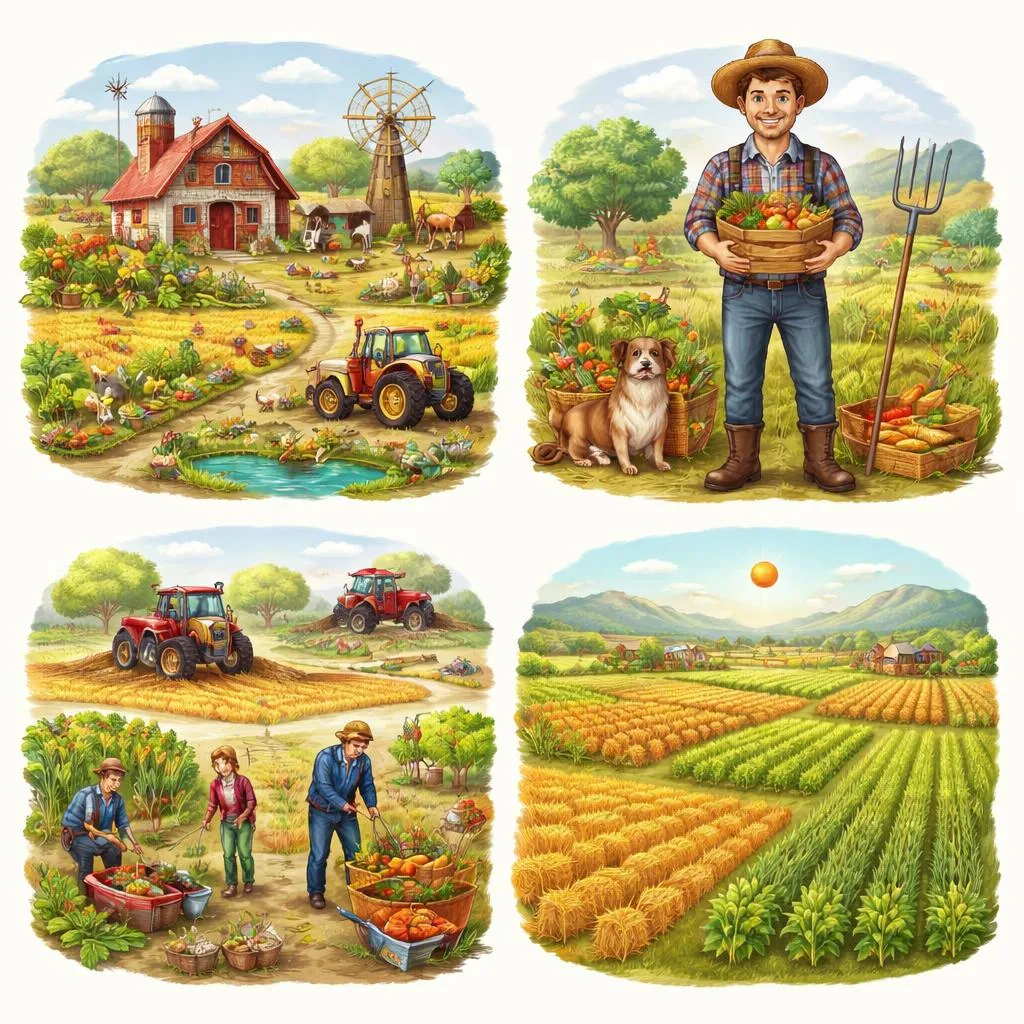

What Does “Same Word, Different Forms” Mean? One root word can grow into four agriculture forms. “Farm, farmer, farming, farmland” share one meaning. That meaning is “to grow food or raise animals on land.” Each form has a different job in a sentence. One word names a place or an action. One word names a person. One word names the activity. One word names the land itself. Learning these four forms builds food and nature vocabulary.
Personal Pronouns Change Their Form This rule applies to pronouns like “they, them, their.” But word families work the same way for other words. “Farm” is a noun or a verb. “Farmer” is a noun. “Farming” is a noun or a verb form. “Farmland” is a noun. Each form answers a different question. What place or action? Farm. What person? Farmer. What activity? Farming. What land? Farmland.
From Verb to Noun to Adjective to Adverb – One Family, Many Words This family starts with the noun “farm.” A farm is a place where food grows. Example: “The farm has cows and corn.” “Farm” can also be a verb. Example: “They farm wheat in this region.” From “farm,” we make the noun “farmer.” “Farmer” names the person who works on a farm. Example: “The farmer wakes up early to feed the animals.” From “farm,” we make the noun “farming.” “Farming” names the activity of growing food. Example: “Farming requires hard work and patience.” From “farm,” we make the noun “farmland.” “Farmland” names the land used for farming. Example: “Miles of farmland stretched across the valley.”
One Root, Many Roles – How Words Grow from Actions to Qualities Think of a family growing vegetables. The place where they grow is a “farm.” That is the place noun. The parents are “farmers.” That is the person noun. The work of planting seeds is “farming.” That is the activity noun. The soil and fields are “farmland.” That is the land noun. The root meaning stays “growing food on land.” The role changes with each sentence.
Same Meaning, Different Jobs – Is It a Verb or a Noun? “Farm” can be a noun or a verb. As a noun: “We visited a farm.” As a verb: “They farm organic vegetables.” “Farmer” is always a noun. It names a person who farms. Example: “The farmer milked the cows.” “Farming” can be a noun or a verb form. As a noun: “Farming is hard work.” As a verb: “He is farming that field this year.” “Farmland” is always a noun. It names the land. Example: “The farmland is fertile and rich.” Same family. Different jobs. Multiple nouns share the same root.
Adjectives and Adverbs – When Do We Add -ly? This family does not have a common adjective or adverb. You could say “farmed” as an adjective. Example: “farmed fish.” But that is not part of this word family set. The -ly rule does not apply directly to these four forms. That is fine. Many word families have gaps. The important part is learning these four farm forms.
Watch Out for Tricky Spelling Changes (Double Letters, y to i, and More) “Farm” has no double letters. It is short and simple. When we add “-er,” we keep the word. Farm + er = farmer. When we add “-ing,” we keep the word. Farm + ing = farming. When we add “-land,” we keep the word. Farm + land = farmland. A common mistake is writing “farmer” with one “r” (famer). The correct spelling has “er” – farmer. Another mistake is writing “farming” with one “m” (faring). The correct spelling has “rm” – farming. Another mistake is writing “farmland” as two words (farm land). The correct spelling is one word: farmland. Write slowly at first. Remember: farm, farmer, farming, farmland.
Let’s Practice – Can You Choose the Right Form? Try these sentences with your child. Fill in the blank with farm, farmer, farming, or farmland.
We visited a _______ that had goats and chickens.
The _______ woke up before sunrise.
_______ takes a lot of patience and knowledge.
The _______ around here is perfect for growing corn.
My uncle wants to _______ apples on his land.
The _______ fixed the broken fence.
She enjoys _______ because she loves animals.
The _______ stretched as far as the eye could see.
Answers:
farm
farmer
Farming
farmland
farm
farmer
farming
farmland
Go through each answer slowly. Ask your child why the word fits. Praise effort and appreciation for food. Keep practice short and down-to-earth.
Tips for Parents – Help Your Child Learn Word Families in a Fun Way You can teach “farm, farmer, farming, farmland” through daily life. Use trips, food, and stories.
In the car, point to a farm. Say “That is a farm.” Ask “What is a farm?”
When you eat vegetables, say “A farmer grew these carrots.” Ask “What does a farmer do?”
When you talk about where food comes from, say “Farming is important.” Ask “What is farming?”
When you see open fields, say “That is farmland.” Ask “What is farmland?”
Play a “who grows it” game. Write the four words on sticky notes. Say a sentence. Let your child hold up the correct word. Example: “The farm has cows.” Child holds “farm.” “The farmer works hard.” Child holds “farmer.” “Farming is tough.” Child holds “farming.” “The farmland is green.” Child holds “farmland.”
Draw a four-part poster. Write “farm” with a picture of a red barn. Write “farmer” with a picture of a person with a pitchfork. Write “farming” with a picture of rows of crops. Write “farmland” with a picture of a big green field. Hang it on the wall.
Use a “food source” game. Ask “Where does milk come from?” Let your child say “A farm.” Then “A farmer gets it from cows.”
Keep each session under five minutes. Repeat games on different days. Children learn through playful farm and food talk.
When your child makes a mistake, smile. Say “Good try. Let me show you again.” Use the correct word in a simple sentence. Then continue.
No need for grammar drills. No need for tests. Just warm examples and real farm connections every day. Soon your child will master “farm, farmer, farming, farmland.” That skill will help them appreciate where food comes from and the people who grow it.