
Children love to create art. Crayons, markers, paint. Two common phrases invite them to create. “Draw a picture” and “Make a drawing.” Both mean “create an image on paper.” But one is more common. One is more general. Parents and kids can learn together. Art expresses feelings and ideas. The right words tell a child what to do. Let us explore these two art expressions.
What Do These Expressions Mean? “Draw a picture” means “use lines and shapes to create an image.” It usually means using pencils, crayons, or markers. It is the most common way to say it.
For a child, think of a blank paper. “Draw a picture” says “Use your crayon. Make a house, a dog, or a flower. Show me your idea.”
“Make a drawing” also means “create an image on paper.” But it is a little less common. “Make” is a general verb. “Make a drawing” focuses on the act of creating.
For a child, think of art time. “Make a drawing” says “Use any tool. Create something. Enjoy the process.” Both phrases mean to create art. Both say “put an image on paper.” They seem similar because people use both for creating pictures. Yet one is more specific to drawing. One is more general.
What’s the Difference? The main difference is commonness. “Draw a picture” is the everyday phrase. Everyone says it. “Make a drawing” is less common. It sounds a little more formal or careful.
Another difference is the verb. “Draw” is the specific action of using lines. “Make” is general. You can make a drawing, a collage, or a mess.
One more difference is tool focus. “Draw a picture” suggests pencils, crayons, or markers. “Make a drawing” could include other tools but still means a drawing.
Also, “draw a picture” is more direct for instructions. “Make a drawing” is also fine.
Teach children that both mean to create art. One is specific to drawing. One is a general creation verb.
When Do We Use Each One? Use “Draw a picture” for everyday art. “Please draw a picture of your family.” “I drew a picture of a rainbow.” “Draw a picture for Grandma.”
Use “Draw a picture” for school assignments. “Draw a picture of the life cycle of a butterfly.”
Use “Draw a picture” as a simple instruction. “Draw a picture of what you did this weekend.”
Use “Make a drawing” for variety in language. “Let us make a drawing together.” “She made a drawing of her cat.”
Use “Make a drawing” for art projects that include other steps. “First, make a drawing. Then paint it.”
Use “Make a drawing” when you want to sound a little different. It is fine to use.
Parents can model both. Say “draw a picture” most of the time. Say “make a drawing” sometimes for variety.
Example Sentences for Kids Here are simple sentences children can say.
Draw a picture:
I want to draw a picture of a dragon.
Please draw a picture of the ocean.
She drew a picture of her whole family.
Draw a picture using only blue crayon.
He draws a picture every day after school.
Make a drawing:
Let us make a drawing of our house.
I made a drawing of a spaceship.
Can you make a drawing of a tree with apples?
She made a drawing and gave it to her teacher.
He likes to make drawings of animals.
Read these aloud. Notice how “draw a picture” sounds more natural for everyday. Notice how “make a drawing” is also fine but less common.
Common Mistakes to Avoid Children make mistakes with these phrases. Here are common errors.
Mistake 1: Saying “make a picture” for drawing. “Make a picture” is for photography, not drawing. You take a picture. Correct: Say “draw a picture” for drawing with crayons.
Mistake 2: Saying “draw a drawing.” “Draw a drawing” is repetitive and wrong. Correct: Say “make a drawing” or “draw a picture.”
Mistake 3: Forgetting that drawing is about lines. Drawing uses lines. Painting uses brushes and washes. Correct: “Draw” is lines. “Paint” is colors on a brush.
Mistake 4: Pressing too hard. Hard pressure breaks crayons and pencils. Correct: Use gentle pressure.
Mistake 5: Saying “I cannot draw.” Everyone can draw. It does not have to be perfect. Correct: Say “I draw my own way.”
Easy Memory Tips Here are simple memory tricks.
Memory tip 1: Think of a crayon and a paper. “Draw a picture” is a crayon. “Make a drawing” is the paper and the whole process.
Memory tip 2: Use your hands. Pretend to draw with a crayon for “draw a picture.” Pretend to create art with both hands for “make a drawing.”
Memory tip 3: Ask “what is the verb?” Draw = “draw a picture.” Make = “make a drawing.”
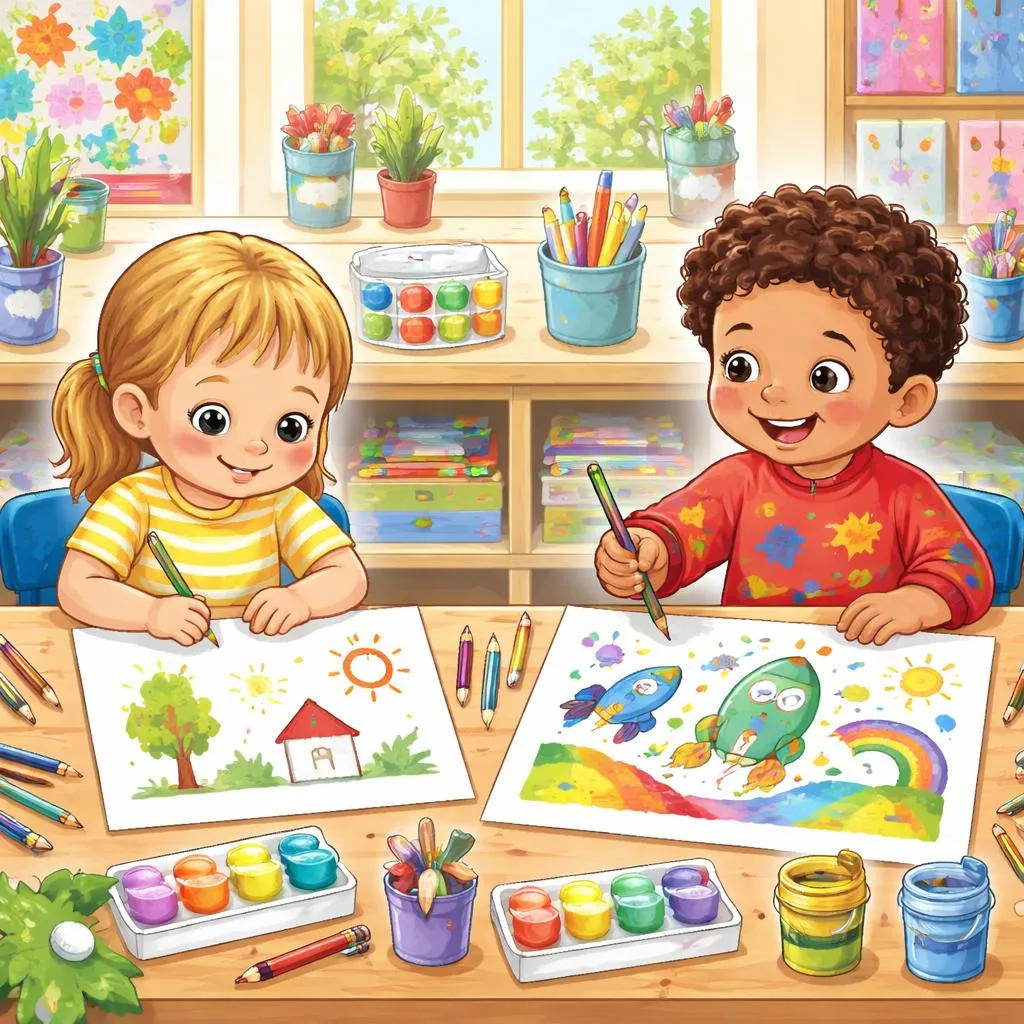
Memory tip 4: Draw two pictures. A child holding a crayon = “draw a picture.” A child at an art table with paper = “make a drawing.”
Memory tip 5: Use the “crayon test.” If you are using a crayon, say “draw a picture.” If you are using any material, “make a drawing” works.
Practice these tips during art time. Enjoy the process.
Quick Practice Time Try these exercises. Parents read aloud. Children answer.
Exercise 1: Choose the best phrase.
Your child has a box of crayons and a piece of paper. Do you say: a) Draw a picture b) Make a drawing
Your child is using markers to create a scene of the beach. Do you say: a) Draw a picture b) Make a drawing
You want to be very specific about using lines, not paint. Do you say: a) Draw a picture b) Make a drawing
Answers: 1(a or b — both fine), 2(a or b — both fine), 3(a — “draw” is more specific)
Exercise 2: Fill in the blank.
“Please __________ of a sunny day.” (common, everyday)
“Let us __________ together with these markers.” (general creation)
Answers: 1. draw a picture, 2. make a drawing
Bonus: Play the “Art Words” game. Hold up different art supplies. Crayons = “draw a picture.” Markers = “draw a picture.” Paint = “paint a picture.” Collage = “make a collage.” Talk about the right verb for each medium.
Wrap-up Use “draw a picture” for creating images with lines using pencils, crayons, or markers. Use “make a drawing” as a general alternative. Both mean to create art. One is more specific and common. One is more general. Teach children that drawing is a skill that grows with practice. Every masterpiece starts with a single line. So draw a picture today. Make a drawing tomorrow. Fill the world with your art. A simple drawing can say a thousand words. Now pick up a crayon. Draw something wonderful. Your imagination is the limit. Enjoy every stroke. That is the joy of art.