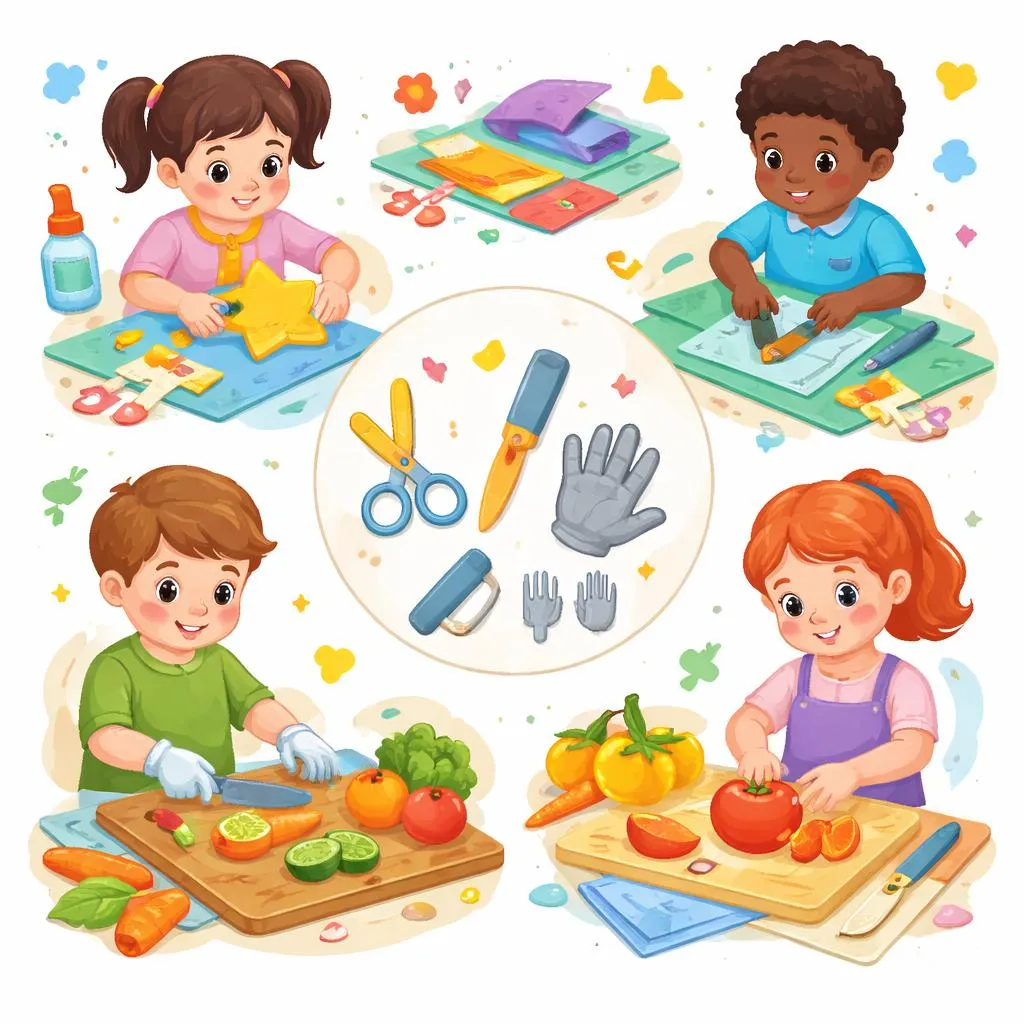

You take scissors. You open and close them. Paper separates into two pieces.
That is cutting. Today we learn four words.
“Cut,” “cutter,” “cutting,” and “cutlery.”
Each word shares the idea of dividing with a sharp edge. Each does a different job.
Parents and children can learn these words together. They help with crafts and meals.
What Does “Same Word, Different Forms” Mean?
One action takes different shapes. The action here is separating something with a blade.
“Cut” is a verb. “Please cut the apple into slices.” Action.
“Cut” is also a noun. “He made a deep cut on his finger.” Wound.
“Cutter” is a noun. “A cookie cutter shapes dough.” Tool.
“Cutting” is a noun or adjective. “Cutting paper is fun.” Activity. “Cutting wind felt cold.” Describes.
“Cutlery” is a noun. “The drawer holds forks, knives, and spoons.” Utensils.
Same root. Different endings. Different jobs. The separation stays.
Personal Pronouns Change Their Form
Pronouns change for grammar. “I” becomes “me.” “We” becomes “us.”
Our words change for role and description. “I cut the fabric.” Present.
“The cutter is sharp.” Tool. “Cutting takes practice.” Activity.
“We need clean cutlery.” Utensils.
Pronouns help us speak faster. Word families help us talk about tools and actions.
When children know these four words, they use scissors and knives safely.
From Verb to Noun to Adjective to Adverb – One Family, Many Words
“Cut” works as a verb. “Cut the rope with a knife.” Action.
“Cut” also works as a noun. “The cut on his knee is healing.” Wound.
“Cutter” is a noun. “A wire cutter is for electrical work.” Tool.
“Cutting” is a noun. “Cutting vegetables takes care.” Activity.
“Cutting” is also an adjective. “A cutting remark hurts feelings.” Sharp in words.
“Cutlery” is a noun. “The restaurant’s cutlery was silver.” Knives, forks, spoons.
We have no common adverbs. “Cuttingly” exists (“He spoke cuttingly”). But skip it.
Six meanings. Very useful family.
One Root, Many Roles – How Words Grow from Actions to Qualities
The root “cut” comes from Old English “cyttan,” meaning to divide or separate.
From that root, we add “-er” to name a tool or person that cuts. “Cutter” is the thing that cuts.
We add “-ing” to name the activity or to make an adjective meaning “sharp” (literal or figurative).
We add “-lery” to make a collective noun. “Cutlery” means a set of cutting tools (knives, plus forks and spoons).
Help your child see this pattern. Cut is the action or wound. Cutter is the tool. Cutting is the activity. Cutlery is the utensil set.
Same Meaning, Different Jobs – Is It a Verb or a Noun?
Look at “cut” in a sentence. Ask: Is it an action? Or is it a wound?
“Please cut the cake.” Action. Verb.
“The cut was deep.” Wound. Noun.
Same word. Two jobs. Context tells you.
Now look at “cutter.” Always a noun. “The paper cutter is on the desk.”
“Cutting” is a noun or adjective. “Cutting is noisy.” Noun. “Her cutting words hurt.” Adjective.
“Cutlery” is always a noun. “We need clean cutlery for dinner.”
Teach children to look at the endings. “-er” noun (tool). “-ing” noun or adjective. “-lery” noun (utensils).
“Cut” alone can be verb or noun.
Adjectives and Adverbs – When Do We Add -ly?
We add “-ly” to “cutting” (the adjective) to make “cuttingly.” This is rare. “She spoke cuttingly.” Means sharply or cruelly.
We do not add “-ly” to “cut,” “cutter,” or “cutlery.”
For children, skip “cuttingly.” Focus on the main words.
“Cut” for action or wound. “Cutter” for tool. “Cutting” for activity. “Cutlery” for utensils.
Watch Out for Tricky Spelling Changes (Double Letters, y to i, and More)
Spelling here is very regular. No double letters. No y to i changes.
“Cut” adds “-er” to make “cutter.” Double the “t”? Yes! “Cut” has a single “t.” When you add “-er,” you double the final consonant if the vowel is short. Cut has short “u.” So “cutter” has double “t.”
“Cut” adds “-ing” to make “cutting.” Double the “t” as well. Cutting.
“Cut” adds “-lery” to make “cutlery.” No double “t.” Cutlery. One “t.”
So the rule: Double the final “t” for “-er” and “-ing.” Keep single “t” for “-lery.”
Practice with your child. Write “cut.” Double the “t,” add “er.” You get “cutter.” Double the “t,” add “ing.” You get “cutting.” Add “lery” (no double “t”). You get “cutlery.”
Let’s Practice – Can You Choose the Right Form?
Try these sentences. Fill in the blank with cut, cutter, cutting, or cutlery.
Please _____ the bread into thick slices. (action verb)
A cookie _____ makes shapes from dough. (tool)
_____ with scissors requires good motor skills. (activity)
We need to wash the _____ before dinner. (utensils)
She had a small _____ on her thumb. (noun, wound)
The paper _____ sits near the printer. (tool)
Her _____ remarks made him sad. (adjective, sharp words)
The restaurant’s _____ was made of stainless steel. (utensils)
Answers: 1 cut, 2 cutter, 3 Cutting, 4 cutlery, 5 cut, 6 cutter, 7 cutting, 8 cutlery.
Number 3 starts with a capital letter because it begins the sentence.
Number 7 uses “cutting” as an adjective meaning “hurtful.”
Tips for Parents – Help Your Child Learn Word Families in a Fun Way
Cut paper together. “Let us cut out snowflakes.”
Use a cookie cutter. “Press the cutter into the dough.”
Explain cutting as an activity. “Cutting with scissors is a good skill.”
Set the table with cutlery. “Knife, fork, and spoon are cutlery.”
Play a game. You name a cutting tool. Your child says its job.
“Scissors?” “Cut paper.” “Knife?” “Cut food.”
Draw a picture of a cutter. A pizza cutter, a cookie cutter, a wire cutter.
Read a book about cooking. “Chop, Sizzle, Wow” shows cutting skills.
Do not correct every mistake. If your child says “cutter” for “cutlery,” gently say “Cutter is one tool. Cutlery is all the utensils together.”
Celebrate when your child uses “cutlery.” That is a very specific word.
Explain that “cutting” can also mean a piece cut from a plant. “A cutting grows into a new plant.”
Tomorrow you will cut wrapping paper. You will use a pizza cutter. You will practice cutting with safety scissors. You will set the table with clean cutlery.
Your child might say “I can cut my own pancakes with cutlery.” You will watch proudly.
Keep cutting safely. Keep using the right cutter. Keep practicing cutting skills. Keep caring for cutlery.
Your child will grow in language and in fine motor skills. Cutting is a life skill. Words help us teach it.