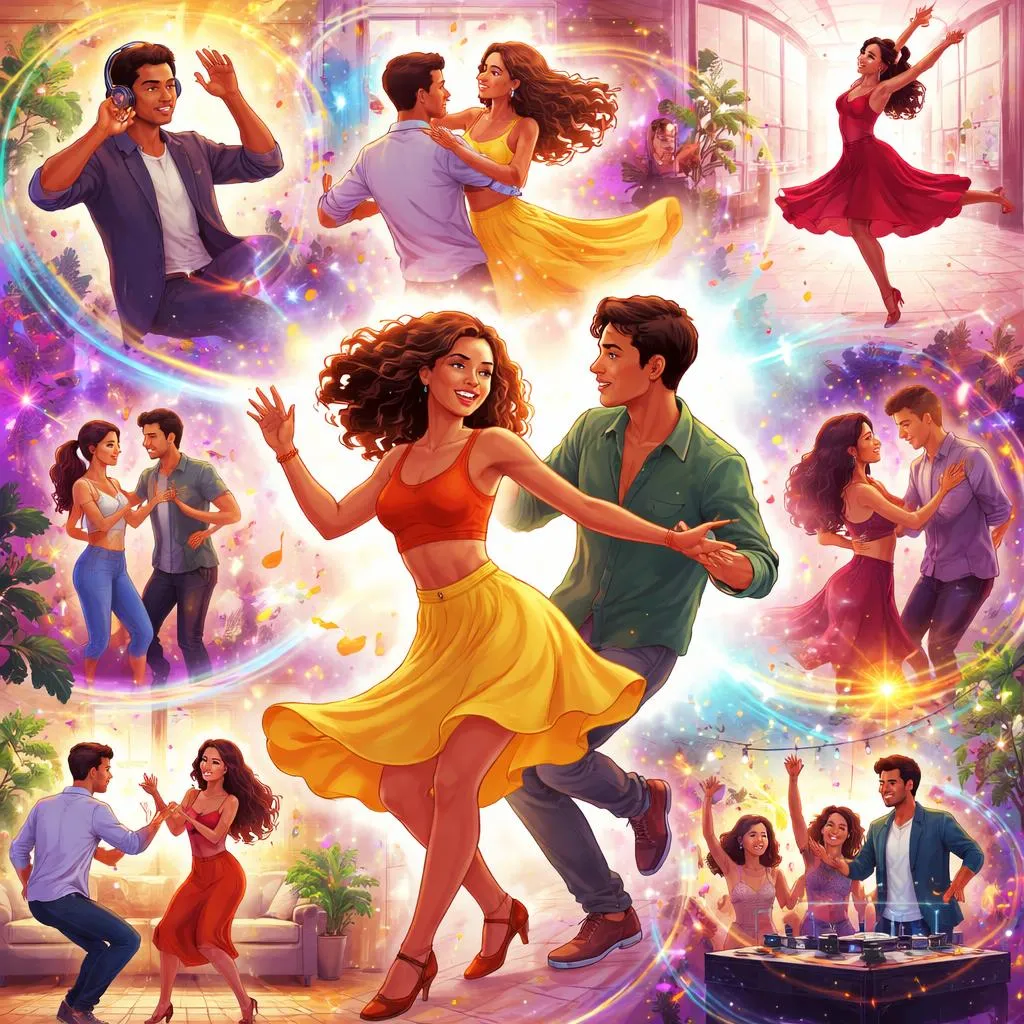

You move your body to music. You tap your feet. You sway your arms.
That is dancing. Today we learn four words.
“Dance,” “dancer,” “dancing,” and “danceable.”
Each word shares the idea of rhythmic movement. Each does a different job.
Parents and children can learn these words together. They help with music and joy.
What Does “Same Word, Different Forms” Mean?
One action takes different shapes. The action here is moving rhythmically to sound.
“Dance” is a verb. “Please dance with me.” Action.
“Dance” is also a noun. “The tango is a beautiful dance.” Art form.
“Dancer” is a noun. “The ballet dancer leaped high.” Person.
“Dancing” is a noun or adjective. “Dancing is good exercise.” Activity. “A dancing flame.” Describes.
“Danceable” is an adjective. “The beat makes this song danceable.” Describes music.
Same root. Different endings. Different jobs. The movement stays.
Personal Pronouns Change Their Form
Pronouns change for grammar. “I” becomes “me.” “We” becomes “us.”
Our words change for role and description. “I dance every Saturday.” Present.
“The dancer spins.” Person. “Dancing keeps you fit.” Activity.
“This song is danceable.” Describes.
Pronouns help us speak faster. Word families help us talk about parties and performances.
When children know these four words, they describe music and fun.
From Verb to Noun to Adjective to Adverb – One Family, Many Words
“Dance” works as a verb. “Dance like nobody is watching.” Action.
“Dance” also works as a noun. “The dance had five parts.” Art.
“Dancer” is a noun. “She is a professional dancer.” Person.
“Dancing” is a noun. “Dancing lifts your mood.” Activity.
“Dancing” is also an adjective. “The dancing leaves swirled in the wind.” Describes.
“Danceable” is an adjective. “This playlist is very danceable.” Describes music.
We have adverbs “danceably” (rare). Skip them.
Six meanings. Very joyful family.
One Root, Many Roles – How Words Grow from Actions to Qualities
The root “dance” comes from Old French “danser,” from Latin “dansare.”
From that root, we add “-er” to name the person. “Dancer” means one who dances.
We add “-ing” to name the activity or to describe something that moves like a dance.
We add “-able” to make an adjective meaning “suitable for dancing.” “Danceable” means you can dance to it.
Help your child see this pattern. Dance is the action or art. Dancer is the person. Dancing is the activity. Danceable describes the music.
Same Meaning, Different Jobs – Is It a Verb or a Noun?
Look at “dance” in a sentence. Ask: Is it an action? Or is it an art form?
“Let us dance!” Action. Verb.
“The waltz is a classic dance.” Art form. Noun.
Same word. Two jobs. Context tells you.
Now look at “dancer.” Always a noun. “The dancer bowed after the show.”
“Dancing” is a noun or adjective. “Dancing is fun.” Noun. “A dancing bird.” Adjective.
“Danceable” is always an adjective. “Every song on the album is danceable.”
Teach children to look at the endings. “-er” noun (person). “-ing” noun or adjective. “-able” adjective.
“Dance” alone can be verb or noun.
Adjectives and Adverbs – When Do We Add -ly?
We add “-ly” to “danceable” to make “danceably.” Very rare. “The song flows danceably.” Skip it.
We do not add “-ly” to “dance,” “dancer,” or “dancing.”
For children, skip these adverbs. Focus on the main words.
“Dance” for action or art. “Dancer” for person. “Dancing” for activity. “Danceable” for music.
Watch Out for Tricky Spelling Changes (Double Letters, y to i, and More)
Spelling here is very regular. No double letters. No y to i changes.
“Dance” adds “-er” to make “dancer.” Drop the “e.” Danc + er = dancer.
“Dance” adds “-ing” to make “dancing.” Drop the “e.” Danc + ing = dancing.
“Dance” adds “-able” to make “danceable.” Keep the “e.” Dance + able = danceable. (Why? Because “danceable” looks better with the “e”? Yes, we keep the “e” for “-able” here.)
So the rule: Drop “e” for “-er” and “-ing.” Keep “e” for “-able.”
Practice with your child. Write “dance.” Drop the “e.” Add “er.” You get “dancer.” Add “ing.” You get “dancing.” Keep the “e,” add “able.” You get “danceable.”
No double letters. Very clean.
Let’s Practice – Can You Choose the Right Form?
Try these sentences. Fill in the blank with dance, dancer, dancing, or danceable.
Let us _____ to this catchy song. (action verb)
The ballet _____ practiced for hours every day. (person)
_____ is a great way to express yourself. (activity)
This music is so _____; I cannot stop moving. (adjective)
The _____ floor was crowded with people. (noun, but “dance floor” – here “dance” is part of compound. We need “dance” as noun: The dance was beautiful.)
Let us adjust: “The _____ was beautiful to watch.” (noun, art form) → dance
She is a talented _____ who performs on Broadway. (person)
The _____ flames in the fireplace were mesmerizing. (adjective)
His music is very _____; everyone gets up to move. (adjective)
Answers: 1 dance, 2 dancer, 3 Dancing, 4 danceable, 5 dance, 6 dancer, 7 dancing, 8 danceable.
Number 3 starts with a capital letter because it begins the sentence.
Number 7 uses “dancing” as an adjective describing flames.
Tips for Parents – Help Your Child Learn Word Families in a Fun Way
Dance together. “Let us dance in the living room!”
Name the dancer. “You are a wonderful dancer.”
Talk about dancing as fun. “Dancing makes my heart happy.”
Find danceable music. “This song is danceable. Feel the beat.”
Play a game. You play a song. Your child says “danceable” or “not danceable.”
Make up a silly dance. Give it a name.
Watch a dance performance online. Point to the dancers.
Read a book about dance. “Giraffes Can’t Dance” by Giles Andreae.
Do not correct every mistake. If your child says “dance” for “dancing,” gently say “Dancing is the activity. Let us dance is the action.”
Celebrate when your child uses “danceable.” That word is fun and unusual.
Explain that “danceable” is a word music critics use. It means the beat makes you want to move.
Tomorrow you will dance to the radio. You will see a dancer on TV. You will enjoy dancing at a party. You will put on danceable music.
Your child might say “You are my favorite dancer.” You will spin them around.
Keep dancing. Keep being a dancer. Keep loving dancing. Keep finding danceable beats.
Your child will grow in language and in joy. Dancing is a universal language. Words help us share it.