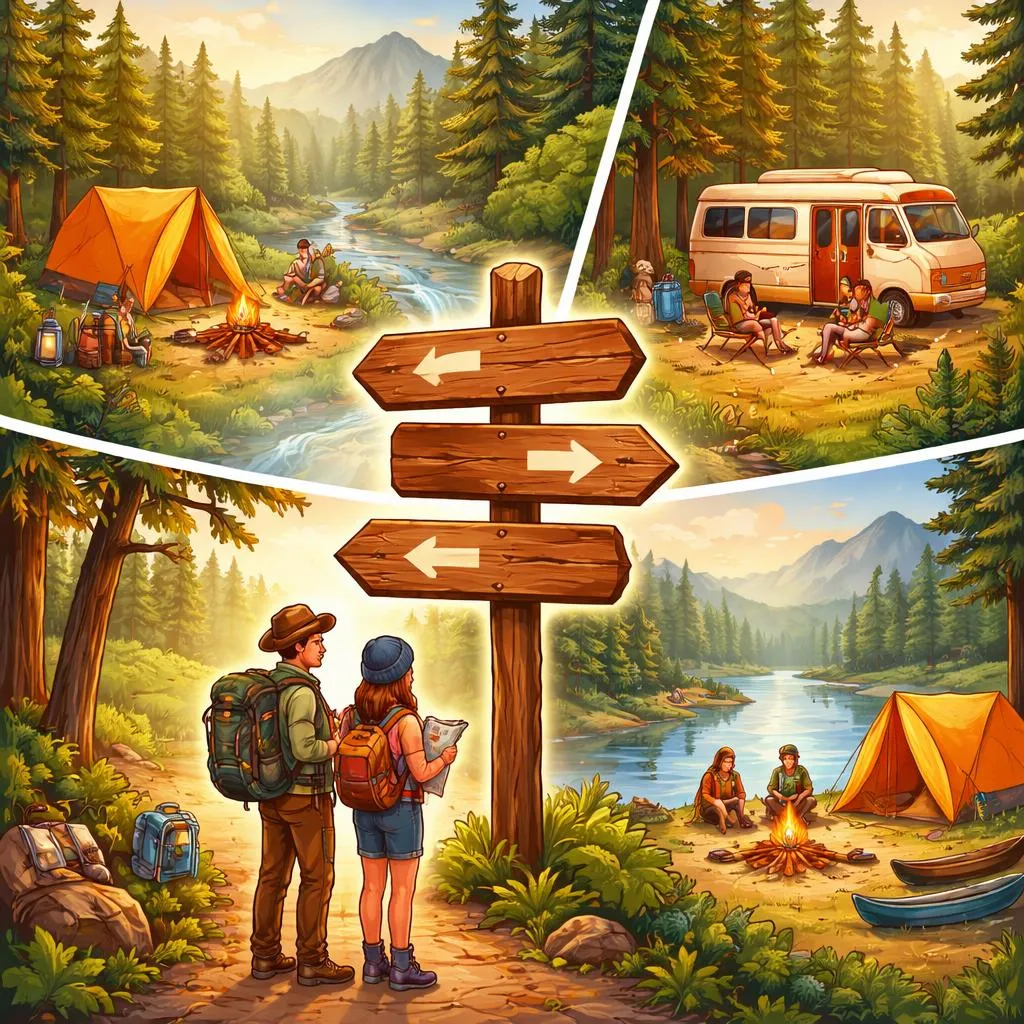

You pack a tent. You find a spot in the woods. You sleep under the stars.
That is camping. Today we learn four words.
“Camp,” “camper,” “camping,” and “campsite.”
Each word shares the idea of outdoor living. Each does a different job.
Parents and children can learn these words together. They help with vacation plans.
What Does “Same Word, Different Forms” Mean?
One activity takes different shapes. The activity here is staying outdoors in a tent or vehicle.
“Camp” is a verb. “We will camp by the river.” Action.
“Camp” is also a noun. “The summer camp has many activities.” Place.
“Camper” is a noun. “The camper slept in a tent.” Person.
“Camper” also means a vehicle. “We cooked inside the camper.” RV.
“Camping” is a noun. “Camping is our favorite family activity.” Activity.
“Campsite” is a noun. “Our campsite had a fire pit.” Specific place.
Same root. Different endings. Different jobs. The outdoor fun stays the same.
Personal Pronouns Change Their Form
Pronouns change for grammar. “I” becomes “me.” “We” becomes “us.”
Our words change for role and place. “We camp in summer.” Action.
“The camper brought marshmallows.” Person. “We love camping.” Activity.
“Our campsite is near the lake.” Place.
Pronouns help us speak faster. Word families help us plan trips clearly.
When children know these four words, they describe outdoor adventures easily.
From Verb to Noun to Adjective to Adverb – One Family, Many Words
“Camp” works as a verb. “Let us camp in the backyard tonight.” Action.
“Camp” also works as a noun. “I go to camp every July.” Place.
“Camper” is a noun for a person. “Each camper needs a sleeping bag.” Person.
“Camper” is also a noun for a vehicle. “Our camper has a small fridge.” RV.
“Camping” is a noun. “Camping teaches us to appreciate nature.” Activity.
“Campsite” is a noun. “We chose a campsite with shade.” Specific location.
No adjective or adverb in this family. That is fine.
Five meanings across four words. Very useful for family trips.
One Root, Many Roles – How Words Grow from Actions to Qualities
The root “camp” comes from Latin “campus.” It meant an open field or plain.
Roman soldiers set up camps in open fields. They called their temporary homes “castra.”
From that root, we add “-er” to name a person. “Camper” means one who camps.
We also use “camper” for the vehicle that takes you camping.
We add “-ing” to name the activity. “Camping” is the whole experience.
We add “-site” to name the location. “Campsite” means the specific spot.
Help your child see this history. Open fields became camps. Camps became camping. Campers sleep at campsites.
Same Meaning, Different Jobs – Is It a Verb or a Noun?
Look at “camp” in a sentence. Ask: Is it an action? Or is it a place?
“We will camp near the waterfall.” Action. Verb.
“Summer camp starts next week.” Place. Noun.
Same word. Two jobs. Context tells you.
Now look at “camper.” Always a noun. “The young camper learned to tie knots.” Person. “We rented a camper for the trip.” Vehicle.
“Camping” is always a noun. “Camping requires a tent and food.”
“Campsite” is always a noun. “Please clean your campsite before leaving.”
Teach children to look at the word’s job. “Camper” can be a person or a vehicle. Both are nouns.
Adjectives and Adverbs – When Do We Add -ly?
We do not add “-ly” to these words. No “camply.” No “campingly.”
All four words are nouns or verbs. No adjectives. No adverbs.
This makes the family simpler. Focus on the noun and verb forms.
“Camp” for action or place. “Camper” for person or vehicle. “Camping” for activity. “Campsite” for location.
That is plenty for outdoor talk.
Watch Out for Tricky Spelling Changes (Double Letters, y to i, and More)
Spelling here is very simple. No double letters. No y to i changes.
“Camp” adds “-er” to make “camper.” Just add.
“Camp” adds “-ing” to make “camping.” Just add.
“Camp” adds “-site” to make “campsite.” Just add. “Site” is a separate word.
No letters drop. No letters change. This is a very regular family.
The only note: “campsite” is one word. Not “camp site.” Write it together.
Practice with your child. Write “camp.” Add “er.” You get “camper.” Add “ing.” You get “camping.” Add “site.” You get “campsite.”
No tricks. Very kind spelling.
Let’s Practice – Can You Choose the Right Form?
Try these sentences. Fill in the blank with camp, camper, camping, or campsite.
We will _____ in the forest for three nights. (action verb)
Each _____ brought their own flashlight. (person)
_____ is fun when you have good weather. (activity)
Our _____ had a picnic table and a fire ring. (specific place)
They drove across the country in a small _____. (vehicle)
The summer _____ offers swimming and archery. (place)
Please set up the tent at the _____. (specific place)
Let us go _____ this weekend. (activity with go)
Answers: 1 camp, 2 camper, 3 Camping, 4 campsite, 5 camper, 6 camp, 7 campsite, 8 camping.
Number 3 starts with a capital letter because it begins the sentence.
Number 5 uses “camper” as a vehicle. Number 2 uses “camper” as a person. Same word. Two meanings.
Tips for Parents – Help Your Child Learn Word Families in a Fun Way
Set up a blanket fort. Call it your camp. “Let us camp in the living room.”
Pretend to be campers. “You are a camper. I am a camper too.”
Name the activity. “We are camping tonight.”
Find a spot. “This is our campsite. Do not cross the blanket line.”
Watch a nature show about camping. Point out the words.
Draw a picture of a campsite. Label the tent, fire, and trees.
Play with toy campers. Many toy sets include small RVs.
Use a cardboard box as a camper. “This box is our camper. We sleep inside.”
Go outside. Find a flat spot. “This would be a good campsite.”
Do not correct every mistake. If your child says “camping spot” instead of “campsite,” that is fine.
Celebrate when your child uses “camper” for both person and vehicle. That shows flexible thinking.
Read a book about camping. “A Camping Spree with Mr. Magee” is a good one.
Explain the difference. “A campsite is the place. Camping is the activity. A camper is the person or the van.”
Tomorrow you might plan a backyard camp. You will be campers. You will go camping. You will choose a campsite behind the swing set.
Your child might say “Let us camp in the fort tonight.” You will grab sleeping bags.
Keep camping. Keep naming campers. Keep talking about camping. Keep finding campsites.
Your child will grow in language and in love for nature. Both are beautiful gifts.