
No one likes to fail. But everyone does. Children drop a glass. They miss a goal. They forget an answer. These moments feel hard. Yet they teach us the most.
The word family “fail, failure, failing, failed” helps us talk about these moments. Not with shame. With honesty. With hope.
This article helps parents and children see failure as a step. Not a stop. We explore how one verb grows into nouns and adjectives. We learn together.
Let us begin with kindness. And a look at what these words really mean.
What Does “Same Word, Different Forms” Mean?
The root means “to miss” or “to not succeed.” But missing does not mean ending. It means trying again.
Each form does a different job. “Fail” is a verb. It shows action. “Failure” is a noun. It names the event or feeling. “Failing” can be a noun or adjective. “Failed” is past tense or adjective.
Your child knows families like “play, player, played.” This works the same way. Only here we talk about hard moments. That is okay. We can name hard things.
Personal Pronouns Change Their Form
Verbs change with pronouns. “Fail” follows the pattern. “I fail. He fails. She fails. They fail.”
That small “s” on “fails” matches he, she, or it. Children hear this naturally.
“Failed” stays the same for all pronouns. “I failed. You failed. We failed.” Easy.
“Failing” also stays the same. “I am failing. He is failing. They are failing.”
“Failure” is a noun. It does not change for pronouns. “My failure. Your failure. Her failure.” Only number changes. One failure. Many failures.
From Verb to Noun to Adjective to Adverb – One Family, Many Words
This family has no adverb. But we can still see the growth.
“Fail” – verb. Shows an attempt without success. “I might fail this test.”
“Failure” – noun. Names the lack of success. “The failure taught me something.”
“Failing” – noun or adjective. As noun: “His biggest failing is impatience.” As adjective: “The failing engine lost power.”
“Failed” – past tense verb or adjective. As verb: “We failed yesterday.” As adjective: “The failed attempt ended quickly.”
See how one root carries the same idea? Not succeeding. But also not stopping.
One Root, Many Roles – How Words Grow from Actions to Qualities
From the verb “fail,” we make the noun “failure” by adding “-ure.” This suffix turns actions into names. “Press” becomes “pressure.” “Fail” becomes “failure.”
We make “failing” by adding “-ing.” This can be a noun or an adjective. “Failing” names a weakness. Or describes something that stops working.
We make “failed” by adding “-ed.” This shows past time. Or turns the verb into an adjective. “A failed test” means a test that did not pass.
Focus first on “fail” and “failed.” Young children understand “I failed” more than “failure.” Introduce “failure” gently. Save “failing” as a noun for older kids.
Same Meaning, Different Jobs – Is It a Verb or a Noun?
Let us check each word’s job in a sentence.
“Fail” – verb only. “I will fail if I do not study.” Ask: Can I do it? Yes. So it is a verb.
“Failure” – noun only. “This project was a failure.” Ask: Can I name it or point to it? The event. Yes. So it is a noun.
“Failing” – noun or adjective. “His failing is lateness.” Noun. “The failing light made it dark.” Adjective. Ask: Does it describe a noun (light)? Yes. So adjective here.
“Failed” – verb or adjective. “They failed the test.” Verb. “The failed experiment went in the trash.” Adjective. Ask: Did it happen before? Verb. Does it describe a noun? Adjective.
Teach your child to ask “Can I do it?” That solves most cases.
Adjectives and Adverbs – When Do We Add -ly?
We can add -ly to “failing” to make “failing-ly.” That is very rare. Do not teach it.
We can add -ly to “failed”? No. That does not work.
Focus on the main forms. “Fail, failure, failing, failed.” These four cover almost everything a young child needs.
For older children, you can mention “failingly” as a strange word. But daily conversation never uses it.
Watch Out for Tricky Spelling Changes (Double Letters, y to i, and More)
“Fail” – simple. F A I L.
“Failed” – add -ed. Keep everything. “Fail” + “ed” = “failed.” No double letters.
“Failing” – add -ing. Keep everything. “Fail” + “ing” = “failing.” No double letters. No dropping letters.
“Failure” – add -ure. Keep everything. “Fail” + “ure” = “failure.” No change. The “u” comes from Latin. Just spell it as one word.
The main rule: no tricky changes. All forms keep the full word “fail.” That makes learning easy.
Let’s Practice – Can You Choose the Right Form?
Try these sentences with your child. Fill in each blank. Use fail, failure, failing, or failed.
Yesterday I _____ to tie my shoes the first time. Then I tried again.
Do not be afraid to _____. Everyone makes mistakes.
The _____ part of the toy was the battery cover. It kept falling off.
Losing the game felt like a _____. But we learned new skills.
Answers:
failed (past action – already happened)
fail (verb – present or future action)
failing (adjective – describes the part)
failure (noun – names the event or feeling)
Read the sentences aloud. Ask why each answer fits. Let your child explain. That builds confidence.
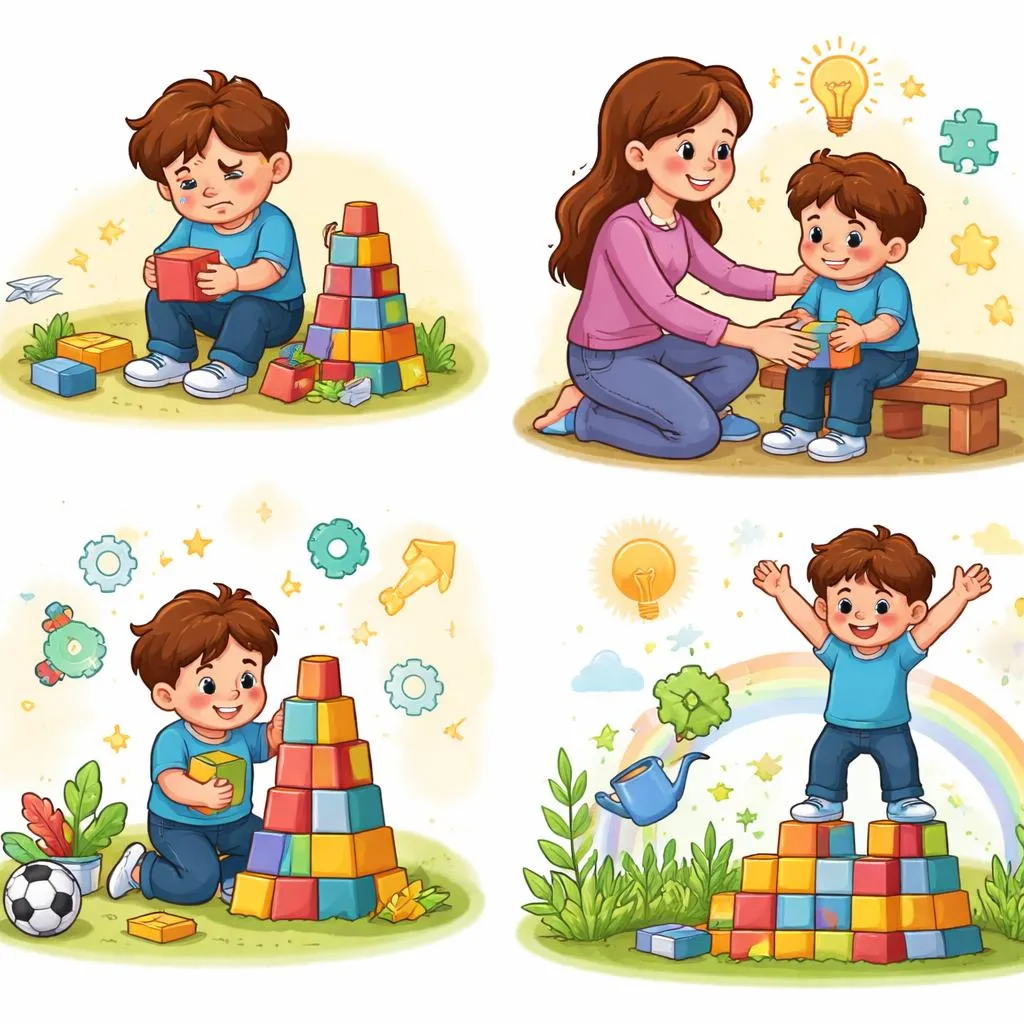
Now play a simple game. Stack three blocks. Try to stack four. When it falls, say “I failed that time.” Then “That was a failure.” Then “The failing tower tipped over.” Use all the forms.
Tips for Parents – Help Your Child Learn Word Families in a Fun Way
Start with small, safe failures. A puzzle piece that does not fit. A drawing that smudges. Say “You failed to fit that piece. Try another.” Keep your voice light.
Never punish failure. Praise the attempt. “You tried hard. That is good. Now let us see why it failed.”
Read books about famous failures. Thomas Edison tried many light bulbs. He said “I found 10,000 ways that failed.” Share that story. It helps.
Play the “Oops Game.” Purposefully fail at something small. Drop a spoon. Say “I failed to catch it.” Laugh. Your child learns that failure is normal.
Use art. Draw a “Failure Monster.” Give it three eyes and messy hair. Say “This monster visits when we fail. But we are not scared.” Naming fear takes its power.
Write a “Failure of the Day” on a small board. “I failed to open the jar.” “You failed to catch the ball.” Then write “What I learned.” “Need stronger hands.” “Need faster hands.” This builds growth mindset.
Celebrate when your child uses any form correctly. If they say “I failed,” say “Good word! And now you try again.” If they say “That was a failure,” nod and ask “What next?”
Do not overprotect from failure. Let your child struggle a little. Tie shoes. Pour milk. Solve a puzzle. Small failures build resilience. Too much help builds fear.
Use “failing” as a gentle noun. “Your only failing is rushing.” Say it softly. Then offer help. “Let us practice slowing down.”
One evening, share your own failure. “Today I failed to call Grandma. I felt bad. Tomorrow I will try again.” Your child sees that even grown-ups fail. And keep going.
Remember the difference between failing and being a failure. No child is a failure. They only fail at a task. Words matter. Choose them with care.
Keep learning gentle. Keep courage high. And keep trying together. Every failed try is a step toward success.
Soon your child will say “I failed, but I will try again” with a strong voice. They will know that failure is not the end. It is a teacher. And you gave them that wisdom.