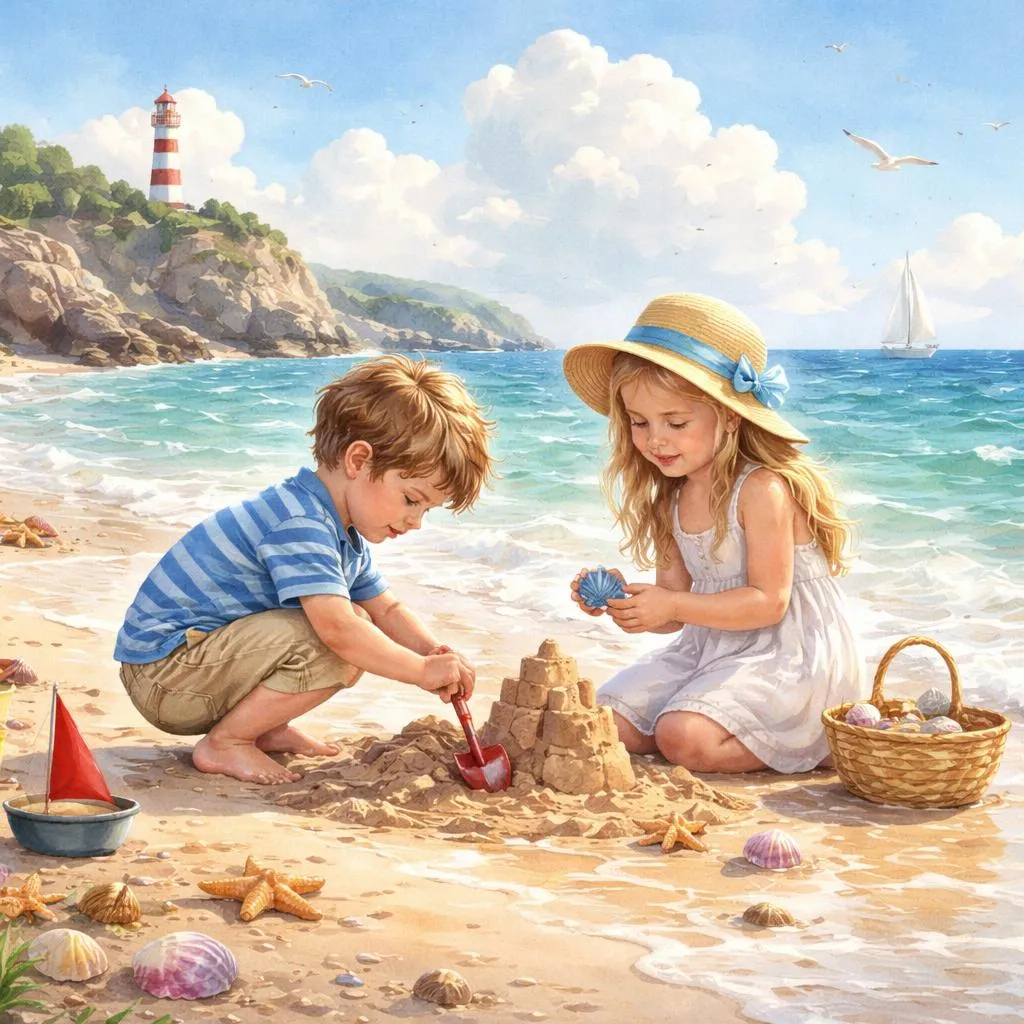

When I was down beside the sea A wooden spade they gave to me To dig the sandy shore. My holes were empty like a cup. In every hole the sea came up, Till it could come no more.
Story Background and Author Introduction
This short poem is a classic example of simple, evocative children's literature that captures the wonder and playfulness of a child’s day at the beach. Though the author is not explicitly named here, this style of poetry is reminiscent of early 20th-century children’s poets like A.A. Milne or Robert Louis Stevenson, who wrote with a gentle rhythm and vivid imagery to engage young readers.
The poem describes a child’s experience with a wooden spade, digging holes in the sand by the sea. The holes fill with seawater, illustrating the natural interaction between the child’s play and the environment. This simple scene invites children to imagine and explore the world around them.
Detailed Story Interpretation and Meaning
At first glance, the poem is about a child digging holes in the sand and watching the sea fill them up. However, it also subtly teaches about cause and effect, the cycle of nature, and the limits of human effort against natural forces. The holes are “empty like a cup,” a metaphor that helps children visualize space and volume. The sea “came up” into every hole, showing how water naturally fills empty spaces, a basic scientific concept.
The poem’s rhythm and repetition create a soothing effect, mirroring the ebb and flow of the sea. It encourages children to observe and appreciate nature’s patterns. The line “Till it could come no more” suggests a boundary or limit, teaching children about persistence but also about recognizing when a task is complete or when nature has its own rules.
What Children and Students Can Learn
- Observation Skills: The poem encourages children to watch carefully how the sea fills the holes, fostering attention to detail and curiosity about natural phenomena.
- Cause and Effect: Children learn that their actions (digging holes) have consequences (sea water filling them), a fundamental concept in science and everyday life.
- Imagination and Creativity: The simple act of digging holes becomes an imaginative adventure, encouraging children to create stories and scenarios from their surroundings.
- Patience and Acceptance: The poem subtly teaches that some things, like the sea’s movement, cannot be controlled, helping children develop patience and acceptance.
- Language and Rhythm: The poem’s structure helps young learners develop phonemic awareness, rhythm, and vocabulary.
Applying the Lessons in Life, Learning, and Social Situations
- In Daily Life: Children can practice observation by exploring natural environments like parks, beaches, or gardens, noticing how water moves and interacts with different surfaces.
- In Learning: Teachers can use this poem to introduce basic scientific concepts such as water displacement, the water cycle, or the properties of materials like sand and water.
- In Social Settings: The poem’s theme of play and exploration encourages cooperative play and sharing, as children often dig and build together at the beach or playground.
- In Emotional Development: Understanding limits and natural boundaries helps children cope with frustration and develop resilience.
Cultivating Positive Spirit and Behavior
This poem inspires a sense of wonder and respect for nature, which is crucial for developing environmental awareness. It also promotes curiosity and a love for learning through play. Parents and educators can encourage children to ask questions about what they observe, fostering a lifelong habit of inquiry.
To nurture the positive behaviors from this story:
- Encourage children to explore outdoors regularly.
- Discuss natural phenomena in simple terms.
- Praise curiosity and patience when children engage with nature.
- Use the poem as a starting point for creative activities like drawing, storytelling, or science experiments.
By embracing the spirit of this poem, children learn to balance effort with acceptance and to find joy in simple, everyday experiences.