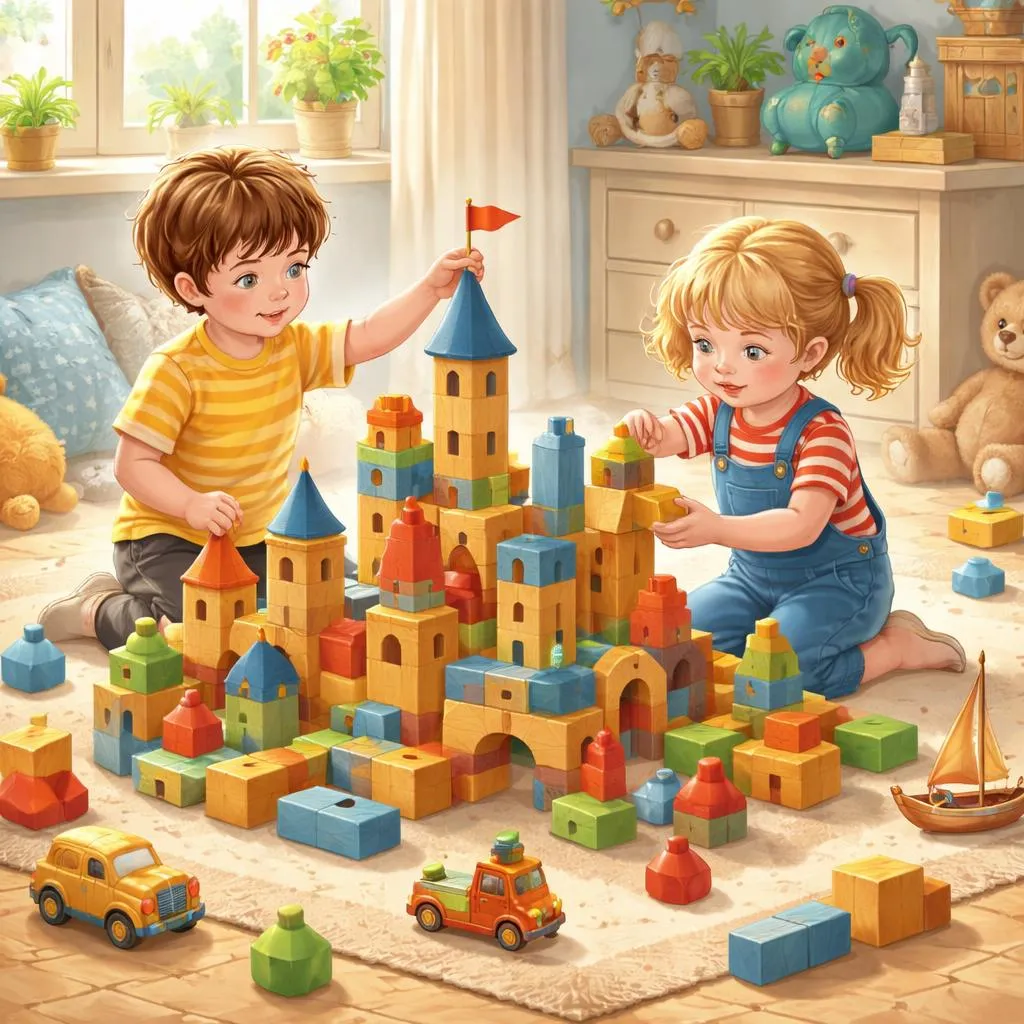

What are you able to build with your blocks? Castles and palaces, temples and docks. Rain may keep raining, and others go roam, But I can be happy and building at home. Let the sofa be mountains, the carpet be sea, There I’ll establish a city for me: A kirk and a mill and a palace beside, And a harbour as well where my vessels may ride. Great is the palace with pillar and wall, A sort of a tower on the top of it all, And steps coming down in an orderly way To where my toy vessels lie safe in the bay. This one is sailing and that one is moored: Hark to the song of the sailors aboard! And see, on the steps of my palace, the kings Coming and going with presents and things! Now I have done with it, down let it go! All in a moment the town is laid low. Block upon block lying scattered and free, What is there left of my town by the sea? Yet as I saw it, I see it again, The kirk and the palace, the ships and the men, And as long as I live and where’er I may be, I’ll always remember my town by the sea.
Story Background and Author Introduction
This charming poem, often enjoyed by children, celebrates the imaginative play and creativity that building blocks inspire. It invites young readers to explore how simple toys can transform into magnificent castles, bustling harbors, and entire cities within the mind’s eye. The poem captures the joy of creation and the magic of play, even when the outside world is gloomy or restrictive.
The author of this piece is an anonymous poet who beautifully captures the universal childhood experience of building and imagining. The poem’s timeless quality has allowed it to be shared and loved across generations, reminding us of the power of imagination and the simple pleasures of play.
Detailed Interpretation and Meaning
At its heart, this poem is about creativity, imagination, and the joy of building something with one’s own hands. The blocks symbolize the building blocks of dreams and ideas. The child in the poem uses everyday objects—the sofa, the carpet—to create an entire world, showing how imagination can transform the ordinary into the extraordinary.
The poem also touches on themes of resilience and contentment. Even when the weather is bad and others go outside to explore, the child finds happiness indoors, building and creating. This shows that joy and adventure can be found anywhere, especially through creativity.
The final lines remind us that even when the physical creation is gone—when the blocks are scattered—the memory and the experience remain vivid. This highlights the lasting impact of imaginative play and how it shapes our memories and feelings.
What Children and Students Can Learn
-
Creativity and Imagination: The poem encourages children to use their imagination to create worlds and stories. This skill is essential not only for play but also for problem-solving and innovation later in life.
-
Patience and Focus: Building with blocks requires concentration and patience. Children learn to plan, build step by step, and see a project through to completion.
-
Resilience and Adaptability: The poem shows that even if things don’t last forever (like the block city), the joy and learning remain. This teaches children to appreciate the process, not just the result.
-
Appreciation of Simple Joys: It reminds children that happiness can be found in simple activities at home, fostering gratitude and contentment.
Applying the Lessons in Daily Life
-
In Learning: Students can use imagination to enhance their studies, such as visualizing stories in reading or imagining scientific concepts. Creative thinking helps in writing, art, and even math problem-solving.
-
In Social Situations: Sharing building blocks or creative play with friends teaches cooperation, communication, and teamwork. Children learn to express ideas and listen to others.
-
In Personal Growth: Encouraging children to build and create helps develop fine motor skills and confidence. It also nurtures a mindset that values creativity and perseverance.
Cultivating Positive Spirit and Behavior
-
Encourage Play and Exploration: Adults can provide children with opportunities and materials for creative play, such as blocks, art supplies, or storytelling sessions.
-
Celebrate Effort Over Outcome: Praise children for their creativity and effort rather than just the finished product, helping them develop a growth mindset.
-
Model Imaginative Thinking: Teachers and parents can join in play, ask open-ended questions, and share their own imaginative ideas to inspire children.
-
Teach Reflection: After play, encourage children to talk about what they built and what they imagined. This helps deepen understanding and verbal skills.
By embracing the spirit of this poem, children and students can grow into imaginative, resilient, and joyful individuals who find wonder in everyday moments and challenges.