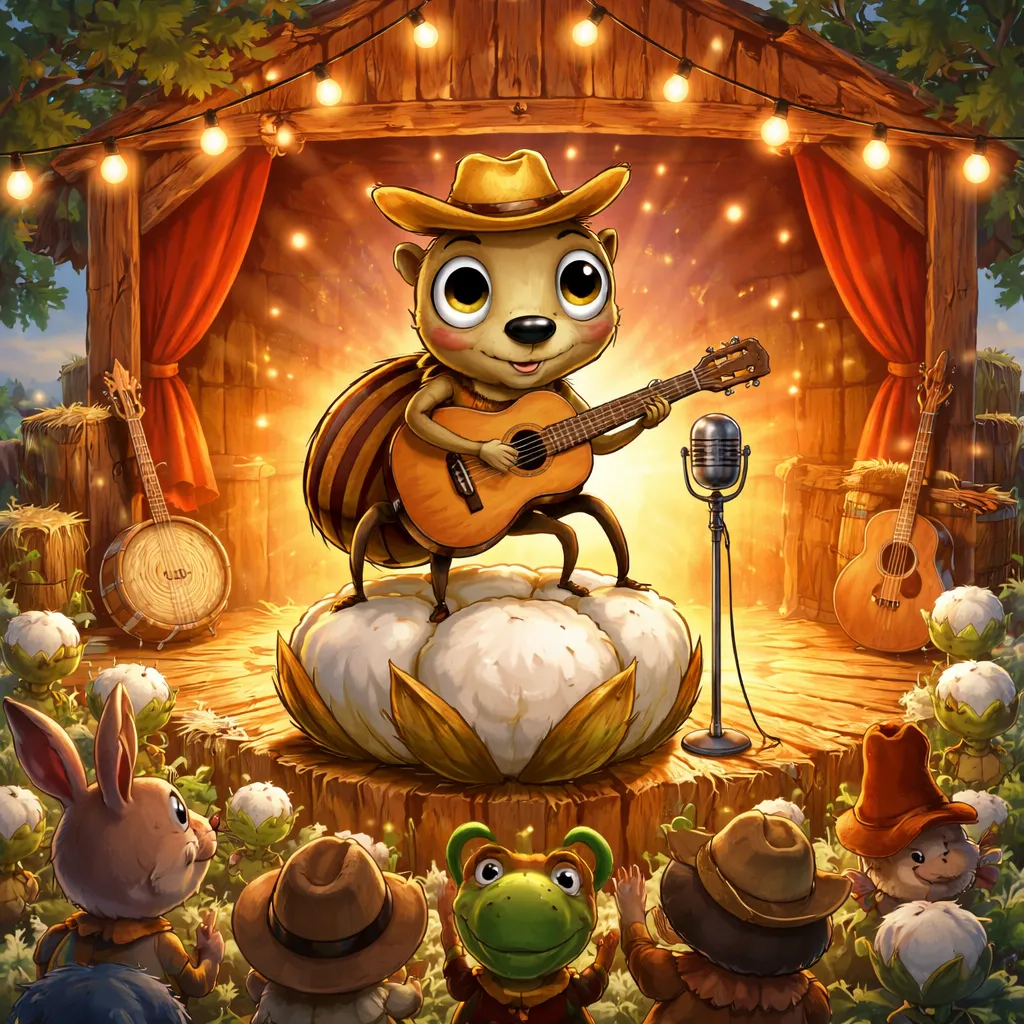

Imagine a farmer works all year to grow a field of soft, white cotton. He cares for the plants every day. Then, a tiny visitor arrives—a little beetle no bigger than a pea. But this tiny bug changes everything for the farmer, his family, and the whole land. Long ago, people told this true and surprising story in a song. The bug is the main character! Let's learn about the story-song "The Boll Weevil Song."
About the Song
Let's read a part of the talking, story-telling words of this famous folk song. There are many verses, but they all tell the same story.
Oh, the boll weevil is a little black bug,
Come from Mexico, they say,
Come all the way to Texas,
Just a-lookin' for a place to stay.
Just a-lookin' for a home, just a-lookin' for a home.
The farmer said to the boll weevil,
"What you think of that?"
"Your little family's gonna starve to death
'Cause you ate up all my hat!"
Just a-lookin' for a home, just a-lookin' for a home.
Oh, the farmer took the boll weevil,
And he put him in hot sand.
The boll weevil said, "This is mighty fine,
It's just like my home land."
Just a-lookin' for a home, just a-lookin' for a home.
This song is a traditional American folk song that tells a true history. It comes from the southern United States in the early 1900s. The song is a ballad, which means it tells a story through its verses. The boll weevil is a real insect that traveled from Mexico and destroyed millions of cotton plants. Farmers were very worried. The song makes the boll weevil a clever, talking character who is just "lookin' for a home." The farmer tries to stop the bug, but the boll weevil always has a clever answer. The song mixes a sad true event with funny, clever words, showing how people use music to tell stories about hard times.
What the Song is About
The song paints a picture of a tiny bug's big journey. The boll weevil is a little black bug. It travels from Mexico all the way to Texas. It is looking for a place to live. It finds a home in the farmer's cotton field. The boll weevil eats the cotton buds, which are called "bolls."
The farmer is upset. He talks to the bug! He says, "Your family will starve because you ate my hat!" This is a funny way to say the bug ate the cotton he needed. The farmer tries to get rid of the boll weevil. He puts it in hot sand. But the clever boll weevil says it likes the hot sand—it feels like home! The song shows the boll weevil as a smart, tough bug that the farmer cannot beat. The story is about a big problem caused by a very small creature.
Who Made It & Its Story
"The Boll Weevil Song" is a traditional folk song, so its original author is unknown. It was created by African American farmers and sharecroppers in the American South in the early 20th century. The boll weevil insect arrived around 1892 and ruined cotton crops for decades. This was a huge economic disaster. The song was a way for people to talk about this difficult event. By making the bug a clever character, the song found humor and a strange kind of respect for the tiny pest that changed their world. Famous musicians like Lead Belly helped make the song popular. It is an important piece of history told through music.
This story-song is remembered for three important reasons. First, it is a brilliant example of personification, giving a tiny bug a big personality and a voice, which makes the history unforgettable. Second, it tells a true and important story about farming, nature, and change in a way that is easy to remember and share. Third, it shows incredible resilience and humor—even when facing a disaster, people made a clever, catchy song to help them through it.
When to Sing It
This song is perfect for times when you are learning a true story. You can sing it when you see a bug in the garden and wonder about its life. You can chant its verses on a car trip, telling the story like a musical tale. You can also sing it in a classroom when learning about how a small change in nature can affect many people, using the music to remember the facts.
What Children Can Learn
This historical, story-telling song is full of lessons about nature, history, and language.
Vocabulary
The song teaches us specific words about farming and nature. A "boll weevil" is a small beetle that eats cotton plants. "Cotton" is a plant grown for its soft, white fibers used to make cloth. A "farmer" is a person who grows crops or raises animals. To "starve" means to suffer or die from not having enough food. A "home" is the place where someone or something lives. "Mighty fine" is an old-fashioned way of saying "very good."
Let's use these words! You can say, "The farmer grows corn and cotton." Or, "The rabbit was looking for a safe home." New word: Pest. This is an insect or animal that damages plants or food. The boll weevil is an agricultural pest.
Language Skills
This song is a wonderful lesson in using the present tense to tell a story and direct speech for conversation. The song starts in the present tense to introduce the character: "The boll weevil is a little black bug." It then uses the past tense for the action: "Come from Mexico," "The farmer said."
The best part is the direct speech. The farmer and the bug talk to each other like characters in a play. The farmer said, "What you think of that?" The boll weevil said, "This is mighty fine." Using quotation marks or saying "said" shows us exactly what the characters spoke. The repeated line, "Just a-lookin' for a home," acts like a chorus that everyone can sing together.
Sounds & Rhythm Fun
Listen to the talking, storytelling rhythm of the melody. The song is not too fast; it has the pace of someone telling a good tale. The rhythm is steady and walking. The most fun part is the repeating chorus line: "Just a-lookin' for a home." It comes back again and again, making the song easy to learn. The lyrics have a simple, conversational rhyme: "say" and "stay," "that" and "hat," "sand" and "land."
The rhythm feels like walking and talking. Try a steady, even clap: OH, the BOLL WEEVIL IS a LIT-tle BLACK BUG. The melody is simple and focuses on the words, perfect for telling a story. This repetitive, narrative, and slightly bluesy musical pattern helped people remember and share this important history. You can write a story-song about an animal! Use the same talking rhythm. Try: "Oh, the squirrel is a clever little thing, climbing up the tree so tall, storing all the nuts in fall, just a-lookin' for a meal, just a-lookin' for a meal."
Culture & Big Ideas
"The Boll Weevil Song" is a vital piece of American agricultural and folk music history. It comes from the southern United States, where cotton was the most important crop for many people. The boll weevil's arrival was a disaster that forced farmers to grow other crops like peanuts, which actually helped the soil and the economy in the long run. The song connects to the tradition of "talking blues" and story-songs, where people sang about news and their lives. It is a historical record that teaches about ecology, economics, and how communities use art to cope with big problems.
The song conveys three big ideas. First, it's about how a tiny part of nature can create huge change. A bug smaller than a peanut changed farms, jobs, and history. Second, it expresses coping with difficulty through humor and storytelling. Instead of just being sad, people made a clever song, showing great strength. Third, it highlights adaptation and resilience. The boll weevil adapted to find a new home, and the farmers eventually had to adapt by changing what they grew. The song is about survival.
Values & Imagination
Imagine you are the boll weevil. You are a tiny beetle on a huge journey. What do you see as you travel? How does the cotton field look to you—a giant, fluffy city? Now, imagine you are the farmer. You see your hard work being eaten. How do you feel? Draw a picture of the conversation. On one side, draw a giant, worried farmer looking down. On the other, draw a tiny, smiling boll weevil looking up. Draw a speech bubble between them with their funny words. This shows the song's special conversation.
The song encourages us to see events from different points of view, to understand how small things can have big effects, and to find creative ways to talk about problems. A lovely idea is to have a "Two-Side Story" activity. With your family, think of a small problem (like ants at a picnic). One person tells the story from the human's point of view. Another person tells the exact same story from the ant's point of view, just like the song does! This builds empathy and storytelling skills.
So, as the last "lookin' for a home" fades, think about the big history in this small bug's song. It is a vocabulary lesson in farming and nature. It is a grammar lesson in storytelling and direct speech. It is a music lesson in a narrative, talking rhythm. From the bug's journey to the farmer's funny threats, it wraps lessons in cause and effect, resilience, and the power of story in a tune that makes history memorable. "The Boll Weevil Song" teaches us that history can be sung, that tiny things matter, and that even big problems can inspire clever, lasting art.
Your Core Takeaways
You are now an expert on "The Boll Weevil Song." You know it is an American folk ballad about the real insect that damaged cotton crops. You've learned words like "boll weevil" and "farmer," and you've practiced using direct speech and the present tense for stories. You've felt its steady, storytelling rhythm and created your own animal verse. You've also discovered the song's roots in agricultural history and its messages about small causes and big effects, using humor in hard times, and the need to adapt.
Your Practice Missions
First, be a "Bug Detective." With a grown-up's help, look at a picture of a real boll weevil. Learn one cool fact about it (like how long it lived or what it ate). Then, draw or describe the boll weevil as a clever character from the song, giving it a speech bubble with a funny line. This connects the science to the story.
Second, create a "Two-Sided Comic." The song shows both the farmer's and the bug's side. Fold a paper in half. On one side, draw the farmer's view of the field with bugs causing trouble. On the other side, draw the boll weevil's view of the field as a wonderful new home. Add captions. This activity helps you see one event from two different perspectives, just like the song does.