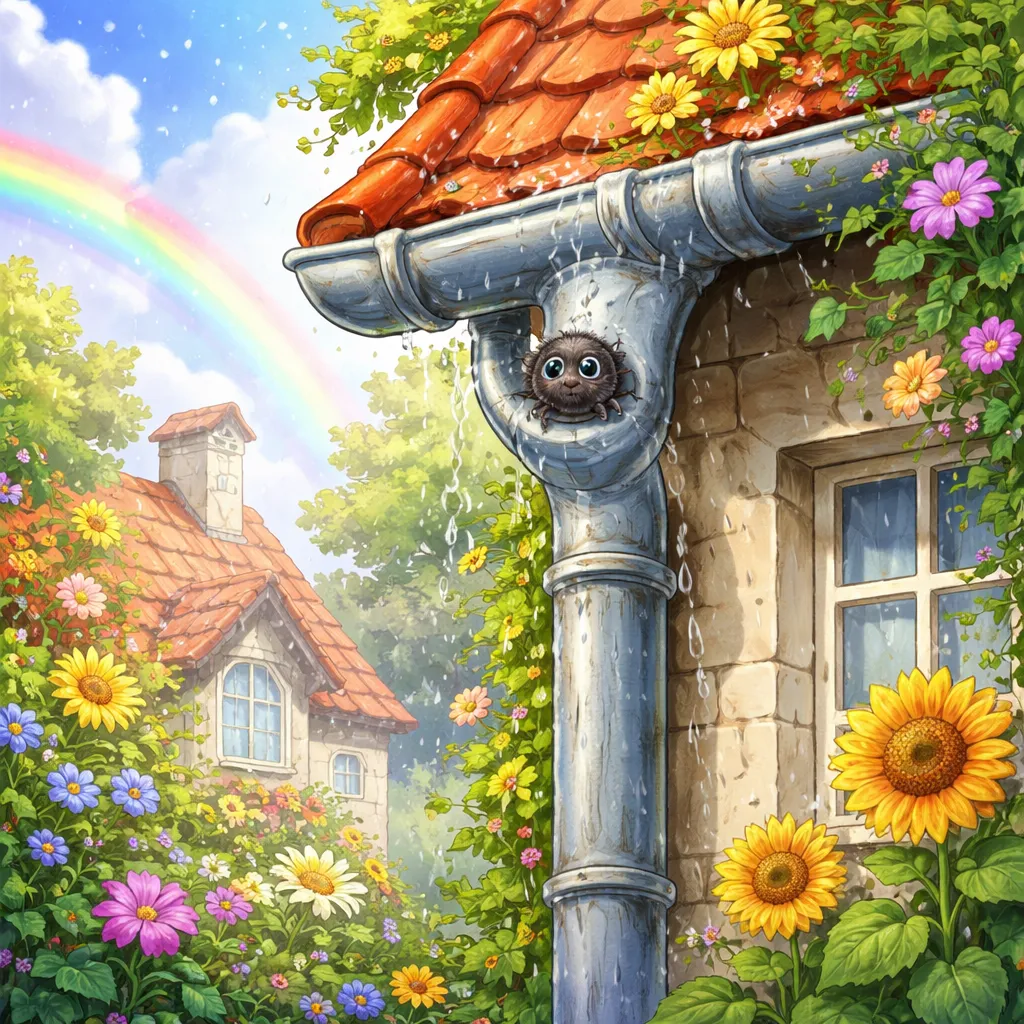

Have you ever watched a tiny spider? It moves so carefully, climbing up and down its silky thread. What happens when a big rain comes? There is a beautiful French song that tells the story of a little spider’s big adventure. It is a song about trying, facing trouble, and trying again. Let’s follow the journey and learn the hopeful song “Itsy Bitsy Spider (La petite araignée).”
About the Song
Here are the gentle, storytelling lyrics of the classic French version:
La petite araignée
Montait, montait, montait.
(The little spider
Climbed up, climbed up, climbed up.)
Vint la pluie
Qui l’a chassée.
(Came the rain
Which chased it away.)
Puis vint le soleil
Qui a tout séché.
(Then came the sun
Which dried everything.)
Et la petite araignée
Remontait, remontait, remontait.
(And the little spider
Climbed up again, climbed up again, climbed up again.)
English Translation:
The little spider
Climbed up, climbed up, climbed up.
Came the rain
Which chased it away.
Then came the sun
Which dried everything.
And the little spider
Climbed up again, climbed up again, climbed up again.
This is the lovely French-language version of the beloved fingerplay song. The song tells a simple but powerful story about a determined little creature. “La petite araignée montait, montait, montait,” it begins. The spider is climbing up, perhaps a water spout or a wall. But then, “Vint la pluie qui l’a chassée.” The rain comes and washes the spider all the way down. Do not worry! “Puis vint le soleil qui a tout séché.” The kind sun comes out and dries up all the rain. Finally, “Et la petite araignée remontait, remontait, remontait.” The brave little spider climbs right back up to try again.
What the Song is About
The song is a mini-story about never giving up. Picture a tiny, brave spider. It is climbing up a shiny rain gutter on the side of a house. Up, up, up it goes with its eight little legs. The sky is blue. But then, a dark cloud appears. Drip, drop, splash! A shower of rain falls down. The raindrops hit the spider and wash it all the way down to the ground. The spider waits. The rain stops. A warm, bright sun peeks out from behind the cloud. The sun’s gentle heat dries the wet wall and the little spider. The spider shakes itself off. It looks up. Then, it starts to climb again. Up, up, up it goes once more, ready for whatever comes next.
Who Made It & Its Story
“La petite araignée” is the traditional French adaptation of the popular American fingerplay song. Its specific creator is unknown. It is a classic in French nursery rhymes (“comptines”), cherished for its combination of simple melody, engaging hand movements, and a gentle, uplifting message. The song fits perfectly with the French appreciation for stories from nature that carry a small lesson (“une petite leçon”).
This gentle, cyclical song is loved for three beautiful reasons. First, it tells a complete, easy-to-follow story with a clear sequence (climb-rain-sun-climb again) that teaches about cause and effect and resilience in nature. Second, it pairs perfectly with delicate hand motions that act out the story (fingers climbing, rain falling, sun shining, climbing again), making it a wonderful exercise for fine motor skills and imagination. Third, it delivers a powerful, positive message about perseverance, hope, and the natural cycle of challenges (rain) and relief (sun) in a way that is comforting and encouraging for children.
When to Sing It
This song is perfect for quiet, thoughtful moments or after a small challenge. You can sing it softly with a caregiver after a little setback, like when a tower of blocks falls down, to remember it is okay to try again. You can sing it while doing the fingerplay together on a cozy carpet, watching your hands tell the spider’s story. You can also sing it on a rainy day by the window, watching real raindrops and imagining the little spider’s adventure outside.
What Children Can Learn
This story-song is a wonderful teacher of nature vocabulary, action verbs, and the concept of telling a story in a sequence using words like “puis” (then) and “et” (and).
Vocabulary
The song teaches us clear French words for nature, actions, and the story. “The” (La). “Little” (petite). “Spider” (araignée). “Climbed (was climbing)” (montait). “Came” (Vint). “The rain” (la pluie). “Which” (qui). “It/her” (l’). “Has chased” (a chassée). “Then” (Puis). “The sun” (le soleil). “Has dried” (a séché). “Everything” (tout). “And” (Et). “Climbed again (was climbing again)” (remontait).
Let’s use these words! You can describe the weather: “La pluie vient.” (The rain is coming.) “Le soleil sèche l’herbe.” (The sun dries the grass.) New word: Le nuage. This means “the cloud.” You can add it to the story: “Vint le nuage, puis vint la pluie.” (Came the cloud, then came the rain.)
Language Skills
This song is excellent for learning about telling a story in the past, using different past tense verbs to show a sequence of events, as in “Montait… Vint la pluie… Puis vint le soleil… Remontait.”
Concept Definition: We are learning about words that tell us about actions that already happened. These are called past tense verbs. The song uses a special French past tense called the “imparfait” for ongoing actions (“montait” – was climbing) and the “passé composé” for completed actions (“est venue”/came, “a séché”/dried). Together, they paint a picture: the spider was climbing (ongoing action), then the rain came (completed event), then the sun dried everything (completed event), and then the spider was climbing again (new ongoing action).
Features and Types: In the song, we see two main ways to talk about the past. First, actions that were happening or used to happen. We see this with “montait” and “remontait.” It is like painting the background scene. Second, actions that happened once and are finished. We see this with “Vint la pluie” (The rain came) and “Puis vint le soleil” (Then came the sun). These are the main events that change the story. The word “Puis” (Then) helps us move from one past event to the next.
How to Spot Them: Here is the “Storytime Signal” trick. Listen for verbs that end with “-ait” like “montait.” This often signals an action that was going on in the past. Also, listen for short, complete action words like “Vint” (Came) or phrases with “a” + a verb, like “a chassée” (chased away) or “a séché” (dried). These tell us a specific event happened. Words like “Puis” (Then) tell you the order.
How to Use Them: A great way to tell a simple past story is the “Story Sequence Formula”. The pattern is: “[Ongoing action in the past…] + [Suddenly, a completed event…] + [Then, another event…] + [And the action continued/started again…].”
Example from the song: “La petite araignée montait… Vint la pluie… Puis vint le soleil… Et la petite araignée remontait.”
Example you can make: “L’oiseau volait… Soudain, il a vu un chat… Puis, il est parti vite! Et il a chanté.” (The bird was flying… Suddenly, it saw a cat… Then, it left quickly! And it sang.)
Sounds & Rhythm Fun
Listen to the climbing, flowing rhythm of the melody. The tune for “La petite araignée montait, montait, montait” rises gently, just like a spider climbing. The repetition of “montait, montait, montait” and “remontait, remontait, remontait” sounds like taking many small steps upward.
The song has a beautiful, poetic sound. Words like “araignée” and “montait” have a soft, gentle feel. The lines “Vint la pluie / Qui l’a chassée” flow quickly, like falling rain. The “-ée” sound in “araignée,” “chassée,” and “séché” creates a lovely rhyme. The melody is simple and memorable, rising for the climbing, falling for the rain, and rising again with hope at the end. This musical pattern is perfect for creating your own mini-story songs. Try a seed’s story: “La petite graine poussait, poussait, poussait. Vint le vent qui l’a secouée. Puis vint la pluie qui l’a arrosée. Et la petite graine grandissait…” (The little seed grew, grew, grew. Came the wind which shook it. Then came the rain which watered it. And the little seed grew bigger…)
Culture & Big Ideas
“La petite araignée” connects to the French love for observing and telling stories about the small wonders of nature. In France, spiders are often seen more as clever weavers than as scary creatures. The song reflects a gentle curiosity about the natural world and the small dramas that happen in a garden or on a house wall after the rain.
The song conveys three gentle but powerful ideas. First, it is a story about perseverance and resilience—the little spider does not give up when washed down by the rain; it waits for the sun and tries again, teaching us about patience and effort. Second, it illustrates a simple cause-and-effect sequence and the cycle of nature: rain falls, the sun shines and dries, life continues. Third, it encourages empathy and care for even the smallest creatures, showing that a tiny spider’s adventure is worthy of a song and that challenges (like the rain) are a normal part of life that can be overcome.
Values & Imagination
Imagine you are very, very small, sitting on a leaf. You watch a little spider begin its journey up a tall, shiny pipe. Its legs move in a careful rhythm. “La petite araignée montait, montait, montait,” you whisper. The climb looks long and hard.
Suddenly, you feel a drop. Then another. A rain shower starts! The drops are like big, wet balls to the spider. “Vint la pluie qui l’a chassée.” The spider holds on tight, but the water stream carries it all the way down to a soft patch of moss. It waits there. The rain stops. A warm light touches your leaf. “Puis vint le soleil qui a tout séché.” The spider’s tiny body dries. It looks up at the pipe. “Et la petite araignée remontait, remontait, remontait.” It starts climbing again, even more determined. How does the spider feel? Tired? Brave? Hopeful? Draw the spider’s adventure. Draw four small boxes like a comic strip. In the first, draw a spider going up a pipe. In the second, draw rain falling. In the third, draw a bright sun. In the fourth, draw the spider climbing again. This shows the song’s story sequence.
The song encourages us to be brave and persistent like the little spider, to understand that setbacks (like the rain) are temporary, and to notice and care for the small, determined creatures in nature around us. A wonderful activity is the “Histoire d’un Animal” (An Animal’s Story) game. Choose a small animal like an ant, a ladybug, or a snail. Imagine a tiny challenge it faces (a big leaf, a puddle, a big step). Tell or sing a very short story about it using the song’s pattern: “La petite fourmi marchait, marchait, marchait…” (The little ant walked and walked…). This connects you to the song’s core spirit of empathetic storytelling.
So, from the first climb to the last, this song is a tiny epic of bravery. It is a vocabulary lesson in nature and simple past actions. It is a language lesson in telling a story sequence. It is a music lesson in a gentle, rising and falling melody that paints a picture. “Itsy Bitsy Spider (La petite araignée)” teaches us about perseverance, natural cycles, and kindness towards all creatures.
Your Core Takeaways
You are now an expert on the song “Itsy Bitsy Spider (La petite araignée).” You know it is a gentle French story-song about a little spider who climbs up, gets washed down by the rain, waits for the sun to dry everything, and bravely climbs up again. You’ve learned French words like “araignée,” “montait,” “pluie,” “soleil,” “séché,” and “remontait,” and you’ve practiced telling a simple past story using sequence words like “puis” (then). You’ve felt its climbing, flowing rhythm perfect for fingerplay and created your own nature story verse. You’ve also discovered the song’s message about never giving up, understanding nature’s cycles, and caring for small creatures.
Your Practice Missions
First, play the “Puis…” (Then…) story game. Tell a very short story about your day using the “Story Sequence Formula.” Use “D’abord,” (First) “Puis,” (Then) and “Et puis,” (And then). For example: “D’abord, j’ai mangé mon petit-déjeuner. Puis, je suis allé à l’école. Et puis, j’ai joué avec mon ami.” (First, I ate my breakfast. Then, I went to school. And then, I played with my friend.) This mission helps you practice the song’s key language skill of sequencing events.
Second, be a “Petit Observateur” (Little Observer). The next time it rains and then the sun comes out, go to a window or outside. Look very carefully on a plant, a wall, or the ground. Can you see any small insects or spiders? What are they doing after the rain? Sing “La petite araignée” quietly and imagine their tiny adventures. This mission connects you to the song’s core theme of observing and empathizing with nature’s small wonders.