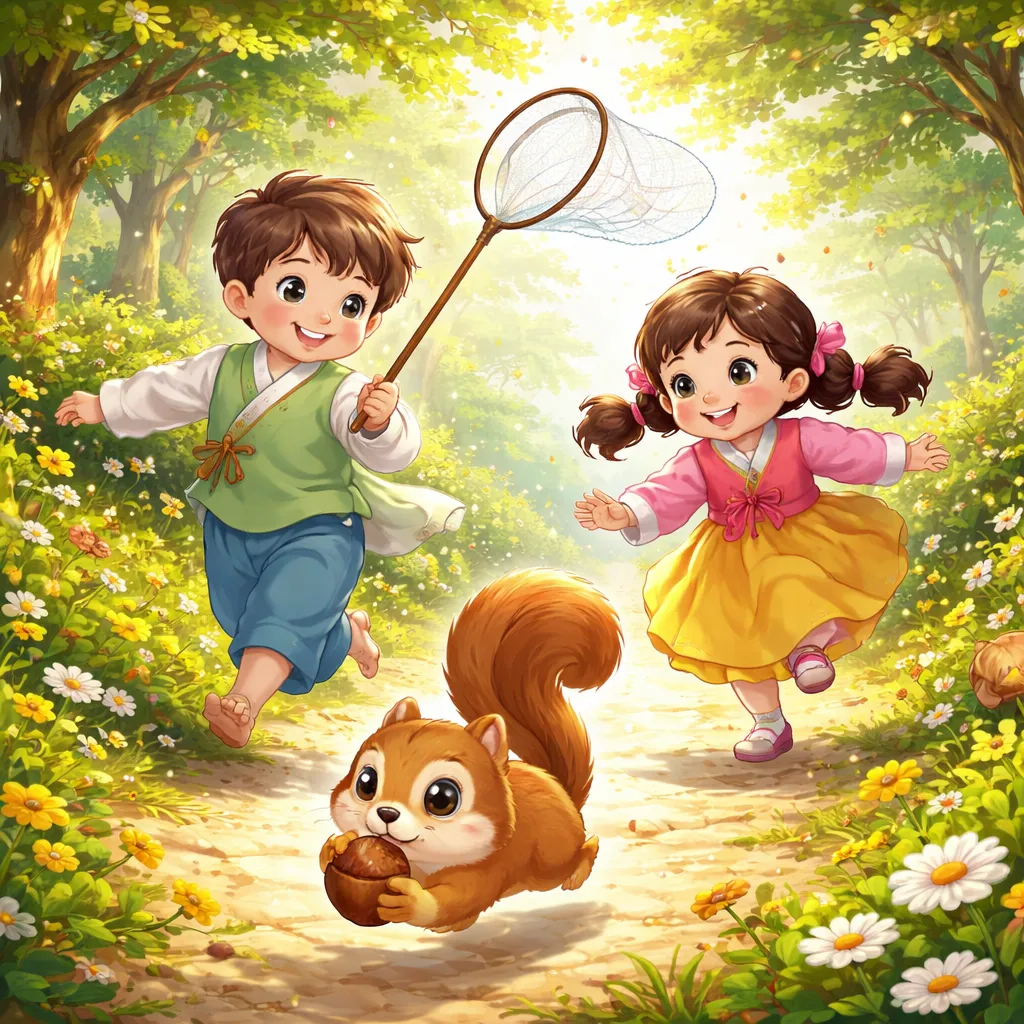

Have you ever played a game of tag in a park, darting between trees as fast as you can? Have you watched a small, furry animal with a bushy tail zip up a tree trunk in a flash? That’s a squirrel, a champion of quick moves and clever planning! In Korea, a country with beautiful, green mountains, there is a famous, fast-paced song about this clever creature. Let’s scurry along with the Korean Song: The Little Squirrel (다람쥐).
About the Song
Here are the classic, energetic lyrics of this beloved song in Korean and English:
다람쥐 다람쥐 한 다람쥐
(Daram-jwi daram-jwi han daram-jwi)
Squirrel, squirrel, a squirrel
숲속으로 쏜살같이
(Sup-so-geu-ro sson-sal-ga-chi)
Into the forest like an arrow
도토리 주워 여물洞里
(Do-to-ri ju-wo yeo-mul dong-ni)
Gathering acorns, into the hollow
겨울나게 숨겨두지
(Gyeo-ul-na-ge sum-gyeo-du-ji)
Hiding them to spend the winter
This song’s original Korean name is “다람쥐” (Daramjwi), which means “squirrel.” It is a very popular and traditional Korean children’s song. The song describes the busy, important work of a squirrel. The music is often quick, light, and full of playful energy, mimicking the squirrel’s speedy movements. The Korean Song: The Little Squirrel (다람쥐) is a musical story about hard work, clever preparation, and the quick dash of a little animal in the woods.
What the Song is About
The song is a snapshot of a squirrel’s important job. First, we call out to it: “Squirrel, squirrel, a squirrel.” We see its incredible speed: “Into the forest like an arrow.” The squirrel runs so fast it looks like a blur. What is it doing? It is busy working: “Gathering acorns, into the hollow.” We picture the squirrel finding nuts, holding them in its mouth, and zipping to its tree. Why? For a very smart reason: “Hiding them to spend the winter.” The squirrel knows the cold season is coming when food will be hard to find, so it works hard now to prepare. The whole song is about foresight, hard work, and moving with a purpose.
Who Made It & Its Story
This song is a traditional Korean folk song, beloved for generations. The original creator is unknown, as it comes from the shared culture of children learning about nature. Squirrels are common in Korea’s many mountains and forests, like the famous Seoraksan (Seorak Mountain). The Korean Song: The Little Squirrel (다람쥐) reflects the Korean appreciation for nature’s cycles and the wisdom of animals. It is adored for three clever reasons. First, it is incredibly fun and active to sing, with a fast pace that makes you want to move. Second, it teaches a simple but important lesson about planning ahead and working hard, just like the squirrel. Third, its melody is catchy, repetitive, and easy to learn, making the lesson easy to remember.
When to Sing It
You can sing this song while playing a fast game of tag, pretending to be squirrels darting around. It’s perfect to chant during a walk in the woods or a park, keeping an eye out for real squirrels. You could also sing it in the fall, while helping to gather leaves or toys, pretending you are storing up for a cozy “winter” indoors.
The Korean Song: The Little Squirrel (다람쥐) shows us a lesson from nature. But to be as clever as the squirrel, we need to learn too. This song is our acorn of knowledge. It teaches us new words, how to describe speed and purpose, and a bit about Korea’s natural beauty. Let’s gather these ideas.
What Children Can Learn
Vocabulary
This song helps us learn words for nature, action, and planning.
Forage: To search widely for food or provisions. The squirrel forages for acorns.
Cache: A hidden store of things. The squirrel makes a cache of nuts for winter.
Agile: Able to move quickly and easily. A squirrel is very agile.
Hibernate: To spend the winter in a dormant state. Some animals hibernate, but squirrels store food instead.
Foresight: The ability to predict or plan for the future. The squirrel shows foresight by preparing for winter.
Habitat: The natural home of an animal. The forest is the squirrel’s habitat.
Language Skills
This song is a great example of using the Present Continuous Tense for actions happening now. We use this tense to describe actions that are in progress at the moment we are speaking about them.
What Is It?: Think of the Present Continuous as the “Right Now” tense. It shows ongoing action. The squirrel is gathering nuts right now in the song.
Finding the Secret: Look for the verb “to be” (am, is, are) plus a main verb ending in “-ing.” Ask: “Is this action happening right this minute in the scene?”
Using It:
◦   Formula: [Subject] + is/am/are + [verb-ing].

◦   Examples: “The squirrel is running. I am singing. We are learning.”

◦   In the song’s spirit: “The squirrel is gathering acorns. It is hiding them.” These are actions happening right now in the story.
Sounds & Rhythm Fun
Listen to the quick, scurrying rhythm! The Korean Song: The Little Squirrel (다람쥐) has a very fast, light, and bouncy beat. It might sound like the pit-a-pat of tiny feet running on tree branches. The melody is playful and jumps around, just like a squirrel. This quick, energetic rhythm makes the song exciting to sing and helps you remember the lesson about speed and preparation. You can use this same quick, jumpy rhythm to make up a song about any fast-moving animal or action.
Culture & Big Ideas
This song connects to the appreciation of nature and the changing seasons in Korea. A time of harvest and preparation is during Chuseok (Korean Thanksgiving), when families gather food and give thanks. The song reflects the value of being prepared. The Korean Song: The Little Squirrel (다람쥐) teaches three important ideas. First, Prepare for the Future: Working hard today makes tomorrow easier and safer. This is a lesson in responsibility. Second, Move with Purpose: The squirrel isn’t just running; it’s running with a clear, important goal. Third, Wisdom of Nature: Animals can teach us valuable lessons about how to live if we observe them carefully.
Values & Imagination
Imagine you are the little squirrel. How do you decide which acorn is the best? Where is your favorite hiding spot? How do you remember where you put all your food? This song teaches you the value of thinking ahead and being responsible. It shows that even small, steady efforts can lead to big security later. A simple idea: Choose one small task you sometimes forget to do, like putting your shoes away. For one week, be like the squirrel and “gather” your shoes right after you take them off. See how it makes your space ready for the next day. You are preparing your own “nest.”
Your Core Takeaways
The Korean Song: The Little Squirrel (다람쥐) is a quick, clever lesson in preparation, hard work, and nature’s wisdom. You learned words like “forage,” “cache,” and “agile.” You discovered how to use the Present Continuous tense to describe ongoing actions. You moved to the song’s fast, scurrying rhythm. You also connected the squirrel’s work to Korean values of preparation seen in holidays like Chuseok. Most importantly, the song teaches that it’s smart to plan ahead, that hard work has a purpose, and that we can learn amazing things by watching the animals around us.
Your Practice Missions
- Be a “Right Now” Squirrel. For two minutes, move quickly and quietly around a room, pretending to “gather” small, safe objects (like pillows or soft toys) and take them to a “hollow” (a corner or a basket). As you do it, say what you are doing: “I am picking up this pillow. I am carrying it to my nest.” This practices action words and the Present Continuous tense.
- Create a “Winter Preparation” Plan. Think of one thing you’d like to be ready for. It could be a school project, a game, or a clean room. Draw a squirrel in the center of a paper. Around it, draw or write three small “acorns” (steps) you can do now to prepare. For example, for a clean room: 1. Put away five toys. 2. Make my bed. 3. Organize my books. This turns the squirrel’s lesson into your own plan.