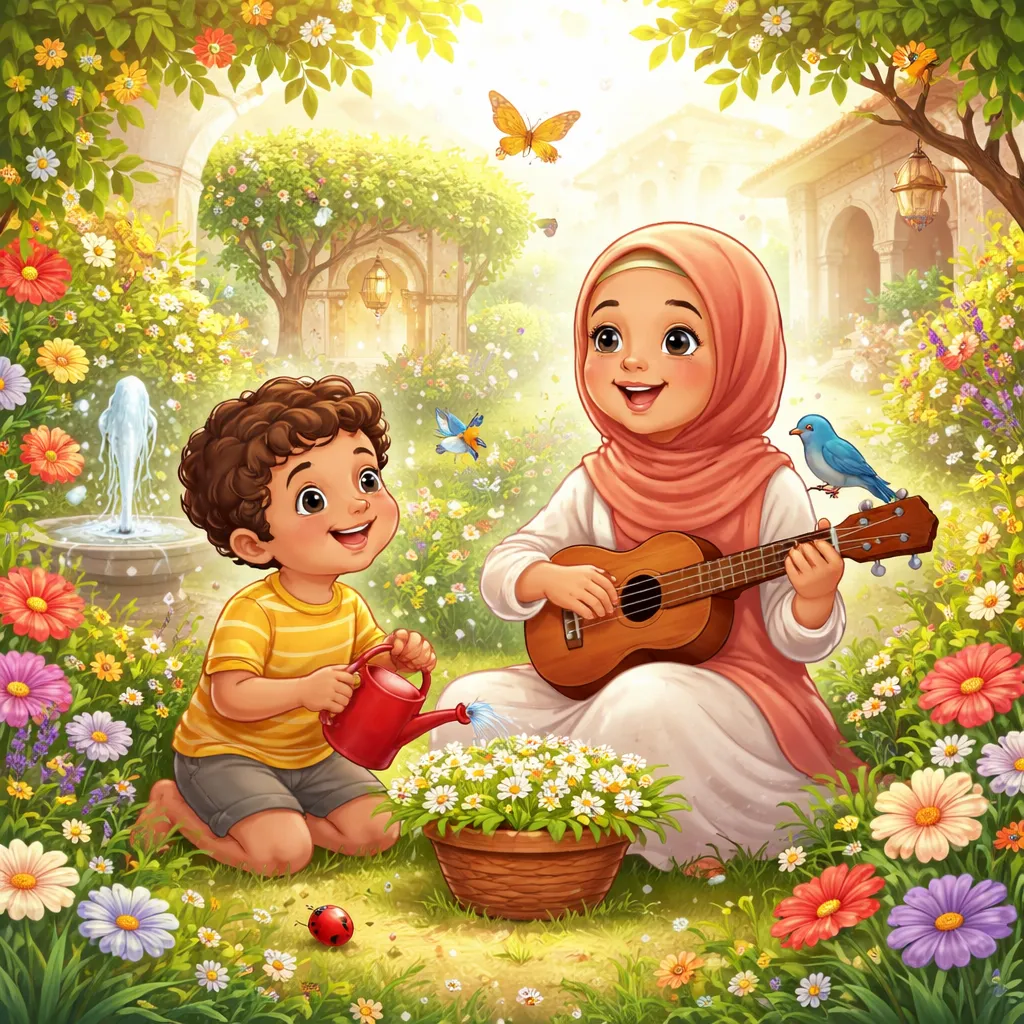

Have you ever planted a tiny seed in a pot? You water it, give it sun, and wait. One day, a small green leaf pushes through the soil. It makes you so happy! A small garden, even with just one plant, is a magical place. There is a sweet, simple song that celebrates just that—the happiness of a little green space. Let’s explore the gentle Arabic song “The Little Garden (الحديقة الصغيرة).”
About the Song
Here is the lovely and simple Arabic verse of this classic children’s song:
الحديقة الصغيرة، فيها زهور جميلة
والعصافير تغرد، في الصباح الباكر
ألعب فيها سعيدة، مع أصدقائي الصغار
الحديقة الصغيرة، مكاني المفضل
English Translation:
The little garden, in it are beautiful flowers
And the birds chirp, in the early morning
I play in it happily, with my little friends
The little garden, my favorite place
This is a beloved traditional Arabic children’s song, shared across many Arab countries. While its specific original composer is not widely known, it is a staple in kindergartens, schools, and homes. The song is sung from a child’s point of view, describing their favorite little garden. It is a song about noticing and loving the small, beautiful things in nature right around you—the flowers, the birdsong, the joy of playing with friends in a green space.
What the Song is About
The song is a happy observation. First, the child singer looks at their special place: “The little garden.” They notice what is in it: beautiful flowers. Then, they listen. They hear the sound of birds chirping early in the morning. It is quiet and peaceful.
The child then joins the scene. They go into the garden to play. They are “happy.” They are not alone; they play “with my little friends.” The song starts and ends by naming this place, calling it “my favorite place.” The whole song is a warm, thankful look at a simple, joyful part of the child’s world.
Who Made It & Its Story
As a traditional folk song, “Al Hadeeqah Al Sagheerah” was passed down through generations. It reflects the deep value of gardens and courtyards in Arab culture, which are seen as places of beauty, family gathering, and peace. It became a classroom classic because it is easy for young children to learn and sing. It is loved for three beautiful reasons. First, its melody is very gentle, sweet, and repetitive, with a calm, swaying rhythm that feels like a peaceful walk, making it soothing and easy to remember. Second, it focuses a child’s attention on appreciating small, everyday wonders in their immediate environment, fostering a sense of gratitude and connection to nature. Third, it perfectly combines three key joys of childhood: the beauty of nature (flowers, birds), the fun of play, and the importance of friendship, all in one familiar, safe place.
When to Sing It
This song is perfect for calm, happy moments connected to nature. You can sing it softly while watering plants in your home or in a real garden, greeting each flower. You can hum it on a quiet morning walk when you hear the birds chirping, just like in the song. You can also sing it with friends when you are playing together in a park, making that spot your own “little garden.”
What Children Can Learn
This peaceful and descriptive song is a wonderful teacher for learning basic present tense verbs and simple adjectives to describe a favorite place.
Vocabulary
The song teaches us lovely words about a peaceful scene. “The garden” (الحديقة / al-ha-dee-kah). “Small / Little” (الصغيرة / as-sa-ghee-rah). “In it” (فيها / fee-ha). “Flowers” (زهور / zu-hoor). “Beautiful” (جميلة / ja-mee-lah). “And the birds” (والعصافير / wal-a-sa-feer). “Chirp / Sing” (تغرد / tu-ghar-rid). “In the morning” (في الصباح / fee as-sa-bah). “Early” (الباكر / al-ba-kir). “I play” (ألعب / al-ab). “Happy” (سعيدة / sa-ee-dah). “With my friends” (مع أصدقائي / ma’a as-dee-ka-ee). “My favorite place” (مكاني المفضل / ma-ka-nee al-mu-fad-dal).
Let’s use these words! You can describe your favorite place: “في غرفتي الصغيرة” (In my little room). Or “ألعب مع أصدقائي.” (I play with my friends.) New word: شجرة (sha-ja-rah). This means “tree.” You can say, “في الحديقة شجرة.” (In the garden there is a tree.)
Language Skills
This song beautifully introduces the present tense for describing habitual actions (“birds chirp,” “I play”) and the use of feminine and masculine adjectives to describe nouns, like “little garden.”
Concept Definition: We are learning about “every day” words (Present Tense verbs) that tell us what things usually do or what we usually do. We are also learning that in Arabic, describing words (adjectives) need to match the thing they describe, like putting on matching clothes.
Features and Types: In Arabic, verbs have different forms. For “he/it” (like “the bird”), a common present tense prefix is “ي-” (ya-). “To chirp” (يغرد / yugh-rid). For “I,” the prefix is often “أ-” (a-). “To play” (ألعب / al-ab). Adjectives must match the noun in gender. “Garden” (حديقة) is feminine, so “little” becomes “صغيرة” (sagheerah). “Place” (مكان) is masculine, so “favorite” becomes “مفضل” (mufaddal).
Example from the song: Present Tense: “العصافير تغرد” (The birds chirp). “ألعب” (I play). Matching Adjectives: “الحديقة الصغيرة” (The little garden). “مكاني المفضل” (My favorite place).
How to Spot Them: Here is the “Every Day Detective” trick. Look for words that describe what something does all the time. They often start with تـ (ta-) or يـ (ya-). Ask: “Is this telling me what usually happens?“ For matching words, look at the noun. If it often ends with “ة” (ta marbuta, like “حديقة”), it’s usually feminine. The describing word after it should sound soft. Ask: “Does the describing word sound like it ‘matches’ the thing it’s describing?“
How to Use Them: A great way to describe a scene is: “[Thing] + [Verb].“ To describe something, use: “[Thing] + [Matching Describing Word].“
Example from the song: “العصافير تغرد.” (The birds chirp.) “الحديقة الصغيرة.” (The little garden.)
Example you can make: “القطة الصغيرة تلعب.” (The little cat plays.) “الكتاب الكبير.” (The big book.)
Sounds & Rhythm Fun
The melody of “الحديقة الصغيرة” is gentle, sweet, and flows smoothly. The rhythm is calm and steady, like a slow, happy walk. It is not a jumping song, but a smiling song. The tune goes up and down gently, like a small hill.
The sounds are soft and musical. The song title itself has a beautiful sound: “Al-Ha-dee-kah As-Sa-ghee-rah.” The “ee” and “ah” sounds repeat. Listen for the “هـ” (h) sound in “الحديقة” and the “غ” (gh, a guttural sound) in “تغرد” which makes it sound like a bird’s warble. The lines are short and clear, making them easy to sing. This gentle, flowing rhythm is perfect for making your own calm verses. Try singing about your room: “الغرفة الصغيرة، فيها سرير جميل، وأقرأ فيه كتابي، بطعم العسل والعب.“ (The little room, in it is a beautiful bed, and I read my book in it, with the taste of honey and play.)
Culture & Big Ideas
In many Arab countries, homes often have a “حوش” (hosh) – a courtyard – or a “حديقة” (hadeeqah) – a garden. This is a private, cherished outdoor space for family. The song reflects this cultural love for a personal, green oasis, a place of peace away from the busy world. It connects to the importance of nature in Arab poetry and daily life.
The song conveys three gentle, important ideas. First, it teaches mindful observation and appreciation for the immediate, simple beauty in one’s own environment, encouraging children to see the “garden” in their own backyard. Second, it links personal happiness (“I play happily”) directly to community (“with my little friends”) and a loved place (“my favorite place”), showing joy as a combination of where you are and who you are with. Third, it presents a complete, peaceful world in miniature—a “little garden” that contains natural beauty (flowers, birds), human joy (play), and friendship, suggesting that you don’t need a huge park to find happiness.
Values & Imagination
Imagine you are in your own “little garden.” It might be a real garden, a balcony with pots, or even a sunny corner of your room with a plant. You are the caretaker. You see the red flower smiling at the sun. You hear a little bird on a fence singing its morning song just for you. You call your friend over. Together, you sit and pretend the grass is a jungle, the pebbles are mountains. This is your favorite place because you notice its beauty, you play in it, and you share it. Draw this place: a small, cozy garden. Draw a few big, bright flowers. Draw a bird in the sky. Draw yourself and a friend smiling. This shows the song’s heart: finding a whole world of happiness in a small, loved space.
The song encourages us to look closely at the nature around us, to take care of plants and listen to birds, and to share our favorite peaceful spots with friends. It teaches that happiness can grow in small spaces if we fill them with care and friendship. A wonderful activity is to create a “حديقتنا الصغيرة” (Our Little Garden). Plant some seeds in a pot. Each day, as you water it, sing the first line: “الحديقة الصغيرة، فيها زهور جميلة.” Watch your little garden grow, just like the joy in the song.
So, from the chirping birds to the happy play, the Arabic song “The Little Garden (الحديقة الصغيرة)” is a warm hug in the form of a song. It is a vocabulary lesson in words for nature, play, and friendship. It is a language lesson in using present tense verbs and matching adjectives. It is a music lesson in a gentle, flowing, sweet melody. It teaches us to cherish our little corners of the world, to play happily with friends, and to find our favorite place.
Your Core Takeaways
You are now an expert on the Arabic song “The Little Garden (الحديقة الصغيرة).” You know it is a gentle, traditional song about a child’s favorite little garden with flowers, birdsong, and happy play with friends. You’ve learned Arabic words like “حديقة,” “صغيرة,” “زهور,” “تغرد,” and “ألعب,” and you’ve practiced the present tense for “what happens” (يغرد) and “what I do” (ألعب), and how adjectives match their nouns. You’ve felt its calm, sweet, and steady rhythm that feels like a peaceful walk. You’ve also discovered the song’s message about loving small beautiful things, finding joy in nature and friendship, and creating your own special, happy place.
Your Practice Missions
First, be a “مستكشف الحديقة” (Garden Explorer). Find a small green space—a garden, a park corner, or even a houseplant. Look and listen carefully. Say out loud in Arabic what you see and hear, using the “[Thing] + [Verb]” pattern. Say: “الزهور جميلة. العصفور يغرد. أنا ألعب.“ (The flowers are beautiful. The sparrow chirps. I play.) This mission helps you practice the song’s grammar for describing a scene.
Second, build your “مكاني المفضل” (My Favorite Place). In your room or yard, arrange a few things to make a “little garden” corner: a plant, a toy bird, a drawing of a flower. Invite a sibling or a stuffed animal “friend.” Sit in your spot and sing the song to them. Then, tell them in simple Arabic or English: “هذا مكاني المفضل لأن…” (This is my favorite place because…). This mission lets you bring the song to life by creating and sharing your own special, happy place.