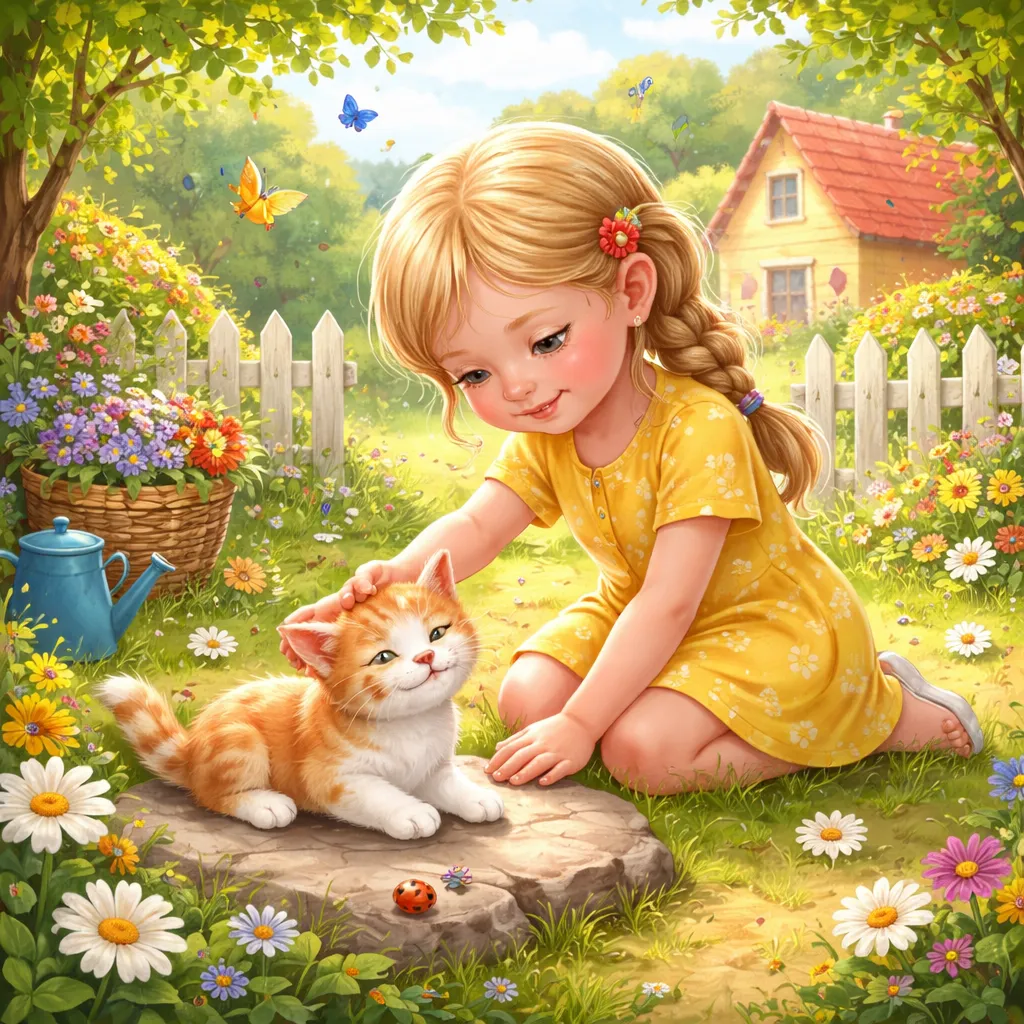

Have you ever seen a soft, furry cat and wanted to gently pat it? You move your hand slowly, wondering if the cat will stay or run away. In Germany, there is a sweet, playful song all about this very moment. It is a song of a friendly question. Let’s learn the gentle song “The Little Cat (Die kleine Katze).”
About the Song
Here are the simple, questioning lyrics of a popular traditional German children’s song, often sung as a clapping or action game:
Die kleine Katze, die kleine Katze,
die kann so schnurren, die kann so spielen.
Die kleine Katze, die kleine Katze,
darf ich dich streicheln, bitte, bitte?
English Translation:
The little cat, the little cat,
she can purr like this, she can play like this.
The little cat, the little cat,
may I pat you, please, please?
This is a beloved German-language children’s song and game from Germany. The song is a friendly conversation with a cat. “The little cat, the little cat, she can purr like this, she can play like this,” it begins, showing us what a wonderful, playful friend a cat can be. The singer is admiring the cat’s happy sounds and fun actions. Then comes a very polite and important question. “The little cat, the little cat, may I pat you, please, please?” It shows how we should always ask gently before touching an animal. The song is about admiration, playfulness, and learning about respectful kindness.
What the Song is About
The song is about asking a cat for permission to be friends. Imagine a cozy room. A small, grey cat is sitting on a rug. “The little cat, the little cat, she can purr like this, she can play like this.” The cat makes a soft, rumbling “prrrrr” sound and then bats playfully at a ball of yarn with her paw.
Someone is watching and thinks the cat is lovely. They want to be friends. They kneel down and speak softly. “The little cat, the little cat, may I pat you, please, please?” They hold out a hand gently, asking in a kind voice before they touch the cat’s soft fur. The song is about noticing how amazing animals are, and about being polite and careful when we want to interact with them. It teaches us to ask first.
Who Made It & Its Story
“Die kleine Katze” is a classic German action and game song for young children. The specific creator is unknown, as it comes from Germany’s rich tradition of interactive “Kinderlieder.” The song is a staple in German “Kindergarten” and playgroups, where it is used to teach children about pets, gentle interaction, and using polite words like “bitte” (please). It reflects the German cultural emphasis on teaching children to be respectful and careful (“vorsichtig”) around animals from a very young age.
This gentle, interactive song is loved for three important reasons. First, it is a perfect, natural way to learn the powerful German verb “können” (can) and the polite question “darf ich?” (may I?), which are essential for daily conversations. Second, it combines simple, memorable lyrics with imitative actions (purring, playing, gentle stroking), making language learning physical, social, and fun. Third, it models empathy, consent, and respectful behavior towards animals in a way that is easy for a child to understand and copy, blending a social lesson with language learning.
When to Sing It
This song is perfect for playful and caring moments. You can sing it softly when you see a real cat, either your own pet or one in the neighborhood, while remembering to ask the owner first too! You can chant it as a fun action game with friends, taking turns being the cat and the person asking. You can also sing it with a stuffed animal cat, practicing the gentle actions of pretending to pat and play.
What Children Can Learn
This kind, questioning song is a wonderful teacher about pets, polite language, and action verbs in German.
Vocabulary
The song teaches us important words for animals, actions, and polite questions in German. “The” (Die). “Little” (kleine). “Cat” (Katze). “She” (die / as in “she” or “it”). “Can” (kann). “So” (so). “Purr” (schnurren). “Play” (spielen). “May I” (darf ich). “You” (dich). “Pat” or stroke gently (streicheln). “Please” (bitte).
Let’s use these words! You can talk about any animal’s ability: “Der Hund kann bellen.” (The dog can bark.) You can ask polite questions: “Darf ich das haben, bitte?” (May I have that, please?) New word: Haustier. This is the German word for “pet,” just like the “kleine Katze” in the song could be.
Language Skills
This song is excellent for learning about asking for permission and talking about abilities in German. The key phrases are “darf ich…?” (may I…?) for polite requests and “kann” (can) for talking about what someone or something is able to do.
Concept Definition: The word “darf” is a special verb we use to ask for permission politely. It is like saying, “Is it okay if I…?”. The word “kann” is a verb we use to talk about an ability or something someone or something is able to do. It is like saying, “I am able to…” or “She knows how to…”.
Features and Types: “Darf” and “kann” are both modal verbs. They are helper verbs that change the meaning of the main action verb. “Darf” is for permission. “Kann” is for ability. In the song, “darf ich” asks for permission to “streicheln” (pat). The word “kann” tells us the cat is able to “schnurren” (purr) and “spielen” (play).
How to Spot Them: Here is a simple “polite ask” and “superpower” trick. If you see “Darf ich…?” at the start of a sentence, someone is asking a very polite “may I” question. If you see “kann” with another action verb, someone is talking about an ability—a superpower someone or something has.
How to Use Them: A great way to be polite or talk about abilities is the “Polite Ask Formula” and “Ability Formula”.
Polite Ask: “Darf ich + [action verb] + …?” Example from the song: “Darf ich dich streicheln?” (May I pat you?)
Ability: “[Person/Thing] + kann + [action verb].” Example from the song: “Die kleine Katze kann schnurren.” (The little cat can purr.)
Sounds & Rhythm Fun
Listen to the playful, gentle rhythm of the melody. The song often has a light, bouncy tune that feels like a happy cat prancing. The wonderful onomatopoeia “schnurren” (to purr) has a rolling “schn-” and “-rrr” sound that you can actually purr while singing! The repetition of the line “Die kleine Katze” acts like a friendly call to the cat. The words “spielen” (play) and “streicheln” (pat) don’t rhyme perfectly, but the repeated “bitte, bitte?” (please, please?) at the end makes the question sound extra sweet and memorable.
The rhythm is clear and catchy, perfect for doing actions: making a purring sound on “schnurren,” pretending to play with a ball on “spielen,” and making a gentle patting motion on “streicheln.” The short, repetitive structure makes it very easy to learn and sing. This musical pattern is perfect for creating your own polite pet song. You can write your own “Der kleine Hund” (The Little Dog) song! Try: “Der kleine Hund, der kleine Hund, der kann so bellen, der kann so springen. Der kleine Hund, der kleine Hund, darf ich dich füttern, bitte, bitte?” (The little dog… can bark like this, can jump like this… may I feed you, please, please?)
Culture & Big Ideas
“Die kleine Katze” connects to the German values of politeness (“Höflichkeit”), caring for animals (“Tierliebe”), and structured, respectful play. Cats (“Katzen”) are one of the most popular pets in German households. The song directly teaches the crucial polite phrase “darf ich?” which is a cornerstone of German social interaction, taught to children from a very young age. It turns a social rule into a joyful, musical game.
The song conveys three important, gentle ideas. First, it encourages close, appreciative observation of animal behavior (“kann so schnurren, kann so spielen”). Second, it explicitly teaches the concept of asking for consent before touching someone (human or animal), modeling respectful boundaries. Third, it combines admiration with polite request, showing that we can express our liking for something while still being careful and respectful.
Values & Imagination
Imagine you are sitting on the floor. A soft, little cat walks into the room. “The little cat, the little cat, she can purr like this, she can play like this,” you think. You hear her gentle motor-like purr and watch her chase her own tail. You think she is wonderful. You slowly move a little closer. “The little cat, the little cat, may I pat you, please, please?” you ask in a soft, kind voice. You hold out your hand gently for her to sniff first. How soft does her fur look? How does her purr sound? Draw the little cat’s scene. Draw a person sitting gently on the floor. Draw a little cat a few steps away. Draw a thought bubble from the person with a question mark and a hand. Write the words “darf ich?” and “bitte, bitte?” on your picture. This shows the song’s core question of polite asking.
The song encourages us to be gentle observers, to always ask permission kindly, and to appreciate the special things animals can do. A wonderful activity is the “Polite Ask” game. With a toy animal or a friend, take turns. One person is the animal showing an ability (“I can jump!”). The other person asks politely, “Darf ich mit dir springen?” (May I jump with you?) or “Darf ich dir zuwinken?” (May I wave at you?). This connects you to the song’s spirit of polite and playful interaction.
So, from the happy purr to the polite question, this song is a lesson in kindness and ability. It is a vocabulary lesson in pets, actions, and polite words. It is a language lesson in using “kann” for ability and “darf ich?” for polite requests. It is a music lesson in a playful, action-friendly, polite melody. “The Little Cat (Die kleine Katze)” teaches us to admire animals, to ask gently, and to play respectfully.
Your Core Takeaways
You are now an expert on the song “The Little Cat (Die kleine Katze).” You know it is a German song about admiring a cat’s abilities and politely asking to pat it. You’ve learned German words like “Katze,” “kann,” “schnurren,” “spielen,” “darf ich,” “streicheln,” and “bitte,” and you’ve practiced asking “May I?” with “darf ich?” and saying “can” with “kann.” You’ve felt its playful, purring rhythm and created your own polite pet verse. You’ve also discovered the song’s message about observing animals, asking for permission, and showing kindness and respect.
Your Practice Missions
First, play the “Kann oder Darf?” (Can or May?) game. Look at things you or others can do. Say sentences with “kann” (can) about abilities: “Ich kann singen.” (I can sing.). Then, practice asking for things politely with “darf ich” (may I): “Darf ich trinken?” (May I drink?). This mission makes you a master of the song’s two key verbs.
Second, be a “Höflicher Freund” (Polite Friend). Find a stuffed animal or pet. First, tell it what it “kann” (can) do, like in the song: “Du kannst schlafen.” (You can sleep.). Then, ask it a polite “darf ich?” question before you do anything, like “Darf ich dich umarmen?” (May I hug you?). This mission lets you act out the song’s most important lesson of noticing abilities and asking politely.