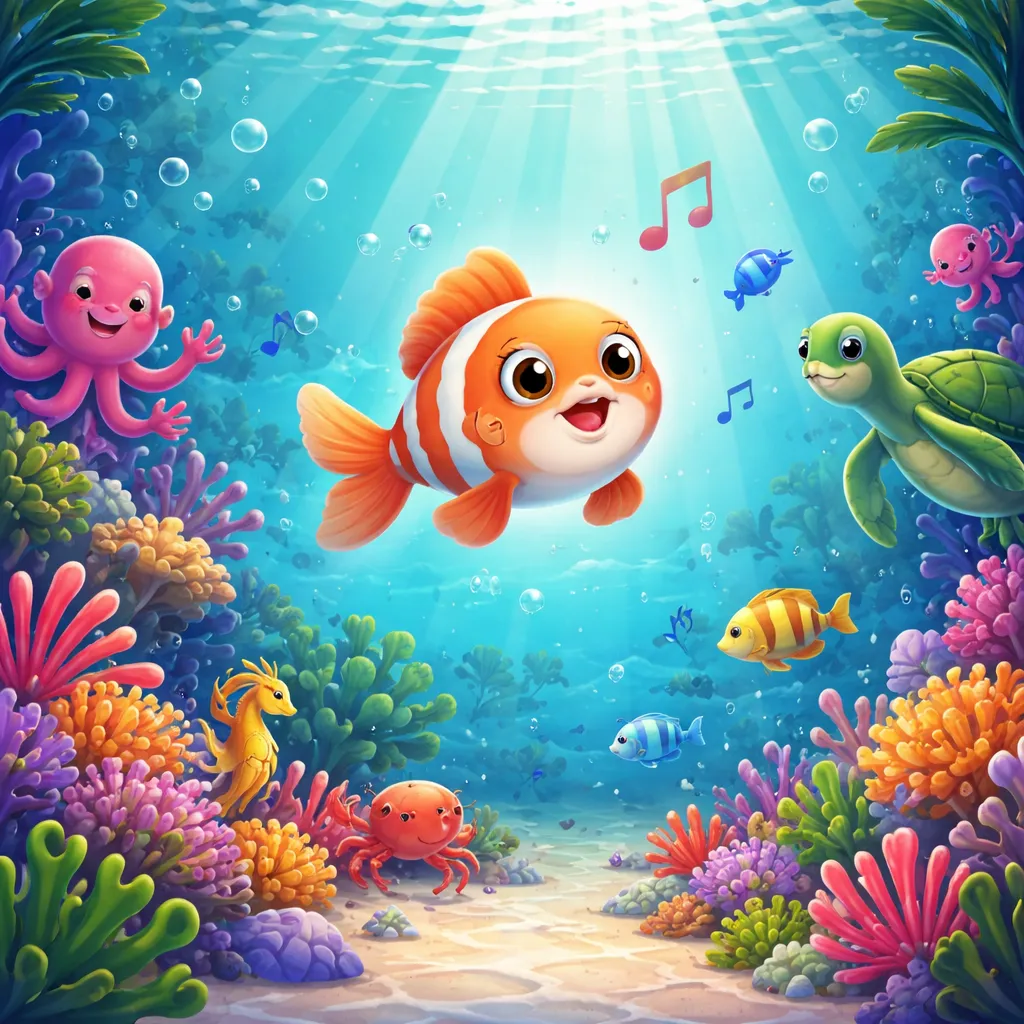

Have you ever watched fish in an aquarium or a pond? They dart and glide without making a sound, their fins fluttering like little fans. How do they move so smoothly? In Turkey, a country surrounded by seas, there is a playful song that makes you want to wiggle and swim. Let’s dive into the Turkish Song: The Little Fish (Küçük Balık).
About the Song
Here are the lively, swimming lyrics of this classic song in Turkish and English:
Küçük balık, kaç kaç kaç
(Little fish, swim away swim away)
Yüzgecinle, şap şap şap
(With your fin, splash splash splash)
Saklan kayalıkların arkasına
(Hide behind the rocks)
Küçük balık, kaç kaç kaç
(Little fish, swim away swim away)
This song’s original Turkish name is “Küçük Balık.” It is one of the most popular and active Turkish children’s songs. The song talks directly to a little fish, giving it quick, playful commands. The music is bouncy, fast-paced, and full of energy, with sounds that mimic splashing water. The Turkish Song: The Little Fish (Küçük Balık) is a musical game of chase, celebrating the fish’s quick movements and clever hiding spots in a fun, imaginary underwater adventure.
What the Song is About
The song is an exciting underwater chase! First, we see a little fish and immediately tell it to move: “Little fish, swim away swim away!” Maybe there’s a friendly bigger fish or a child’s hand trying to say hello. The song focuses on how the fish moves: “With your fin, splash splash splash.” We can see the little fin moving side to side, pushing the fish forward and making tiny splashes. The fish needs a safe spot, so the song gives advice: “Hide behind the rocks.” The clever fish zips behind a big, gray rock and stays very still. But the game isn’t over! We call out again, “Little fish, swim away swim away!” Maybe it’s time to swim to a new hiding place. The whole song is a fun, active game of tag set under the water.
Who Made It & Its Story
This song is a traditional Turkish folk song for children, part of the rich oral tradition passed down through generations. The original creator is unknown, as it was shaped by countless parents and teachers singing with children. Turkey is a peninsula with the Mediterranean, Aegean, and Black Seas around it, so the sea and fish are a natural part of life. The Turkish Song: The Little Fish (Küçük Balık) brings that marine world into play. It is adored for three splashy reasons. First, it is incredibly fun to act out, encouraging children to move their bodies like swimming fish. Second, it is very repetitive and easy to learn, even for very young children. Third, it’s a perfect song for group play, where one child can be the “fish” and others can gently pretend to chase, teaching about play and movement in a safe, musical way.
When to Sing It
You can sing this song in the swimming pool or bathtub, splashing the water in time with the “şap şap şap” part. It’s perfect for a game of tag in the backyard, where the person who is “it” is the chaser and everyone else are little fish who must “hide.” You could also sing it during a craft time when drawing or coloring a big underwater scene, making your crayon fish “swim” across the paper.
The Turkish Song: The Little Fish (Küçük Balık) gets us moving and playing. But there’s more to learn beneath the surface! This song is like a clear pool of knowledge. It teaches us words for movement and marine life, how to give quick commands, and about the importance of the sea in Turkish culture. Let’s take a deep breath and dive into the learning.
What Children Can Learn
Vocabulary
This song helps us learn words for marine life, movement, and safety.
Fin: The thin, flat part on a fish’s body that helps it swim and balance. The fish uses its fin to splash.
Gills: The part on the side of a fish’s head that it uses to breathe underwater.
Current: The steady, continuous flow of water in a river, lake, or ocean. A fish swims with or against the current.
Camouflage: The way an animal’s color or shape helps it hide in its surroundings. Hiding behind a rock is a type of camouflage.
Aquatic: Living or found in or near water. Fish are aquatic animals.
Ecosystem: A community of living things and their environment. A rocky underwater area is an ecosystem.
Language Skills
This song is a fun example of using Imperative Sentences for Direct Commands. We use these to give orders, instructions, or warnings—just like telling the fish what to do.
What Is It?: Think of Imperative sentences as the “Do It Now!” sentences. They tell someone to do something. They are very direct and often start with the verb (action word).
Finding the Secret: Look for sentences that tell you to do something. They often have no subject (like “you” or “fish”) written at the beginning; it’s just understood. Ask, “Is this sentence telling me to take an action?”
Using It:
◦   The basic formula is: [Verb] + [the rest of the instruction].

◦   Direct Command: “[Verb]!” (“Swim!” “Hide!” “Splash!”)

◦   In the song: “Swim away swim away!” “Hide behind the rocks!” These are commands telling the little fish how to stay safe and play the game.
Sounds & Rhythm Fun
Feel the splashy rhythm! The Turkish Song: The Little Fish (Küçük Balık) has a very fast, bubbly, and energetic beat. It might sound like the quick, light splashing of water. The words “kaç kaç kaç” (swim away) and “şap şap şap” (splash) are repeated quickly, mimicking the fish’s rapid movements. This fast, repetitive rhythm makes you want to move quickly and makes the commands easy to remember and shout out during play. You can use this same quick, splashy rhythm to make up a song about any fast-moving animal, like a buzzing bee or a running rabbit.
Culture & Big Ideas
This song connects to Turkey’s deep relationship with the sea. A key part of life in coastal towns is balıkçılık (fishing). The Istanbul Balık Pazarı (Fish Market) is a bustling, colorful place where fresh fish are sold daily, showing the importance of the sea for food. The Turkish Song: The Little Fish (Küçük Balık) teaches three big ideas. First, Adaptation for Survival: The fish’s fins are perfect for swimming, and hiding is a way to stay safe—these are adaptations. Second, The Language of Play: The song turns the natural behavior of a fish (swimming, hiding) into a universal game that children everywhere can understand and play. Third, Respect for Marine Life: The song encourages us to imagine life from the fish’s perspective, fostering curiosity and care for aquatic creatures.
Values & Imagination
Imagine you are the little fish. What does the water feel like on your scales? What do you see through the bubbles? How does it feel to be safe behind your rock? This song teaches you to think about how animals live and move in their own homes. It encourages quick thinking and playful movement. A simple idea: The next time you’re near water (even a puddle), watch how it moves. Can you make a small paper boat or leaf “swim” across it? You are exploring the same element the little fish calls home.
Your Core Takeaways
The Turkish Song: The Little Fish (Küçük Balık) is a splashy, energetic lesson in movement, adaptation, and play. You learned marine words like “fin,” “gills,” and “current.” You discovered how to use imperative sentences to give clear, direct commands. You moved to the song’s fast, splashy rhythm. You also connected the song to Turkey’s coastal culture and the importance of the sea. Most importantly, the song teaches that animals are adapted to their homes in amazing ways, that we can learn about them through play and imagination, and that quick thinking and movement can be both fun and smart.
Your Practice Missions
- Be an “Imperative” Game Leader. Play a simple game like “Simon Says” with a friend or family member. Give three commands using imperative sentences, like “Hop on one foot!” “Clap your hands!” “Spin around!” See if they can follow your direct orders, just like the fish in the song.
- Create an “Underwater Hideout.” Using pillows, blankets, and chairs, build a “rocky” fort to be your hiding spot, like the fish’s rocks. Once inside, pretend you are the little fish. Draw or cut out a paper fish, and make it “swim” and “hide” in your fort. Explain to someone how your hideout keeps you safe.














