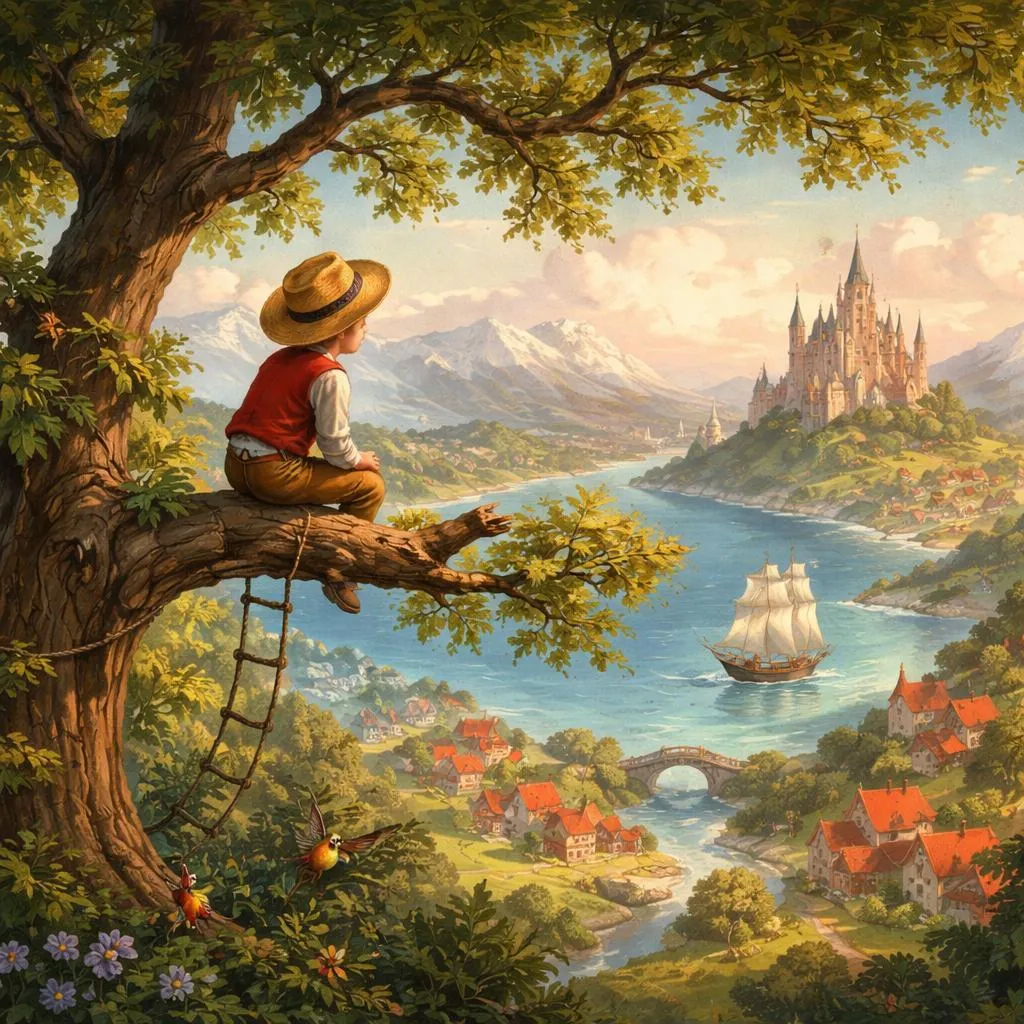

Up into the cherry tree Who should climb but little me? I held the trunk with both my hands And looked abroad in foreign lands. I saw the next door garden lie, Adorned with flowers, before my eye, And many pleasant places more That I had never seen before. I saw the dimpling river pass And be the sky’s blue looking-glass; The dusty roads go up and down With people tramping in to town. If I could find a higher tree Farther and farther I should see, To where the grown-up river slips Into the sea among the ships, To where the roads on either hand Lead onward into fairy land, Where all the children dine at five, And all the playthings come alive.
A Climb into Imagination: An Expanded Tale
One bright morning, I decided to climb the cherry tree in my backyard. Who else but me, the little adventurer, would dare to reach for the sky? I wrapped my small hands tightly around the sturdy trunk and began my climb. As I reached higher, the world below transformed into a magical land. I could see the garden next door, blooming with colorful flowers waving gently in the breeze. Beyond that, there were many more beautiful places I had never noticed before.
From my perch, I spotted a sparkling river winding like a silver ribbon, reflecting the blue sky like a giant mirror. The dusty roads twisted and turned, filled with people bustling into town, each on their own journey. I dreamed of finding an even taller tree, one that would let me see farther and farther away, all the way to where the big river meets the sea, where ships sail on endless adventures.
I imagined the roads on both sides leading to a magical land—a fairyland where children gather for dinner at five o’clock, and where all the toys come alive, ready to play and share stories. Up in the cherry tree, I found a world of wonder, waiting just beyond my reach, inviting me to explore and dream.
Background of the Story
This charming poem, often titled "Up into the Cherry Tree," is a classic example of children’s literature that celebrates imagination and the joy of discovery. It captures the innocence and curiosity of childhood, where even a simple climb up a tree becomes a gateway to a magical world. The author, whose identity remains unknown in many versions, wrote this piece to inspire young readers to look beyond the ordinary and find wonder in their everyday surroundings.
Author Introduction
Though the specific author of this poem is not widely documented, the style and themes are reminiscent of early 20th-century children’s poets who focused on nature, imagination, and childhood innocence. Writers like A.A. Milne and Robert Louis Stevenson often explored similar themes, encouraging children to see the world through a lens of curiosity and joy.
Detailed Interpretation and Meaning
At its heart, this poem is about exploration and the power of imagination. The cherry tree symbolizes a stepping stone from the familiar to the unknown. Climbing it represents a child’s natural desire to grow, learn, and see the world from new perspectives. The vivid descriptions of the garden, river, roads, and fairyland evoke a sense of wonder and possibility.
The poem also highlights the idea that the world is full of beauty and adventure, waiting to be discovered by those who dare to look. The “playthings come alive” line suggests that imagination can bring life and magic to even the simplest objects, encouraging creativity and joy.
What Children and Students Can Learn
- Curiosity and Exploration: The poem encourages children to be curious about their environment and to explore new places, whether in their backyard or through books and stories.
- Imagination: It shows how imagination can transform ordinary experiences into extraordinary adventures.
- Observation Skills: By noticing the details in the garden, river, and roads, children learn to pay attention to the world around them.
- Appreciation of Nature: The natural elements in the poem foster a love and respect for the environment.
- Dreaming Big: The desire to climb higher and see farther teaches children to set goals and dream beyond their current limits.
Applying These Lessons in Daily Life
- In Learning: Encourage students to ask questions and explore topics beyond their textbooks. Use imagination to create stories or projects that connect with their interests.
- In Social Settings: Use curiosity to learn about others’ experiences and perspectives, fostering empathy and understanding.
- In Personal Growth: Set small goals like climbing a tree or trying a new activity, building confidence and resilience.
- In Creativity: Engage in creative play, drawing, writing, or role-playing to bring imagination to life.
Cultivating Positive Spirit and Behavior
- Encourage Exploration: Support children when they want to try new things or explore their surroundings safely.
- Value Imagination: Celebrate creative ideas and storytelling as important parts of learning and self-expression.
- Promote Patience and Perseverance: Climbing a tree requires effort and care, teaching children to be patient and persistent.
- Foster a Sense of Wonder: Help children see everyday moments as opportunities for discovery and joy.
By embracing the spirit of this poem, children and students can develop a lifelong love of learning, creativity, and adventure—qualities that will enrich their lives in countless ways.