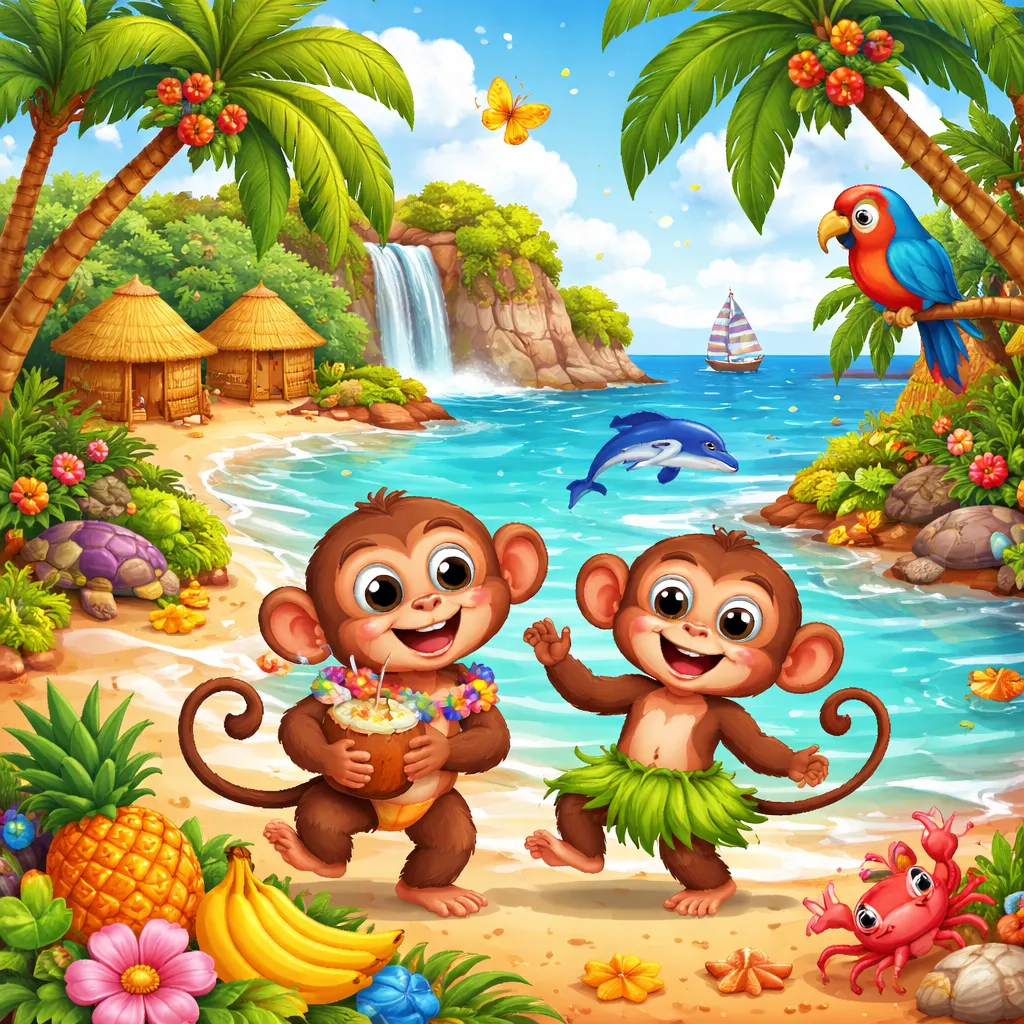

Close your eyes. Imagine the happiest place you can think of. Is it a place where the sun is always shining? Where yummy fruit falls right into your hands? Where everyone smiles and sings all day long? There is a magical song about just such a place. Let’s go on an adventure to discover the Russian song “Chunga-Changa (Чунга-Чанга).”
About the Song
Here is the super cheerful and catchy chorus of this famous song:
Чунга-чанга, синий небосвод!
Чунга-чанга, лето круглый год!
Чунга-чанга, весело живём!
Чунга-чанга, песенку поём!
Чудо-остров, чудо-остров!
Жить на нём легко и просто!
Жить на нём легко и просто!
Чунга-чанга!
English Translation:
Chunga-changa, blue sky!
Chunga-changa, summer all year round!
Chunga-changa, we live happily!
Chunga-changa, we sing a song!
Miracle-island, miracle-island!
Living on it is easy and simple!
Living on it is easy and simple!
Chunga-changa!
This is the super famous theme song from the 1970 Soviet cartoon “Katerok” (“The Little Ship”). The music was written by the beloved composer Vladimir Shainsky, with lyrics by Yuri Entin. The song is sung by the happy children who live on a wonderful tropical island. The words “Chunga-Changa” are fun, made-up words that express pure joy. The whole song is a celebration of a perfect, happy life in a simple, sunny world.
What the Song is About
The song paints a picture of a perfect, happy island. First, it gives the island its magical name: “Чунга-чанга!” Then, it describes why it is so wonderful. The sky is always blue. It is summer all year long, with no cold winter. The people live “весело” (happily). They spend their time singing songs.
The song calls it a “чудо-остров” (miracle-island, wonder-island). Life there is “легко и просто” (easy and simple). The singers list all the good things: they have nothing to worry about, they eat coconuts and bananas that just grow for them, and they swim in the sea every day. The song is a big, smiling list of everything you could wish for in a perfect home.
Who Made It & Its Story
The song was created for an animated film about a little ship traveling the world and visiting different countries. The island of Chunga-Changa was one of its stops. The team of Vladimir Shainsky (music) and Yuri Entin (lyrics) created a tune that is impossible not to dance to. It became an iconic symbol of carefree childhood joy in Russian-speaking culture. It is loved for three bright reasons. First, its melody is incredibly energetic, bouncy, and catchy, with a calypso-like rhythm that makes you want to jump up and dance immediately. Second, it uses playful, nonsense words (“Chunga-Changa”) that are fun to say and easy to remember, inviting everyone to join in the fun, regardless of language. Third, it presents a powerful, simple idea of utopia (a perfect place) from a child’s perspective: a land of eternal summer, plenty of food, simple fun, and friendship, which resonates with every child’s dream.
When to Sing It
This song is perfect for anytime you need a burst of energy and happiness. You can sing and dance to it loudly in your living room, pretending to swing from imaginary palm trees. You can sing it on a summer day at the beach or park, running around and shouting “Чунга-чанга!” with your friends. You can also hum it on a grey, boring day to imagine your own “miracle-island” and make yourself feel sunny inside.
What Children Can Learn
This joyful, rhythmic song is a fantastic teacher for learning vocabulary about an ideal world and a very useful negative structure in Russian.
Vocabulary
The song teaches us words about a perfect, happy place. “Blue” (синий / SEE-nee). “Sky” (небосвод / nye-bas-VOT). “Summer” (лето / LYEH-ta). “Round” (круглый / KROOG-ly). “Year” (год / got). “Happily” (весело / VYE-se-la). “We live” (живём / zhi-VYOM). “We sing” (поём / pa-YOM). “Miracle / Wonder” (Чудо / CHOO-da). “Island” (остров / OS-traf). “Easy” (легко / lekh-KO). “Simple” (просто / PROS-ta). “Coconuts and bananas” (кокосы и бананы / ka-KO-sy ee ba-NA-ny).
Let’s use these words! You can describe a happy day: “Сегодня синий небосвод. Мы живём весело!” (Today the sky is blue. We live happily!) New word: Солнце (SOLN-tse). This means “sun.” You can say, “На чудо-острове есть солнце.” (On the miracle-island there is sun.)
Language Skills
This song is excellent for learning about negation with “ни…ни” (neither…nor) and the construction for expressing ease with “легко и просто” (easy and simple).
Concept Definition: We are learning a special word pair for saying “not this AND not that” or “neither this NOR that.” It is like a double “no” that connects two things. We are also learning a handy phrase to say that something is not hard to do.
Features and Types: The pair “ни…ни” is used to strongly deny two or more things. You put “ни” before each thing you are saying “no” to. The phrase “легко и просто” uses two adverbs that both mean something is not difficult. “И” means “and.”
Example from the song: Negation: “Ни болезней, ни неприятностей.” (Neither sickness, nor troubles.) Ease: “Жить на нём легко и просто!” (Living on it is easy and simple!)
How to Spot Them: Here is the “Double No Detective” trick. Look for the word “ни” appearing two times (or more!) in a row. Ask: “Is the singer listing things that are NOT there or NOT happening?“ For the easy phrase, listen for “легко” (easy) and “просто” (simple) together. Ask: “Is the singer saying that doing something is not hard at all?“
How to Use Them: A clear way to list missing things is the “Ни [Thing 1], ни [Thing 2].” formula. To say something is easy, use the “[Action] + легко и просто.“ pattern.
Example from the song: “Ни забот, ни тревог.“ (Neither cares, nor worries.)
Example you can make: “В моей комнате ни беспорядка, ни пыли.“ (In my room there is neither mess, nor dust.) “Готовить суп легко и просто.“ (Making soup is easy and simple.)
Sounds & Rhythm Fun
The melody of “Чунга-Чанга” is unbelievably energetic, bouncy, and fast. It has a tropical, calypso rhythm that makes you want to wiggle your hips, clap your hands, and jump. The rhythm is very clear and driving, perfect for dancing.
The sounds are playful and repetitive. The most famous part is, of course, the nonsense words “Чунга-чанга!” (CHOON-ga CHAN-ga!). They are fun and easy to shout. The “ч” (ch) sound appears many times: “чунга-чанга,” “чудо,” making it punchy. The lines “Жить на нём легко и просто!” are repeated, which helps everyone remember and sing along. This super bouncy rhythm is perfect for creating your own happy island chant. Try making up your own island name and list: “Бум-бам, зелёный океан! Бум-бам, радуга для нас! Бум-бам, веселимся каждый час!“ (Boom-bam, green ocean! Boom-bam, a rainbow for us! Boom-bam, we have fun every hour!)
Culture & Big Ideas
This song is a cherished piece of Soviet animation history from the 1970s, a time of very popular and creative cartoons for children. It reflects a universal childhood (and adult!) dream of a carefree, tropical paradise. The song, with its calypso-inspired tune, also shows how Russian composers were inspired by music from all over the world.
The song conveys three joyful, important ideas. First, it celebrates simplicity and abundance, painting a picture of a life where happiness comes from nature (sun, fruit, sea) and friendship, not from complicated things. Second, it uses the power of pure nonsense (“Chunga-Changa”) and repetition to create a feeling of uninhibited joy and communal singing, breaking down barriers. Third, it encourages gratitude and a positive outlook by listing all the wonderful things present (sun, summer, song) and all the bad things absent (“ни болезней…” – no sickness), teaching us to focus on the good.
Values & Imagination
Imagine you are stepping onto the sandy beach of Chunga-Changa. The sun is warm. You look up and shout “Чунга-чанга, синий небосвод!” You taste a sweet piece of pineapple. You have “ни забот, ни тревог” – no homework worries, no sad thoughts. You run into the clear blue water with new friends. Everyone is singing the same song. You build a sandcastle and declare it your “чудо-остров.” Life is “легко и просто.” Draw this island: a circle of land in a blue sea. Draw a big smiling sun, palm trees with coconuts, and happy, dancing stick figures. Write “Чунга-чанга!” in big, colorful letters above it. This shows the song’s power to create a whole world of happiness in your mind.
The song encourages us to use our imagination to create places of joy, to be thankful for simple pleasures like sun and fruit, and to share fun with friends through music and dance. It shows that sometimes, happiness is a choice to focus on the good and sing about it. A wonderful activity is to have a “День Чунга-Чанги” (Chunga-Changa Day). Put on summer clothes. Spread a yellow blanket for the sun. Have a bowl of banana and pineapple slices. Play the song and dance. Every time you hear “Чунга-чанга!”, everyone must jump and shout it! This turns the song into a real celebration.
So, from the magical words “Чунга-чанга” to the promise of “лето круглый год,” the Russian song “Chunga-Changa (Чунга-Чанга)” is a burst of musical sunshine. It is a vocabulary lesson in describing a perfect world. It is a language lesson in using “ни…ни” to list what’s not there and saying something is easy. It is a music lesson in an irresistibly bouncy, tropical rhythm. It teaches us to imagine happiness, celebrate simplicity, and sing our joy out loud.
Your Core Takeaways
You are now an expert on the Russian song “Chunga-Changa (Чунга-Чанга).” You know it is a super happy song from a cartoon about a perfect tropical island where life is easy, fun, and full of singing. You’ve learned Russian words like “небосвод,” “лето,” “весело,” “чудо-остров,” and “легко и просто,” and you’ve practiced the “ни…ни” (neither…nor) structure and the phrase for saying something is easy. You’ve felt its incredibly bouncy, fast, and catchy calypso rhythm. You’ve also discovered the song’s message about using imagination to find joy, being thankful for simple things, and creating happiness together with friends.
Your Practice Missions
First, play the “Ни-Ни Охотник” (Neither-Nor Hunter). Look around your room or think about your perfect, happy place. What is NOT there? Use the “ни…ни” structure to list two things. Say: “В моей счастливой комнате ни шума, ни ссор.“ (In my happy room there is neither noise, nor arguing.) Or “На моём острове ни дождя, ни скуки.“ (On my island there is neither rain, nor boredom.) This mission helps you practice the song’s grammar to describe a positive place by saying what’s absent.
Second, create your own “Остров Радости” (Island of Joy) chant. Think of a silly, fun name for your island, like “Бим-Бом” or “Смайлик.” Now, to the tune of “Chunga-Changa,” make up a short song about it. Use the pattern: “[Your Island Name], [something great!]”. Example: “Бим-бом, сладкий мёд кругом! Бим-бом, все танцуют в нём!“ (Bim-bom, sweet honey everywhere! Bim-bom, everyone dances in it!). Dance while you sing it! This mission lets you use the song’s energy and structure to invent your own world of happiness.