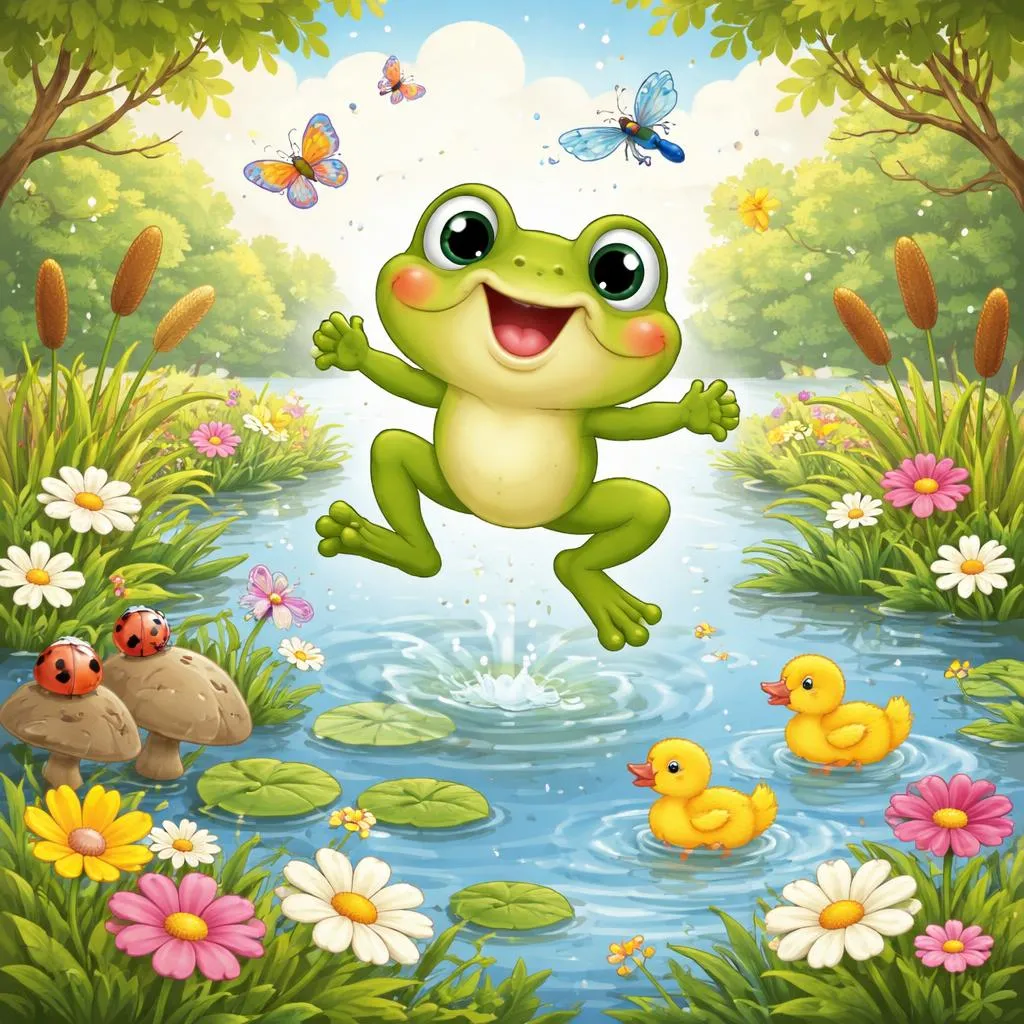

Have you ever sat very still by a pond, watching the water? Suddenly, you see a small, green shape leap from a lily pad! Plop! It’s a frog, a fantastic jumper. Frogs are amazing creatures that can live on land and in water. In Turkey, a country with beautiful lakes and rivers, there is a fun song that makes you want to jump like one. Let’s bounce along with the Turkish Song: The Little Frog (Küçük Kurbağa).
About the Song
Here is a playful verse from this popular song in Turkish and English:
Küçük kurbağa, küçük kurbağa
(Little frog, little frog)
Kuyruğun nerede?
(Where is your tail?)
Küüüt, küüüt diye
(With a küüüt, küüüt sound)
Öter göllerde
(It sings in the lakes)
This song’s original Turkish name is “Küçük Kurbağa.” It is a very popular and playful Turkish children’s song. The song talks directly to a little frog, asking it a funny question. The music is bouncy, silly, and full of energy, with sounds that mimic the frog’s call. The Turkish Song: The Little Frog (Küçük Kurbağa) is a musical game of questions and silly answers, celebrating the frog’s unique shape and funny sound.
What the Song is About
The song is a cheerful chat with a frog. First, we call out to it twice: “Little frog, little frog!” Then, we ask a curious question. We notice the frog’s body and ask, “Where is your tail?” This is funny because grown frogs do not have tails, only tadpoles do! The frog doesn’t answer with words. Instead, it responds with its own special sound: “Küüüt, küüüt!” This is the Turkish version of “ribbit, ribbit.” The song tells us this is how the frog “sings” in the lakes. The whole song is lighthearted, using a simple question to teach us about how frogs look and the funny sounds they make in their watery homes.
Who Made It & Its Story
This song is a traditional Turkish folk song for children, loved for generations. The original creator is unknown, as it comes from the shared culture of Turkish childhood. Turkey has many lakes, rivers, and wetlands, so frogs are a common and familiar part of the natural world for many children. The song’s playful question about the missing tail is a gentle way to teach a small science fact. The Turkish Song: The Little Frog (Küçük Kurbağa) is a favorite for three jumpy reasons. First, it is incredibly interactive and fun to act out, with big jumps and silly sounds. Second, it teaches a simple animal fact in a memorable, humorous way. Third, its melody is catchy, repetitive, and perfect for getting children moving and laughing.
When to Sing It
You can sing this song while hopping like a frog across the living room floor, taking a big jump on each “küüüt.” It’s perfect to chant after a rain shower, when you might see real frogs or puddles that look like little lakes. You could also sing it with friends in a game of tag, where the person who is “it” is the frog asking the question.
The Turkish Song: The Little Frog (Küçük Kurbağa) gets us moving and laughing. But to really understand our froggy friend, we can learn more. This song is a springboard for knowledge. It teaches us new animal words, how to ask friendly questions, and about the habitats of another country. Let’s take a leap into learning!
What Children Can Learn
Vocabulary
This song helps us learn words for animals, their bodies, and their homes.
Amphibian: An animal that can live both in water and on land. Frogs, toads, and salamanders are amphibians.
Habitat: The natural home or environment of an animal, plant, or other organism. A lake is a frog’s habitat.
Tadpole: The baby stage of a frog, which has a tail and lives in water. The song asks about the tail the frog had as a tadpole.
Metamorphosis: The process of transformation from an immature form to an adult form in two or more distinct stages. A tadpole undergoes metamorphosis to become a frog.
Vocalize: To produce sound using the voice. Frogs vocalize to communicate with each other.
Wetland: Land consisting of marshes or swamps; saturated land. Wetlands are important habitats for amphibians.
Language Skills
This song is a wonderful example of asking Yes/No Questions using the verb “To Be.” We use these questions to get a simple “yes” or “no” answer.
What Is It?: Think of Yes/No questions as your quick-check questions. They often start with a form of the verb “to be” (am, is, are). The expected answer is just “yes” or “no.”
Finding the Secret: Look for a sentence where the verb (like “is” or “are”) comes BEFORE the subject. It inverts the usual order. Ask: “Can this question be answered with a simple ‘yes’ or ‘no’?”
Using It:
◦   Formula: [Am/Is/Are] + [subject] + [rest of sentence]?

◦   Examples: “Are you happy?” “Is the frog green?” “Are we there yet?”

◦   The song’s question, “Where is your tail?” is an information question. But we can turn it into a Yes/No question: “Is your tail gone?” The frog’ answer, in a way, is “Yes!”
Sounds & Rhythm Fun
Get ready to bounce! The Turkish Song: The Little Frog (Küçük Kurbağa) has a very distinct, jumpy, and repetitive rhythm. It might sound like the motion of a frog hopping—hop (pause) hop (pause). The silly sound “Küüüt, küüüt!” is the most fun part to shout. This bouncy, stop-start rhythm is perfect for physical play and makes the short, repetitive lyrics extremely easy to memorize. You can use this same jumpy, call-and-response rhythm to make up a song about any animal and the sound it makes.
Culture & Big Ideas
This song connects to Turkey’s rich natural landscapes. A famous place is Lake Van, a large saltwater lake. While specific frogs might not live there, it represents the country’s many important bodies of water that support wildlife. The song reflects a comfort with and curiosity about nature. The Turkish Song: The Little Frog (Küçük Kurbağa) teaches three big ideas. First, Observation Leads to Questions: Noticing something (like a frog having no tail) can lead to interesting questions, which is the start of all science. Second, Change and Growth: The question about the tail subtly hints at the frog’s life cycle—it changed and grew! Third, Communication is Diverse: Animals “talk” in different ways, not with words but with sounds, just like the frog’s “küüüt.”
Values & Imagination
Imagine you are the little frog. How does it feel to push off with your strong back legs? What does the cool lake water feel like on your skin? This song teaches you to observe animals closely and respectfully. It encourages curiosity about life cycles and the different forms animals can have. A simple idea: The next time you are near a puddle or pond, look carefully at the edges. Do you see any movement? Any small creatures? Just observe quietly. You are being a young naturalist.
Your Core Takeaways
The Turkish Song: The Little Frog (Küçük Kurbağa) is a joyful, bouncy lesson in curiosity and animal facts. You learned science words like “amphibian,” “habitat,” and “tadpole.” You practiced how to form Yes/No questions using “is” and “are.” You moved to the song’s jumpy, playful rhythm. You also connected the frog’s home to Turkey’s natural landscapes like lakes. Most importantly, the song teaches that asking questions about nature is fun, that animals change as they grow, and that we can communicate joy through silly sounds and movements just like the little frog.
Your Practice Missions
- Be a “Yes/No Question” Detective. With a family member or a toy, play a game. Take turns asking three Yes/No questions about the room. “Is the lamp on?” “Are my shoes blue?” “Is this a book?” Answer with “Yes, it is” or “No, it isn’t.”
- Create Your “Life Cycle Leap” Drawing. Fold a piece of paper into four squares. In square one, draw a frog egg in water. In square two, draw a tadpole with a tail. In square three, draw a tadpole with legs. In square four, draw the “Küçük Kurbağa” with no tail! Show your drawing and explain the metamorphosis. This shows the answer to the song’s question about the tail