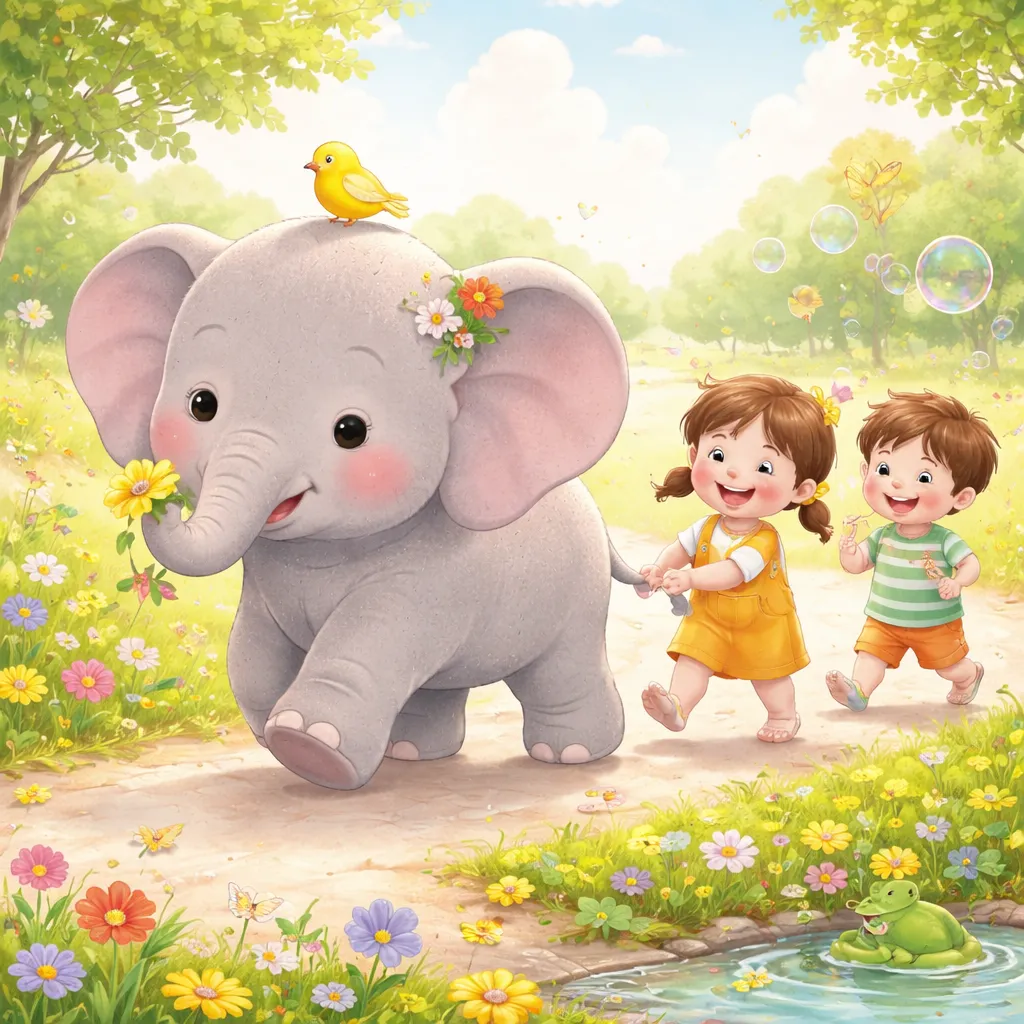

Have you ever seen the biggest animal on land? It has a long trunk, huge floppy ears, and tusks that look like giant teeth. It’s an elephant, and it’s known for being very smart and very kind. In Korea, a country that loves stories and nature, there is a wonderful song about this majestic creature. Let’s march along with the Korean Song: The Little Elephant (코끼리).
About the Song
Here is a verse from this charming song in Korean and English:
코끼리 코끼리 커다란 코끼리
(Kokkiri kokkiri keodaran kokkiri)
Elephant, elephant, big elephant
긴 코를 흔들며 걸어가네
(Gin koreul heundeulmyeo georeogane)
Walking, swinging its long trunk
똑똑하고 친절한 우리 코끼리
(Ttokttokago chinjeolhan uri kokkiri)
Our smart and kind elephant
가족과 함께 사네
(Gajokgwa hamkke sane)
Lives with its family
This song’s original Korean name is “코끼리” (Kokkiri), which means “elephant.” It is a popular and beloved Korean children’s song. The song is a friendly and admiring description of an elephant. The music is often slow, steady, and grand, matching the elephant’s size and gentle nature. The Korean Song: The Little Elephant (코끼리) is a musical tribute, celebrating the elephant’s intelligence, kindness, and strong family bonds.
What the Song is About
The song is a happy observation of an elephant’s traits. First, we greet it and note its size: “Elephant, elephant, big elephant.” We see its most famous feature in action: “Walking, swinging its long trunk.” The trunk is like a super-useful hand! The song tells us about its character: “Our smart and kind elephant.” Elephants are known for their good memories and gentle ways. Finally, we learn about its social life: “Lives with its family.” Elephants live in close, caring herds. The whole song is about admiring the elephant’s unique features, its intelligence, and the importance of family.
Who Made It & Its Story
This song is a modern Korean children’s song, likely created in the 20th century for educational entertainment. While the specific creator isn’t widely known, it reflects Korea’s engagement with global animal life through zoos, stories, and media. Elephants are not native to Korea, so the song comes from a place of fascination and education about animals from other parts of the world. The Korean Song: The Little Elephant (코끼리) is loved for three big reasons. First, it introduces children to an exotic and captivating animal in a simple, memorable way. Second, it emphasizes positive character traits like intelligence and kindness, which are universal values. Third, its melody is often catchy and easy to sing, with a fun, bouncy rhythm that mimics an elephant’s walk, making it a hit in schools and at home.
When to Sing It
You can sing this song while walking slowly and swaying your arm like an elephant’s trunk. It’s perfect to chant during a visit to the zoo when you see the elephants. You could also sing it with friends, linking arms to form a “herd” and marching around the room together.
The Korean Song: The Little Elephant (코끼리) teaches us about a magnificent animal. But there’s so much more to discover! This song is a treasure trove of learning. It introduces us to new words, shows us how to describe characteristics, and shares values we can all live by. Let’s take a big step into this learning adventure.
What Children Can Learn
Vocabulary
This song helps us learn words for animals, characteristics, and family.
Trunk: The long, flexible nose of an elephant, used for breathing, smelling, and grabbing. The elephant uses its trunk to eat and drink.
Tusk: A long, pointed tooth that sticks out of an elephant’s mouth, made of ivory. Some elephants have tusks.
Herd: A large group of animals that live together. Elephants live in a herd led by the oldest female.
Gentle Giant: A phrase for something or someone that is very large but also very kind. The elephant is a gentle giant.
Endangered: At risk of no longer existing. Some elephants are an endangered species.
Memory: The ability to remember. Elephants are famous for their excellent memory.
Language Skills
This song is a great example of using Adjectives to Describe Character and Size. Adjectives are words that describe nouns. Here, they tell us what the elephant is like.
What Are They?: Think of adjectives as your “describing words.” They add detail. They tell us about size, color, shape, or how something feels.
Finding the Secret: Look for words that come before a noun (like “elephant”) and tell you more about it. Ask: “What word is describing the noun?”
Using It:
◦   Formula: [Adjective] + [Noun] or [Noun] + is + [adjective].

◦   Examples: “a big elephant,” “a long trunk,” “The elephant is smart.”

◦   In the song: “big elephant,” “long trunk,” “smart and kind elephant.” These adjectives paint a vivid picture.
Sounds & Rhythm Fun
Listen to the heavy, steady rhythm! The Korean Song: The Little Elephant (코끼리) often has a slow, plodding, and deliberate beat. It might sound like the thump, thump, thump of an elephant’s big feet walking. The melody is often simple and repetitive, easy to remember. This big, steady rhythm makes the song fun to act out and helps the descriptive lyrics stick in your mind. You can use this same slow, heavy rhythm to make up a song about any large, gentle thing, like a friendly giant or a slow-moving cloud.
Culture & Big Ideas
While elephants are not native to Korea, they appear in global culture and media that Korean children enjoy. The song reflects a global curiosity about the natural world. In Korean culture, values like intelligence (지혜, jihye) and family (가족, gajok) are very important, and the song connects the elephant to these values. The Korean Song: The Little Elephant (코끼리) teaches three important ideas. First, Gentleness and Strength Together: Being big and strong doesn’t mean you can’t also be smart and kind. True strength is gentle. Second, The Importance of Family: Just like the elephant, we thrive when we live and work together with our family. Third, Celebrating Diversity: Learning about animals from far away helps us appreciate the amazing diversity of life on our planet.
Values & Imagination
Imagine you are the little elephant. How does the world look from so high up? What does your trunk feel like? How do you communicate with your family? This song teaches you to appreciate differences and to value intelligence and kindness over just appearance. It shows that everyone, no matter how big or small, needs a family. A simple idea: Think of one way you can be a “gentle giant” today—maybe by helping someone smaller than you or by being extra patient. You are using your strength for kindness.
Your Core Takeaways
The Korean Song: The Little Elephant (코끼리) is a grand, gentle lesson in appreciating amazing animals, valuing family, and celebrating kindness and intelligence. You learned words like “trunk,” “tusk,” “herd,” and “gentle giant.” You discovered how to use adjectives to describe size and character. You marched to the song’s slow, steady rhythm. You also connected the elephant to universal values like family and curiosity about the world. Most importantly, the song teaches that true greatness comes with a good heart, that family is everything, and that our world is full of wonderful creatures to learn about and protect.
Your Practice Missions
- Be an “Adjective Explorer.” Look around your room. Find three objects and describe each one with an adjective. Example: “a soft pillow, a tall bookshelf, a colorful toy.” This helps you practice using descriptive words.
- Create an “Elephant Family Portrait.” Draw a picture of an elephant family—a big elephant, a baby elephant, and maybe others. Give each one a name and a thought bubble saying something smart or kind they would do for their herd. Share your drawing and explain why family is important to elephants. This turns the song’s message into a visual story.