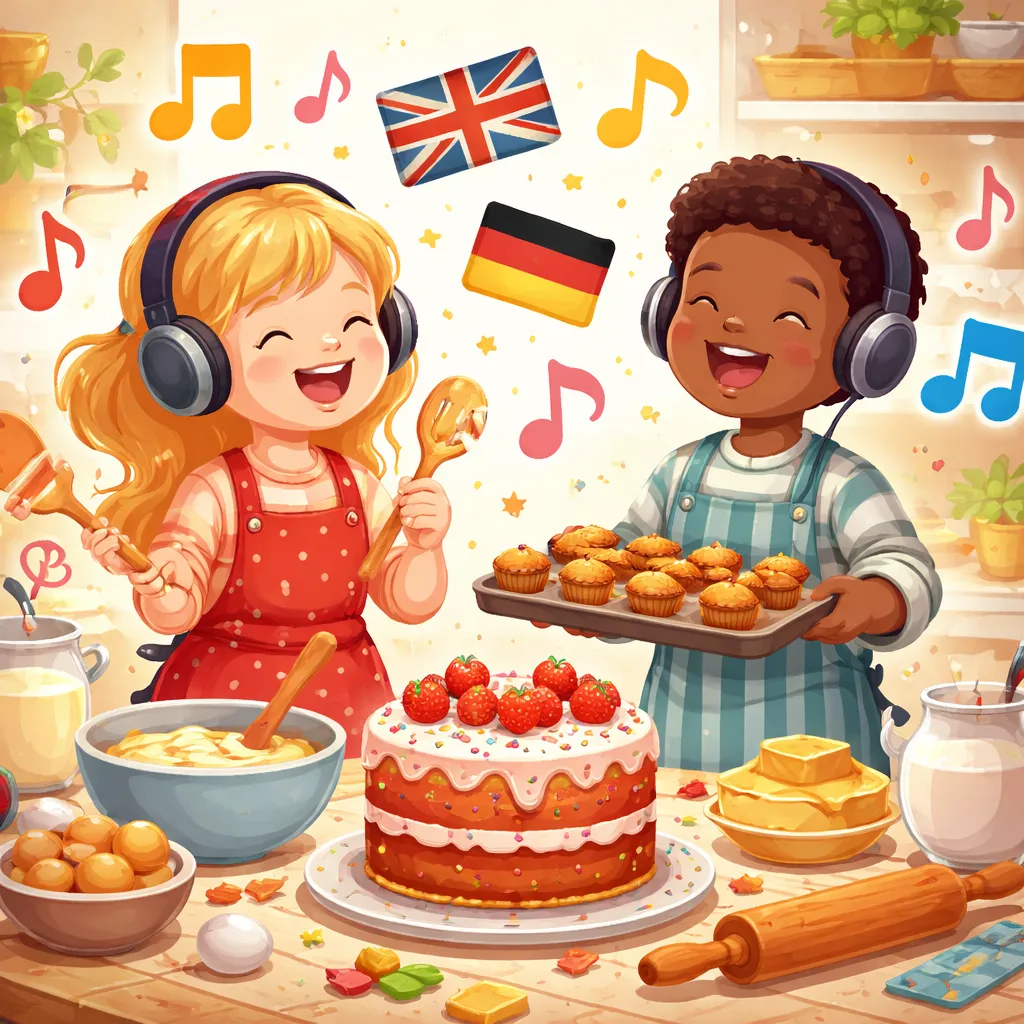

The smell of baking fills a kitchen with warmth. The sound of mixing and stirring brings anticipation. A children’s song can bring that same sensory joy to language learning. Today, we explore a beloved German nursery rhyme called “Backe, backe Kuchen,” which translates to “Bake, Bake Cake.” This cheerful song follows the steps of baking a cake. We will use this melody as a warm, hands-on path into English. Together, we will learn new words, explore important sounds, and discover how a simple song can make language learning feel as natural and comforting as baking with someone you love. The baker mixes ingredients one by one. Your child can learn English words one by one, building something wonderful.
What is the rhyme? “Backe, backe Kuchen” is a traditional German children’s song about baking a cake. It has been sung for generations in kitchens and classrooms. The song lists the ingredients and steps needed to make a cake. It has a steady, rhythmic beat that mimics the rhythm of stirring and kneading. Children often use hand movements. They pretend to stir a bowl. They crack eggs. They knead dough. The song creates a warm, cozy atmosphere. It celebrates the joy of creating something with your hands. When we bring this song to English learning, we keep its warm, building spirit. We use the familiar melody to introduce English words in a way that feels like following a simple recipe.
The lyrics of nursery rhymes To appreciate this song, we first look at the original German words. Then we see how they translate into English. This shows children that the same cozy baking activity can be described in different languages. You do not need to know German to enjoy the steady, rhythmic beat of the words.
Original Version (German)
Backe, backe Kuchen Der Bäcker hat gerufen Wer will guten Kuchen backen Der muss haben sieben Sachen Eier und Schmalz Butter und Salz Milch und Mehl Safran macht den Kuchen gelb Schieb, schieb in den Ofen ’rein
English Version
Bake, bake cake The baker has called Who wants to bake a good cake Must have seven things Eggs and lard Butter and salt Milk and flour Saffron makes the cake yellow Push, push it into the oven
As you read these words, notice the steady, listing rhythm. The song moves through the ingredients one by one. The story is simple and hands-on. A baker calls for bakers. To bake a good cake, you need seven things. Eggs, lard, butter, salt, milk, flour, and saffron. Then you push it into the oven. This narrative invites children to learn through doing.
Vocabulary learning This song offers a rich set of words that connect to cooking, ingredients, and following steps. We can explore these words through conversation, real baking, and playful imitation.
Start with the action: baking. In German, it is backe. In English, we say “bake.” Baking is cooking food in an oven. If you can, bake a simple cake or cookies together. The hands-on experience makes the words stick.
Here are the key words to focus on from the song:
Bake: To cook in an oven. Explain that when we bake, we use heat to make food.
Cake: A sweet baked food. Show a picture or a real cake. Talk about when you eat cake.
Baker: A person who bakes. The baker calls for help. Ask your child if they want to be a baker.
Called: Asked for someone. The baker called for bakers.
Seven: The number 7. Count to seven together. Show seven fingers.
Eggs: Food from chickens. Show an egg. Crack one together if you are baking.
Lard: A type of fat used in baking. You can substitute butter in a real recipe.
Butter: A dairy product made from milk. Show butter. It is soft and yellow.
Salt: A white mineral used for flavor. Show salt. Let your child taste a tiny bit.
Milk: A white liquid from cows. Show milk. It is used in many recipes.
Flour: A powder made from grains. Show flour. Let your child feel the soft powder.
Saffron: A spice that gives a yellow color. Explain that it makes the cake yellow.
Oven: The appliance where we bake. Point to your oven. Say “the cake goes in the oven.”
Use these words in natural moments. When you cook, name the ingredients. “This is flour. This is butter.” When you count, say “seven ingredients, like the song.” These connections make the vocabulary meaningful.
Phonics points Phonics helps children understand the sounds that build English words. This song gives us several clear sounds to explore in a warm, hands-on way.
First, focus on the long ‘a’ sound in “bake” and “cake.” Say “ay” like in “day.” Then say “bake.” Practice with “make,” “take,” and “cake.” This sound is bright and open.
Next, notice the short ‘e’ sound in “eggs” and “seven.” Say “e” like in “bed.” Then say “eggs.” Practice with “red,” “ten,” and “seven.” This sound is short and clear.
The word “flour” contains the ‘ow’ sound. Say “ow” like in “cow.” Then say “flour.” Practice with “flower,” “power,” and “flour.” This sound is fun to make.
Finally, look at the ‘th’ sound in “butter” and “salt” does not have ‘th.’ Let us look at “the” in the English version. The ‘th’ sound is made with the tongue between the teeth. Say “th th th.” Practice with “this,” “that,” and “the.” The song also has “oven,” which contains the short ‘u’ sound. Say “u” like in “up.”
Grammar patterns Even a simple song contains grammar that we can introduce gently. We do not need to use technical terms. Instead, we show how words work together through examples and play.
The song uses the imperative mood. “Bake,” “push,” and “must have” give instructions. The imperative is used for commands or requests. You can practice giving simple instructions. “Stir the bowl.” “Pour the milk.” This builds understanding of how to give directions.
The phrase “must have” shows necessity. To bake a cake, you must have seven things. You can practice with other “must have” phrases. “To make a sandwich, you must have bread.” “To draw, you must have paper.” This builds understanding of requirements.
Notice the listing structure. “Eggs and lard, butter and salt, milk and flour.” Listing is a common way to organize information. You can practice listing things your child knows. “Colors: red, blue, yellow.” “Toys: ball, doll, car.” This builds organizational skills.
Also, look at the question “who wants to bake a good cake?” This is a question that invites participation. You can ask similar questions. “Who wants to read a book?” “Who wants to sing a song?” This builds interactive language.
Learning activities Activities bring the song into the body and the imagination. They transform listening into active participation. These ideas are simple and require little preparation.
Baking Play Play the song and pretend to bake a cake. Use a bowl and spoon. Pretend to add ingredients. When the song names each ingredient, pretend to put it in the bowl. Stir the bowl. Then push the pretend cake into the oven. This activity builds listening skills and imaginative play.
Real Baking If possible, bake a simple cake or cupcakes together. Use the song as you work. Name each ingredient as you add it. Count to seven. Sing the song while the cake bakes. This connects the song to a real, memorable experience.
Ingredient Hunt Go to the kitchen together. Find as many of the seven ingredients as you can. Point to them. Name them. If you do not have lard or saffron, talk about substitutes. This builds vocabulary and kitchen familiarity.
Printable materials Printable resources offer a quiet way to reinforce the song’s vocabulary. They are perfect for moments when children want to create or focus calmly.
Flashcards Create a set of flashcards. One card shows a cake. One shows a mixing bowl for “bake.” One shows the number 7. One shows an egg. One shows butter. One shows a bag of flour. One shows an oven. Use these cards for a matching game. Sing a line from the song and ask your child to find the matching card. This builds word recognition.
Coloring Page Draw a simple scene from the song. Show a bowl with ingredients around it. Show an oven nearby. Children can color the ingredients and the oven. As they color, talk about the scene. “What ingredients do you see?” “What color is the cake?” This keeps the language flowing naturally.
Recipe Card Create a simple recipe card for the song’s cake. Write or draw the seven ingredients. Add the instruction “bake in the oven.” Your child can decorate the card. This builds literacy and sequencing skills.
Educational games Games encourage repetition without boredom. They invite children to use the language in new and creative ways.
Baker Says Play a game similar to “Simon Says.” Give commands using the song’s vocabulary. “The baker says add the flour.” “The baker says stir the bowl.” “The baker says push the cake into the oven.” If you give a command without saying “the baker says,” the child does not move. This game builds listening skills.
Ingredient Memory Place pictures of the seven ingredients on a tray. Let your child look at them. Then cover the tray. Ask “what ingredients did you see?” Add more ingredients to make it more challenging. This builds memory and vocabulary.
Count the Ingredients Practice counting to seven using the song. Count eggs. Count scoops of flour. Count pats of butter. Use real items or toys. This builds number vocabulary and counting skills.
As you share “Backe, backe Kuchen” with your child, remember that you are building language through experience. Baking is a sensory activity. You see, touch, smell, and taste. Language learning can be sensory too. When you say “flour,” your child can feel the soft powder. When you say “oven,” they can feel the warmth. Let the warm baker be your guide. Sing the song when you are in the kitchen. Let the delicious spirit of baking remind you both that learning English can be as natural as following a simple recipe. You gather the words. You mix them together. You let them bake in conversation and play. And before you know it, something wonderful has been made.