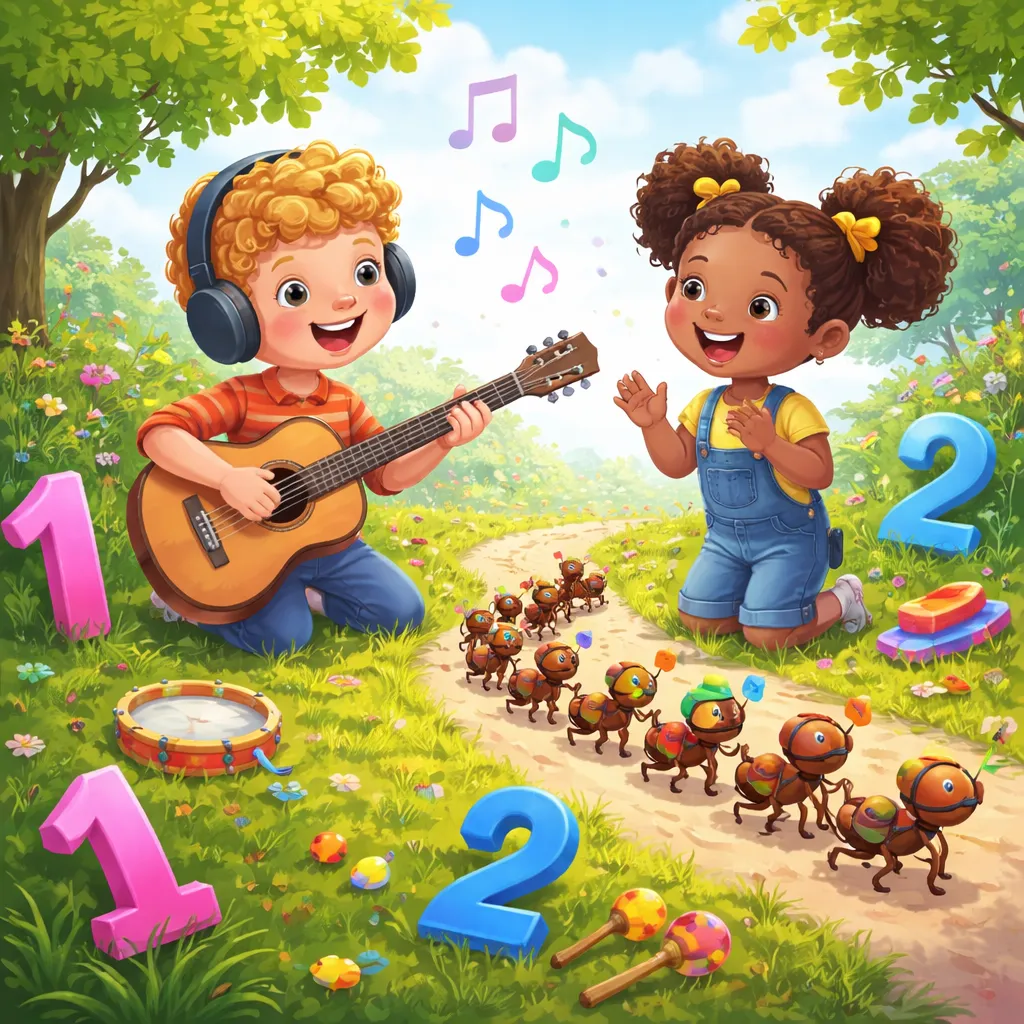

Ants march in a line. One by one, two by two, they go. They work together. They do not stop. A children’s song can turn that steady march into a joyful language lesson. Today, we explore a German version of the beloved nursery rhyme “The Ants Go Marching,” known as “Die Ameisen gehen zwei by zwei.” This cheerful song follows ants marching in increasing numbers. We will use this melody as a rhythmic, counting path into English. Together, we will learn new words, explore important sounds, and discover how a simple song can make language learning feel like a steady, marching parade. The ants march one by one. Your child can learn English numbers and actions with that same steady rhythm.
What is the rhyme?
“The Ants Go Marching” is a popular children’s song that combines counting, rhythm, and action. The German version, “Die Ameisen gehen zwei by zwei,” follows the same pattern. The song tells the story of ants marching in increasing numbers. Each verse adds another ant. The ants march through the rain and do various actions. The song has a strong, marching rhythm. Children love the repetitive “hurrah, hurrah” chorus and the different actions. The song creates a joyful, participatory atmosphere. It invites children to march, count, and imagine. When we bring this song to English learning, we keep its rhythmic, counting spirit. We use the familiar melody to introduce English words in a way that feels like marching in a parade.
The lyrics of nursery rhymes
To appreciate this song, we first look at the original German words. Then we see how they translate into English. This shows children that the same marching, counting song exists in different languages. You do not need to know German to enjoy the steady, building rhythm of the words.
Original Version (German)
Die Ameisen gehen zwei by zwei
Hurrah, hurrah
Die Ameisen gehen zwei by zwei
Hurrah, hurrah
Die Ameisen gehen zwei by zwei
Die eine bleibt mal kurz stehen
Und dann geht’s weiter im Regen
Und sie gehen, gehen, gehen, gehen
Zwei by zwei, zwei by zwei
English Version
The ants go marching two by two
Hurrah, hurrah
The ants go marching two by two
Hurrah, hurrah
The ants go marching two by two
The little one stops to tie her shoe
And they all go marching down to the ground
To get out of the rain
Boom, boom, boom, boom
Other Verses (Numbers and Actions):
The ants go marching one by one
The little one stops to suck his thumb
The ants go marching three by three
The little one stops to climb a tree
The ants go marching four by four
The little one stops to shut the door
The ants go marching five by five
The little one stops to take a dive
The ants go marching six by six
The little one stops to pick up sticks
The ants go marching seven by seven
The little one stops to pray to heaven
The ants go marching eight by eight
The little one stops to shut the gate
The ants go marching nine by nine
The little one stops to check the time
The ants go marching ten by ten
The little one stops to say “The End!”
As you read these words, notice the building repetition. The rhythm moves like marching feet. The song introduces numbers and actions one by one. This narrative invites children to count, march, and imagine.
Vocabulary learning
This song offers a wonderful set of words that connect to numbers, actions, and marching. We can explore these words through conversation, movement, and playful counting.
Start with the main characters: the ants. In German, they are Ameisen. In English, we say “ants.” Ants are small insects that work together in lines.
Here are the key words to focus on from the song:
Ants: Small insects that live in colonies. Show pictures of ants.
Marching: Walking in a steady, regular way. March in place.
One by one: One at a time. Count one.
Two by two: In pairs. Count two.
Hurrah: A cheer of joy. Shout “hurrah!”
Little one: A small ant. The smallest ant in the line.
Stops: Pauses. The little ant stops.
Suck his thumb: Put thumb in mouth. This is one action.
Tie her shoe: Fasten a shoelace. Pretend to tie a shoe.
Climb a tree: Go up a tree. Pretend to climb.
Shut the door: Close a door. Pretend to shut a door.
Take a dive: Jump into water. Pretend to dive.
Pick up sticks: Gather sticks. Pretend to pick up.
Pray to heaven: Say a prayer. Fold hands.
Shut the gate: Close a gate. Pretend to close a gate.
Check the time: Look at a clock. Pretend to look at a watch.
Say “The End”: Finish the story. Say “the end!”
Use these words in natural moments. When you walk in a line, say “we are marching, one by one.” When you count, say “two by two.” These connections make the vocabulary meaningful.
Phonics points
Phonics helps children understand the sounds that build English words. This song gives us several clear sounds to explore in a marching, rhythmic way.
First, focus on the ‘m’ sound at the beginning of “marching.” This is a voiced sound made with the lips together. Say “m m m” like a hum. Practice with “mother,” “moon,” and “marching.” This sound is steady and strong.
Next, notice the long ‘o’ sound in “one” and “two.” “One” has the ‘w’ sound plus ‘un.’ “Two” has the ‘oo’ sound. Practice with “blue,” “shoe,” and “two.” The long ‘oo’ is rounded.
The word “hurrah” contains the ‘h’ sound and the ‘ah’ sound. Say “h” like a sigh. Then “urrah.” Practice with “hooray,” “happy,” and “hurrah.” This is a joyful sound.
Finally, look at the ‘th’ sound in “thumb,” “three,” and “the.” This is a soft sound made with the tongue between the teeth. Say “th th th.” Practice with “think,” “mother,” and “thumb.” The song also has “shoe,” which contains the ‘sh’ sound. Say “sh” like in “ship.”
Grammar patterns
Even a simple song contains grammar that we can introduce gently. We do not need to use technical terms. Instead, we show how words work together through examples and play.
The song uses the present tense to describe what the ants do. “Go,” “stops,” and “march” describe actions that happen in the song. You can practice by describing what you do. “We march.” “We count.” This builds understanding of present tense.
Notice the repetition of numbers. “One by one,” “two by two.” This shows a pattern. You can practice counting with this pattern. “One by one, we count.” “Two by two, we walk.” This builds number vocabulary.
The phrase “the little one” shows the smallest ant. You can practice with other “little” phrases. “The little one is the smallest.” “The little bird sings.” This builds comparative language.
Also, look at the action words in each verse. “Suck his thumb,” “tie her shoe,” “climb a tree.” These are all verb phrases. You can practice acting out the actions while saying the words. This builds verb vocabulary.
Learning activities
Activities bring the song into the body and the imagination. They transform listening into active participation. These ideas are simple and require little preparation.
Ant March
Play the song and march around the room. When the song says “one by one,” march alone. When it says “two by two,” find a partner and march together. Do the actions for each verse. This activity builds listening skills and movement.
Counting Line
Line up toys or family members. Count them one by one. Then count them two by two. Say “one by one, two by two.” This builds counting and number vocabulary.
Action Game
Act out the actions from the song. Tie your shoe. Climb a tree. Shut a door. Take a dive. Pick up sticks. Shut a gate. Check the time. Make it a game. This builds verb vocabulary.
Printable materials
Printable resources offer a quiet way to reinforce the song’s vocabulary. They are perfect for moments when children want to create or focus calmly.
Flashcards
Create a set of flashcards. One card shows ants marching for “marching.” One shows the number 1 for “one by one.” One shows the number 2 for “two by two.” One shows an ant tying a shoe. One shows an ant climbing a tree. One shows an ant shutting a door. Use these cards for a matching game. Sing a line from the song and ask your child to find the matching card. This builds word recognition.
Coloring Page
Draw a simple scene of ants marching in a line. Number them 1 to 10. Children can color the ants and the background. As they color, count the ants together. “One ant, two ants, three ants.” This keeps the language flowing naturally.
Number and Action Booklet
Create a small booklet. On each page, write a number and draw the action. 1: suck thumb. 2: tie shoe. 3: climb tree. 4: shut door. 5: take dive. 6: pick up sticks. 7: pray to heaven. 8: shut gate. 9: check time. 10: say “The End!” Your child can color each page. This builds literacy and sequencing.
Educational games
Games encourage repetition without boredom. They invite children to use the language in new and creative ways.
Ant Says
Play a game similar to “Simon Says.” Give commands using the song’s vocabulary. “The ant says march one by one.” “The ant says stop to tie your shoe.” “The ant says climb a tree.” If you give a command without saying “the ant says,” the child does not move. This game builds listening skills.
Number March
Call out a number. “One!” Your child marches one step. “Two!” Two steps. March to the rhythm. This builds number recognition and coordination.
Action Match
Match the number to the action. 1: suck thumb. 2: tie shoe. 3: climb tree. 4: shut door. Call out a number, and your child does the action. This builds number and verb vocabulary.
As you share this song with your child, remember that you are building a sense of rhythm, numbers, and working together. The ants march one by one, two by two. They stop for little actions. Then they keep marching. Learning a new language is like marching too. You learn one word, then two words. You stop to practice an action. Then you keep going. Let the marching ants be your guide. March around the room together. Count your steps. Do the silly actions. Let the steady rhythm of the song remind you both that every step forward, no matter how small, is part of the march toward speaking English with joy and confidence.