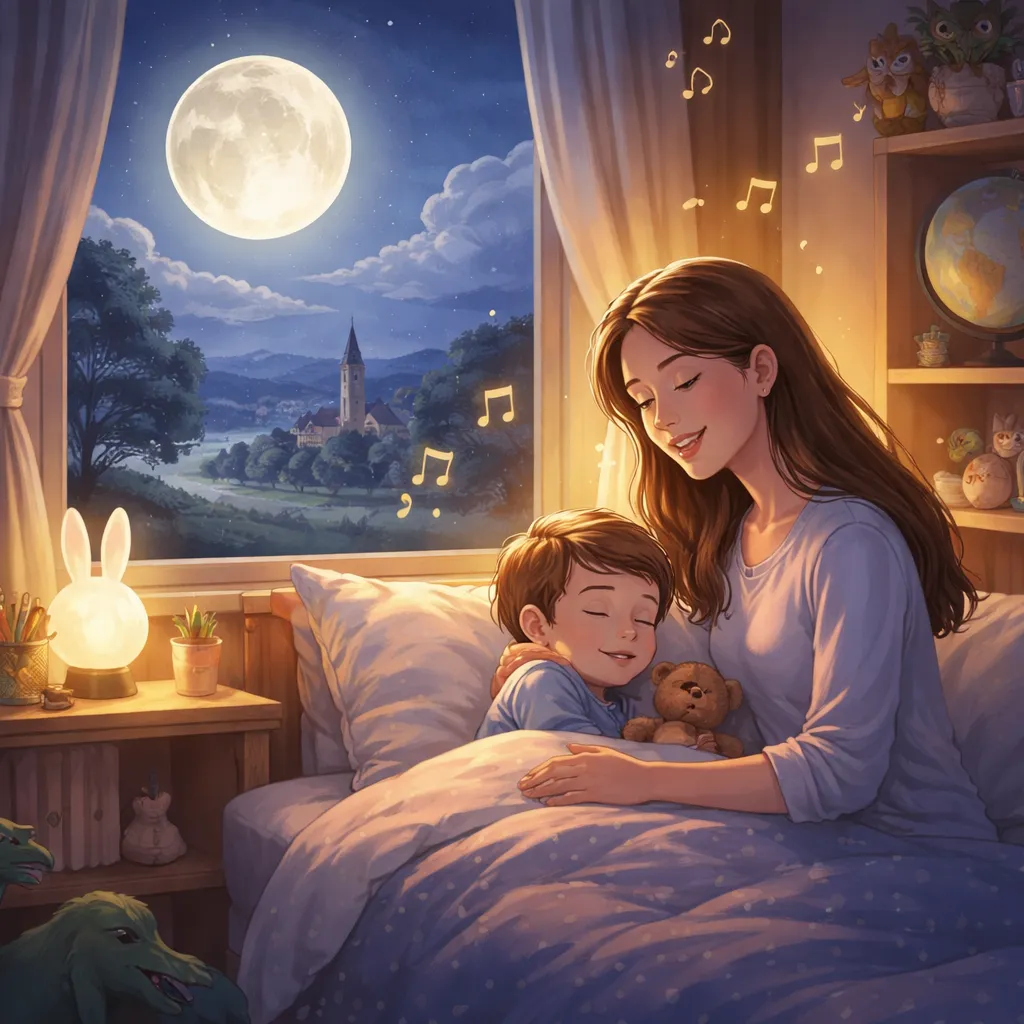

The moon rises. The stars appear. The world grows quiet. A children’s song can bring that same sense of peace to language learning. Today, we explore a traditional German evening song called “Der Mond ist aufgegangen,” which translates to “The Moon Has Risen.” This gentle hymn-like song has been sung to children for generations. It describes the beauty of the night and offers a quiet prayer before sleep. We will use this melody as a calm, reflective path into English. Together, we will learn new words, explore important sounds, and discover how a simple song can make language learning feel like a peaceful moment at the end of the day. The moon rises quietly. Your child can learn English words with that same gentle, peaceful spirit.
What is the rhyme?
“Der Mond ist aufgegangen” is a traditional German evening song written in the 18th century. It is often sung as a bedtime prayer. The song describes the night sky, the quiet world, and the goodness of God. It has a slow, meditative rhythm. Children listen quietly or sing softly. The song creates a calm, reflective atmosphere. It invites children to appreciate the beauty of the night and to rest peacefully. When we bring this song to English learning, we keep its calm, reflective spirit. We use the familiar melody to introduce English words in a way that feels like a quiet moment of peace before sleep.
The lyrics of nursery rhymes
To appreciate this song, we first look at the original German words. Then we see how they translate into English. This shows children that the same peaceful evening song can be expressed in different languages. You do not need to know German to enjoy the slow, gentle rhythm of the words.
Original Version (German)
Der Mond ist aufgegangen
Die goldnen Sternlein prangen
Am Himmel hell und klar
Der Wald steht schwarz und schweiget
Und aus den Wiesen steiget
Der weiße Nebel wunderbar
English Version
The moon has risen
The golden little stars shine
In the sky, bright and clear
The forest stands black and silent
And from the meadows rises
The white mist, wonderful
A later verse offers a prayer:
Original Version (German)
So legt euch denn ihr Brüder
In Gottes Namen nieder
Kalt ist der Abendhauch
Verschon uns Gott mit Strafen
Und lass uns ruhig schlafen
Und unsern kranken Nachbarn auch
English Version
So lie down now, you brothers
In God’s name, go to rest
Cold is the evening breeze
Spare us, God, from punishment
And let us sleep peacefully
And our sick neighbors as well
As you read these words, notice the slow, gentle rhythm. The rhythm moves like a quiet evening settling in. The song describes the moon, stars, forest, mist, and then offers a prayer for peaceful sleep. This narrative invites children to reflect on the beauty of the night and to rest with gratitude.
Vocabulary learning
This song offers a beautiful set of words that connect to nature, night, and peace. We can explore these words through conversation, pictures, and quiet moments before sleep.
Start with the main image: the moon. In German, it is Mond. In English, we say “moon.” The moon rises in the evening and lights the night.
Here are the key words to focus on from the song:
Moon: The bright round object in the night sky. Look at the moon together.
Risen: Has come up. The moon has risen.
Golden: The color of gold. The stars are golden.
Stars: Bright points of light in the sky. Count the stars you see.
Shine: Give out light. The stars shine.
Sky: The space above us. Look at the sky.
Bright: Full of light. The sky is bright with stars.
Clear: Easy to see. The sky is clear.
Forest: A place with many trees. The forest is black and silent.
Silent: Quiet, making no sound. The forest is silent.
Meadows: Fields of grass. The mist rises from the meadows.
Mist: Light fog. The white mist rises.
Wonderful: Very beautiful and amazing. The mist is wonderful.
Lie down: Get into bed. We lie down to sleep.
Sleep peacefully: Rest without worry. We ask to sleep peacefully.
Use these words in natural moments. At bedtime, say “the moon has risen. The stars are shining.” When you go outside at night, say “the forest is silent.” These connections make the vocabulary meaningful.
Phonics points
Phonics helps children understand the sounds that build English words. This song gives us several clear sounds to explore in a calm, gentle way.
First, focus on the ‘m’ sound at the beginning of “moon.” This is a voiced sound made with the lips together. Say “m m m” like a hum. Practice with “mother,” “moon,” and “mist.” This sound is warm and round.
Next, notice the long ‘o’ sound in “moon” and “golden.” The ‘oo’ in “moon” is like “moon.” The ‘o’ in “golden” is a long ‘o.’ Say “oh” like in “go.” Practice with “cold,” “gold,” and “golden.”
The word “stars” contains the ‘st’ blend and the ‘ar’ sound. Say “s,” then quickly add “t.” Then add “ars.” Practice with “stop,” “star,” and “stars.” The ‘ar’ sound is like “car.”
Finally, look at the ‘sh’ sound in “shine” and “silent.” This is a quiet, airy sound. Put your finger to your lips and say “shhh.” Then say “shine.” Practice with “ship,” “fish,” and “silent.” The song also has “peacefully,” which contains the long ‘e’ sound. Say “ee” like in “see.”
Grammar patterns
Even a simple song contains grammar that we can introduce gently. We do not need to use technical terms. Instead, we show how words work together through examples and play.
The song uses the present perfect tense in “has risen.” This tense connects the past to the present. The moon rose, and now it is in the sky. You can practice with other present perfect phrases. “The sun has set.” “The stars have appeared.” This builds understanding of this tense.
Notice the present tense in “stand,” “shines,” and “rises.” These describe what is happening now. You can practice by describing what you see. “The moon shines.” “The forest stands.” This builds present tense.
The phrase “lie down” is a command. You can practice giving gentle commands at bedtime. “Lie down.” “Close your eyes.” “Sleep peacefully.” This builds understanding of instructions.
Also, look at the word “wonderful.” This adjective describes the mist. You can practice using “wonderful” to describe beautiful things. “The moon is wonderful.” “The stars are wonderful.” This builds descriptive language.
Learning activities
Activities bring the song into the body and the imagination. They transform listening into active participation. These ideas are simple and require little preparation.
Evening Song
At bedtime, play the song softly. Sing along. Look at the moon and stars if you can see them. Say “the moon has risen. It is time to sleep peacefully.” This connects the song to the bedtime routine.
Night Sky Drawing
Draw the night sky together. Draw the moon. Draw stars. Draw a dark forest. Draw mist rising from meadows. As you draw, name the parts. “Here is the golden moon. Here are the shining stars.” This builds vocabulary and creativity.
Quiet Reflection
Sit quietly together before bed. Look out the window if it is dark. Listen for silence. Talk about what you see. “The forest is silent.” “The sky is clear.” This builds observation and language.
Printable materials
Printable resources offer a quiet way to reinforce the song’s vocabulary. They are perfect for moments when children want to create or focus calmly.
Flashcards
Create a set of flashcards. One card shows the moon for “moon.” One shows stars for “stars.” One shows a dark forest for “forest.” One shows mist rising from a meadow. One shows a child lying down for “lie down.” One shows a peaceful face for “sleep peacefully.” Use these cards for a matching game. Sing a line from the song and ask your child to find the matching card. This builds word recognition.
Coloring Page
Draw a simple night scene. Show the moon and stars in the sky. Show a dark forest below. Show mist rising from a meadow. Children can color the scene with soft, dark colors. As they color, talk about the scene. “What is in the sky?” “What is rising from the meadows?” This keeps the language flowing naturally.
Bedtime Prayer Card
Create a simple card with the English words of the prayer verse. “Let us sleep peacefully.” Your child can decorate the card and keep it by their bed. This builds literacy and a sense of calm.
Educational games
Games encourage repetition without boredom. They invite children to use the language in new and creative ways.
Moon Says
Play a game similar to “Simon Says.” Give commands using the song’s vocabulary. “The moon says shine like a star.” “The moon says lie down.” “The moon says sleep peacefully.” If you give a command without saying “the moon says,” the child does not move. This game builds listening skills.
Night Sound Hunt
Sit quietly and listen. What sounds do you hear at night? A clock ticking. A faraway car. The wind. Then listen for silence. Say “the world is silent, like the forest.” This builds listening skills and calm.
Wishing Game
Before bed, take turns making a quiet wish. “I wish for peaceful sleep.” “I wish for a beautiful moon.” This builds expressive language and a sense of peace.
As you share “Der Mond ist aufgegangen” with your child, remember that you are creating a space for peace and reflection. The moon rises. The stars shine. The forest is silent. The mist rises. Then we lie down and sleep peacefully. Learning a new language can also have moments of peace. It is not always about action and energy. Sometimes it is about sitting quietly, listening to gentle words, and letting them settle into your mind. Let the peaceful moon be your guide. Sing the song at bedtime. Let the gentle spirit of the evening remind you both that language learning can be calm, that words can be like stars in the sky—quiet, steady, and always there, shining in the quiet moments.