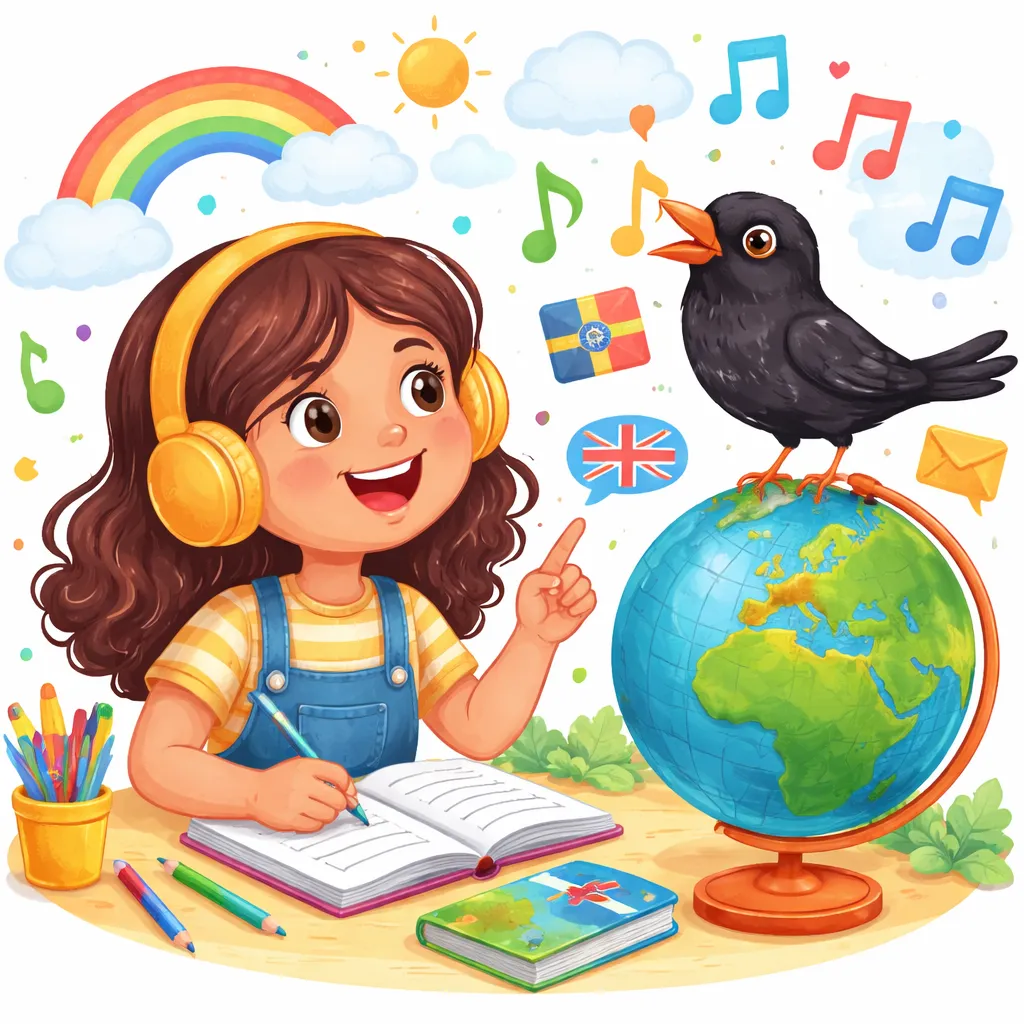

A blackbird sings with a clear, confident voice. Its dark feathers make it stand out against the bright sky. A children’s song can give a child that same confidence to make their voice heard in a new language. Today, we explore a traditional Portuguese rhyme called “O Melro,” which means “The Little Blackbird.” This cheerful song follows a small blackbird who sings proudly in the morning. We will use this melody as a confident path into English. Together, we will learn new words, explore important sounds, and discover how a simple song can make language learning feel as natural as a bird greeting the day. The blackbird sings without hesitation. Your child can learn to speak English with that same quiet confidence.
What is the rhyme?
“O Melro” is a lively nursery rhyme in Portuguese-speaking cultures. It tells the story of a little blackbird who wakes up early and sings a beautiful song. The song has a bright, morning rhythm. Children often use hand movements. They make a beak with their fingers. They stretch like birds waking up. They sing along with the melody. The song celebrates the start of a new day and the joy of making music. When we bring this song to English learning, we keep its bright, confident spirit. We use the familiar melody to introduce English words in a way that feels like greeting the morning with a song.
The lyrics of nursery rhymes
To appreciate this song, we first look at the original Portuguese words. Then we see how they translate into English. This shows children that the same confident morning song can be expressed in different languages. You do not need to know Portuguese to enjoy the bright, waking rhythm of the words.
Original Version (Portuguese)
O melro, o melro
Vai acordar, vai acordar
Bem cedo, bem cedo
Vai cantar, vai cantar
English Version
The little blackbird, the little blackbird
Will wake up, will wake up
Very early, very early
Will sing, will sing
A second verse often continues the story, describing the blackbird’s beautiful song.
Original Version (Portuguese)
Que linda canção, que linda canção
Faz o melro, faz o melro
Pula de galho, pula de galho
Sem parar, sem parar
English Version
What a beautiful song, what a beautiful song
Makes the blackbird, makes the blackbird
He jumps from branch, jumps from branch
Without stopping, without stopping
As you read these words, notice the bright repetition. The rhythm moves like a bird hopping from branch to branch. The story is simple and uplifting. A blackbird wakes up very early. He sings a beautiful song. He jumps from branch to branch without stopping. This narrative invites children to start their day with joy and confidence.
Vocabulary learning
This song offers a wonderful set of words that connect to morning routines, music, and joyful movement. We can explore these words through conversation, actions, and daily moments.
Start with the main character: the blackbird. In Portuguese, it is melro. In English, we say “little blackbird.” Blackbirds are known for their clear, melodic songs. They are often among the first birds to sing in the morning. You can look at pictures of blackbirds together. Notice their black feathers and bright yellow beaks.
Here are the key words to focus on from the song:
Blackbird: A bird with black feathers that sings beautifully. Explain that blackbirds are often heard early in the morning.
Wake up: To become awake. This is a familiar daily action. Stretch and pretend to wake up together.
Very early: The time when the sun is just rising. Point to the morning light. Talk about waking up early.
Sing: To make music with the voice. The blackbird sings. Sing together.
Beautiful song: A lovely piece of music. The blackbird’s song is beautiful. Listen to bird songs outside.
Makes: Creates or performs. The blackbird makes a song. You make sounds when you speak.
Jumps: Moves off the ground. Blackbirds jump from branch to branch. Jump together.
Branch: A part of a tree. Look at trees outside. Point to branches.
Without stopping: Continuously. The blackbird moves without stopping.
Use these words in natural moments. In the morning, say “wake up! The little blackbird is singing.” When you hear a bird, say “what a beautiful song.” These connections make the vocabulary meaningful.
Phonics points
Phonics helps children understand the sounds that build English words. This song gives us several clear sounds to explore in a bright, confident way.
First, focus on the ‘bl’ blend at the beginning of “blackbird.” This is two consonants together. Say “b” and then quickly add “l.” Then add “ackbird.” Practice with “blue,” “black,” and “blackbird.” This blend appears in many color words.
Next, notice the short ‘a’ sound in “blackbird” and “branch.” Say “a” like in “apple.” Then say “black” slowly. Practice with “cat,” “hat,” and “branch.” This is a very common vowel sound.
The word “song” contains the ‘ng’ sound at the end. Say “ng” like in “ring.” Then say “song.” Practice with “long,” “strong,” and “song.” This sound is made with the back of the tongue.
Finally, look at the ‘j’ sound in “jumps.” This is a voiced sound made with the tongue and lips. Say “j j j” like a bouncing ball. Then say “jumps.” Practice with “joy,” “jelly,” and “jump.” The song also has “without,” which contains the ‘ow’ sound. Say “ow” like in “cow.”
Grammar patterns
Even a simple song contains grammar that we can introduce gently. We do not need to use technical terms. Instead, we show how words work together through examples and play.
The song uses the future tense with the word “will.” “Will wake up” means the blackbird plans to wake up. You can explain this simply. “Will” is a helper word that tells us something is going to happen. Practice by talking about morning routines. “You will wake up.” “We will sing a song.” This gives children a tool to talk about future events.
The second verse uses the present tense. “Makes the blackbird” describes what the blackbird does now. You can point out that we use this form when something is happening regularly. “The blackbird sings every morning.” “You sing every day.”
Notice the exclamation “what a beautiful song!” This expresses admiration. You can practice using exclamations. “What a big tree!” “What a lovely day!” This builds expressive language.
Also, look at the phrase “without stopping.” This uses “without” to show absence. You can practice with other “without” phrases. “She jumps without stopping.” “He sings without resting.” This introduces a more advanced structure.
Learning activities
Activities bring the song into the body and the imagination. They transform listening into active participation. These ideas are simple and require little preparation.
Blackbird Morning
Play the song in the morning. Stretch and pretend to wake up like the blackbird. When the song says “will sing,” make a singing sound. When it says “jumps from branch,” jump from one spot to another. When it says “without stopping,” keep moving. This activity builds listening skills and connects the song to the morning routine.
Morning Song Walk
Go for a walk in the morning. Listen for bird songs. When you hear a bird, say “what a beautiful song!” Talk about whether it might be a blackbird. This connects the song to real observation.
Branch Jumping
Place cushions or paper circles on the floor. These are “branches.” Take turns jumping from one branch to another. As you jump, say “I jump from branch to branch, without stopping!” This builds movement and vocabulary.
Printable materials
Printable resources offer a quiet way to reinforce the song’s vocabulary. They are perfect for moments when children want to create or focus calmly.
Flashcards
Create a set of flashcards. One card shows the blackbird. One shows a person waking up for “wake up.” One shows a clock showing early morning. One shows musical notes for “sing.” One shows a bird on a branch for “branch.” One shows jumping feet. Use these cards for a matching game. Sing a line from the song and ask your child to find the matching card. This builds word recognition.
Coloring Page
Draw a simple scene from the song. Show the little blackbird on a branch. Draw the sun rising in the background. Add musical notes coming from his beak. Children can color the bird black with a yellow beak. As they color, talk about the scene. “What is the blackbird doing?” “What time is it?” This keeps the language flowing naturally.
Morning Routine Chart
Create a simple chart with pictures. Show waking up, singing a song, and starting the day. Connect each step to the song. “The blackbird wakes up. You wake up.” This builds connections between the song and daily life.
Educational games
Games encourage repetition without boredom. They invite children to use the language in new and creative ways.
Blackbird Says
Play a game similar to “Simon Says.” Give commands using the song’s vocabulary. “The blackbird says wake up.” “The blackbird says sing a song.” “The blackbird says jump without stopping.” If you give a command without saying “the blackbird says,” the child does not move. This game builds listening skills.
Song Echo
Sing a line from the song. Ask your child to echo it back. Start with short lines. “The little blackbird.” Then longer lines. “The little blackbird will wake up.” This builds memory and pronunciation.
Morning Sound Hunt
In the morning, listen for different sounds. A bird singing. A clock ticking. A car passing. Ask “what do you hear?” Then sing the part of the song about the beautiful song. This builds observation and vocabulary.
As you share “O Melro” with your child, remember that you are nurturing confidence and joy. The little blackbird wakes up early. He sings a beautiful song without hesitation. He jumps from branch to branch with energy. Learning a new language can have that same bright spirit. Some mornings, your child will feel like singing. Some days, they will jump from one word to another with ease. Let the confident blackbird be your guide. Sing the song when you start your day together. Let the bright morning spirit of the blackbird remind you both that every new day brings new words to sing, and every word learned is something to be proud of.