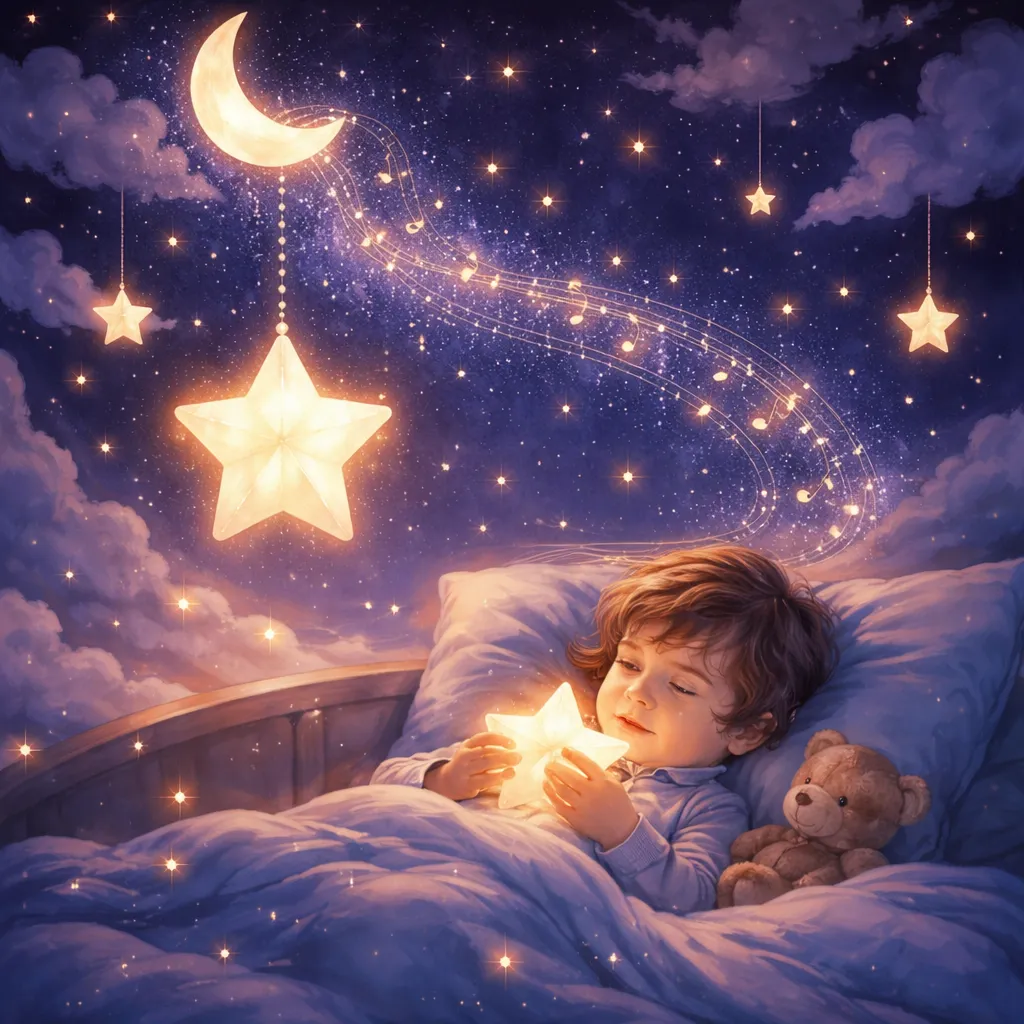

Have you ever looked up at the night sky and seen a tiny, bright point of light shining back at you? It seems to wink, as if it has a secret. For hundreds of years, children and adults have sung a simple, perfect song to that little light. When sung very slowly, it becomes a magic spell for sleep. Let’s learn about the world’s most famous lullaby: “Twinkle, Twinkle, Little Star.”
About the Song
Let’s read the wondering, gentle words of this beloved song.
Twinkle, twinkle, little star,
How I wonder what you are!
Up above the world so high,
Like a diamond in the sky.
Twinkle, twinkle, little star,
How I wonder what you are!
This song is a classic English nursery rhyme and lullaby. The poem was written by Jane Taylor and first published in 1806. The famous melody is not original; it is a very old French folk tune called “Ah! vous dirai-je, Maman” (“Oh! Shall I tell you, Mama”). The great composer Wolfgang Amadeus Mozart loved this tune so much that he used it to write a set of piano variations when he was a young man. The combination of Jane Taylor’s simple, wondering poem and this timeless, beautiful melody created the perfect song. The “lullaby version” simply means singing it very slowly and softly, letting the gentle melody rock the listener to sleep, like a musical cradle.
What the Song is About
The song paints a picture of quiet wonder. A person, perhaps a child, is looking up at the night sky. They see one particular star that seems to twinkle, or shine with a flickering light. The child speaks directly to the star, calling it “little.”
The child is filled with curiosity. They sing, “How I wonder what you are!” This is the big question of the song. The child is thinking deeply about the nature of the star. Is it a hole in a dark blanket? A distant lantern? A jewel? To describe its beauty, the child uses a simile, saying the star is “like a diamond in the sky.” The song repeats the first two lines, emphasizing the endless wonder and the peaceful, twinkling mystery. The lullaby version turns this wonder into a hypnotic, calming thought that slowly carries the listener from curiosity into dreams.
Who Made It & Its Story
The words of “Twinkle, Twinkle, Little Star” were written by the English poet Jane Taylor. The melody is a traditional French folk song. The connection to Wolfgang Amadeus Mozart is that he famously used this same French tune for his “Twelve Variations on ‘Ah vous dirai-je, Maman’” in the early 1780s, proving its charm even to a musical genius. The poem and tune were first put together in the early 19th century and quickly became a staple of childhood. Its simple, five-note range and easy rhyming words made it one of the first songs many children ever learn. As a lullaby, its slow tempo and repetitive, rising-and-falling melody perfectly mimic a gentle rocking motion, making it a natural choice for bedtime.
This song is perhaps the most famous children’s song in the world for three perfect reasons. First, its melody is scientifically simple and memorable. Using only a few notes, it is incredibly easy to learn and hard to forget. Second, its lyrics capture a universal human moment—the awe of looking at the night sky and asking a big question. Third, it is incredibly versatile. It can be a lively nursery rhyme, a first piano lesson, a lesson in simile, and, when sung slowly, one of the most effective lullabies ever created.
When to Sing It
This song is perfect for any quiet, observant moment. You can sing it very slowly and softly as a lullaby at bedtime, gazing at a nightlight or a star-shaped sticker. You can sing it on a clear night while stargazing with your family, wondering about each “little star.” You can also hum it during a calm, thoughtful time, like while drawing or resting, letting the simple melody calm your mind.
What Children Can Learn
This simple, profound song is a universe of learning in just a few lines. Let’s explore its twinkling lessons.
Vocabulary
The song teaches us beautiful, descriptive words. To “twinkle” means to shine with a light that seems to flicker or sparkle. A “star” is a giant ball of hot gas in space that looks like a tiny point of light from Earth. To “wonder” means to think about something with curiosity and amazement. “Above” means higher than or over. A “diamond” is a precious, clear gem that sparkles with brilliant light.
Let’s use these words! You can say, “The city lights twinkle below the airplane.” Or, “I wonder how birds know where to fly.” New word: Simile. This is when you compare two different things using the word “like” or “as.” The song uses a simile: “Like a diamond in the sky.”
Language Skills
This song is a masterful lesson in using the simile and the exclamatory sentence to show strong feeling. The core comparison is the simile: the star is “Like a diamond in the sky.” This helps us understand the star’s beauty by comparing it to something shiny and precious we know.
The song is also one big exclamation of wonder. The lines “How I wonder what you are!” is an exclamatory sentence, showing the singer’s strong feeling of amazement and curiosity. The song uses direct address, talking right to the star (“little star”), which makes it feel personal and engaging.
Sounds & Rhythm Fun
Listen to the simple, perfect, rising-and-falling melody. The song uses a clear, steady rhythm and a wonderful AABB rhyme scheme: “star” rhymes with “are,” and “high” rhymes with “sky.” The repetition of the first two lines makes the song easy to remember and sing.
The lullaby version takes the same melody and slows it way down. The rhythm becomes a gentle, slow 4/4 or 6/8 time, like a relaxed heartbeat. Try singing it very slowly: Twin-kle, twin-kle, lit-tle star. The melody moves in small, safe steps, never jumping in a scary way. This slow, predictable, and beautiful pattern is what makes it so hypnotic and perfect for sleep. You can write your own wondering lullaby! Use the same slow rhythm. Try: “Shimmer, shimmer, moon so bright, filling up the dark of night. Hanging in the evening air, like a lantern, shining there.”
Culture & Big Ideas
“Twinkle, Twinkle, Little Star” sits at a special crossroads of culture: English poetry, French folk music, and Austrian classical genius (Mozart). It shows how a simple tune can travel across borders and inspire everyone. The song reflects a very human desire to find meaning and beauty in the vast, unknown universe. The act of singing it as a lullaby turns that big, scary universe into a friendly, twinkling companion for a child, shrinking the infinite down to a comforting, familiar tune.
The song conveys three timeless ideas. First, it’s about curiosity and the birth of science. The simple question “what are you?” is the starting point for all discovery, from astronomy to poetry. Second, it’s about finding comfort in the familiar unknown. We may not know what a star is, but its familiar, twinkling light and the familiar song about it make the night feel safe. Third, it celebrates the power of simple, shared art. This song connects generations and cultures through a common, humble melody, teaching that you don’t need complicated things to share wonder and comfort.
Values & Imagination
Imagine you are the person singing the song. Are you in a cozy bed? On a grassy hill? What does the “diamond in the sky” look like tonight? Is it blue-white? Gold? Now, imagine the star answering. What would it say? “I am a sun, very far away”? “I am a wish, waiting for you”? Draw a picture of the sky from your point of view. Draw one especially twinkling star. Instead of drawing lines for light, write the words “Twinkle, Twinkle” in small letters, radiating out from the star. This shows the song and the starlight becoming the same thing.
The song inspires us to be curious, to appreciate beauty, and to find comfort in routine. A lovely idea is to have a “Wonder Question” ritual. At bedtime, with your family, look out a window or at a picture of space. Each person asks one “I wonder” question about the night sky. “I wonder if the moon feels lonely?” “I wonder what stars are made of?” There are no wrong answers. This keeps the song’s spirit of curiosity alive.
So, as the last, slow “what you are” fades into silence, think about the journey of this tiny song. It is a vocabulary lesson in wonder and beauty. It is a grammar lesson in similes and exclamations. It is a music lesson in one of the most perfect, simple melodies ever found. From the first “twinkle” to the final, wondering thought, it wraps lessons in curiosity, comfort, and shared human experience in a tune that feels as eternal and comforting as the stars themselves. “Twinkle, Twinkle, Little Star” teaches us that big questions can be gentle, that the universe can be lulled to sleep with a song, and that sometimes, the most powerful magic is a simple, shared melody sung slowly in the dark.
Your Core Takeaways
You are now an expert on the “Twinkle, Twinkle, Little Star” lullaby. You know the poem is by Jane Taylor, the tune is a French folk melody loved by Mozart, and singing it slowly makes it a perfect lullaby. You’ve learned words like “twinkle” and “wonder,” and you’ve mastered the “like a diamond” simile. You’ve felt its simple, slow rhythm and created your own wondering verse. You’ve also discovered the song’s cultural journey and its messages about curiosity, finding comfort in the unknown, and the power of simple, shared art.
Your Practice Missions
First, become a “Lullaby Astronomer.” On a clear night, find one star. Sing the lullaby version very slowly to that one star. Watch it as you sing. Does it seem to twinkle more? How does singing to it slowly make you feel compared to singing it fast? Share your experience with your family.
Second, compose a “Star Answer.” The song wonders what the star is. Write the star’s answer. It can be poetic (“I am a dream that hasn’t been dreamed yet”), scientific (“I am a ball of hot gas called plasma”), or silly (“I am the night’s shiny button”). Write your answer on a paper star and hang it near your bed. This lets you complete the song’s conversation with your own imagination.