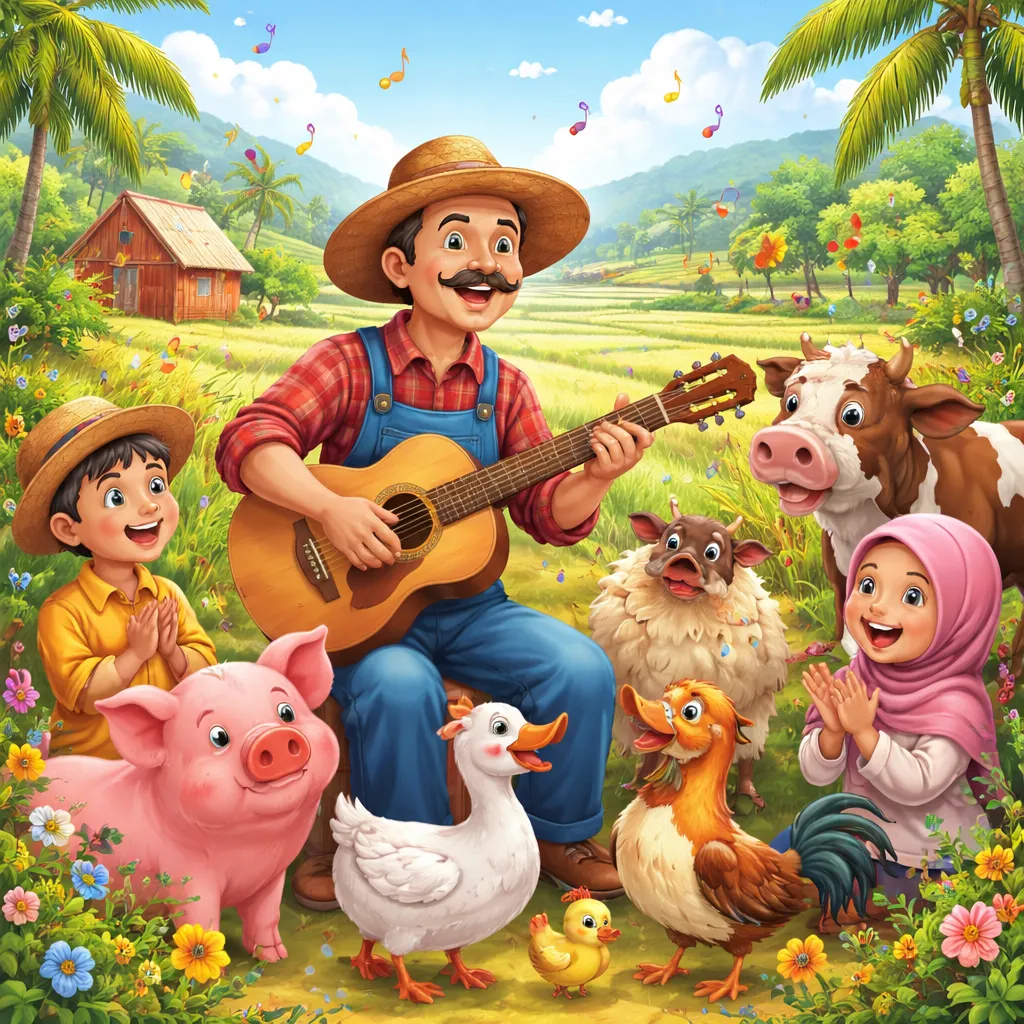

A cow says “moo.” A duck says “quack.” A sheep says “baa.” These are sounds children love to make. A song can turn those sounds into a joyful language lesson. Today, we explore an Indonesian version of the beloved nursery rhyme “Old MacDonald Had a Farm,” known as “Pak MacDonald Punya Kebun.” This cheerful song introduces farm animals and the sounds they make. We will use this melody as a lively, sound-filled path into English. Together, we will learn new words, explore important sounds, and discover how a simple song can make language learning feel like visiting a farm full of noisy, happy animals. Old MacDonald had a farm. Your child can learn English animal names and sounds with that same joyful noise.
What is the rhyme?
“Old MacDonald Had a Farm” is one of the most beloved children’s songs in the English-speaking world. The Indonesian version, “Pak MacDonald Punya Kebun,” follows the same pattern. The song introduces a farmer named Pak MacDonald and the animals on his farm. Each verse adds a new animal and its sound. The song has a lively, repetitive rhythm with a catchy “E-I-E-I-O” chorus. Children love making the animal sounds. They moo, oink, quack, and baa along with the music. The song creates a joyful, participatory atmosphere. It invites children to learn animal names and sounds through playful repetition. When we bring this song to English learning, we keep its lively, sound-filled spirit. We use the familiar melody to introduce English words in a way that feels like playing with farm animals.
The lyrics of nursery rhymes
To appreciate this song, we first look at the original Indonesian words. Then we see how they translate into English. This shows children that the same joyful farm song exists in different languages. You do not need to know Indonesian to enjoy the lively, repetitive rhythm of the words.
Original Version (Indonesian)
Pak MacDonald punya kebun
E-I-E-I-O
Dan di kebun ada sapi
E-I-E-I-O
Dengan moo-moo di sini
Dan moo-moo di sana
Di sini moo, di sana moo
Di mana-mana moo-moo
Pak MacDonald punya kebun
E-I-E-I-O
English Version
Old MacDonald had a farm
E-I-E-I-O
And on that farm he had a cow
E-I-E-I-O
With a moo, moo here
And a moo, moo there
Here a moo, there a moo
Everywhere a moo, moo
Old MacDonald had a farm
E-I-E-I-O
Additional Animals:
Dan di kebun ada bebek (duck)
Dengan kwek-kwek di sini (quack, quack)
Dan di kebun ada domba (sheep)
Dengan mbek-mbek di sini (baa, baa)
Dan di kebun ada kuda (horse)
Dengan hiiii-hiiii di sini (neigh, neigh)
Dan di kebun ada ayam (chicken)
Dengan petok-petok di sini (cluck, cluck)
As you read these words, notice the joyful repetition. The rhythm moves like a happy barn dance. The song introduces animals and their sounds one by one. This narrative invites children to make sounds and learn animal names.
Vocabulary learning
This song offers a wonderful set of words that connect to farm animals and the sounds they make. We can explore these words through conversation, pictures, and playful imitation.
Start with the main character: Pak MacDonald. He is a farmer. In English, we say “farmer.” A farmer takes care of animals and crops.
Here are the key words to focus on from the song:
Farmer: A person who works on a farm. Pak MacDonald is a farmer.
Farm: A place where animals live and crops grow. Show pictures of farms.
Cow: A large animal that gives milk. A cow says “moo.”
Duck: A bird that swims. A duck says “quack.”
Sheep: A fluffy animal that gives wool. A sheep says “baa.”
Horse: A large animal that people ride. A horse says “neigh.”
Chicken: A farm bird. A chicken says “cluck.”
Here: In this place. The sound is here.
There: In that place. The sound is there.
Everywhere: In all places. Sounds are everywhere.
Use these words in natural moments. When you see a cow, say “look, a cow! It says moo.” When you visit a farm or look at a farm book, name the animals. These connections make the vocabulary meaningful.
Phonics points
Phonics helps children understand the sounds that build English words. This song gives us several clear sounds to explore in a lively, playful way.
First, focus on the ‘f’ sound at the beginning of “farm” and “farmer.” This is a soft, airy sound. Put your hand in front of your mouth and say “f f f.” You will feel air. Practice with “fish,” “fun,” and “farm.” This sound is light.
Next, notice the long ‘e’ sound in “E-I-E-I-O.” The “E” makes the long ‘e’ sound, like “see.” Say “ee.” Practice with “bee,” “tree,” and “E.” This sound is high and clear.
The animal sounds have their own phonics patterns. “Moo” has the long ‘oo’ sound, like “moon.” “Quack” has the ‘qu’ sound, like “quick.” “Baa” has the long ‘a’ sound, like “day.” “Neigh” has the long ‘a’ sound as well. “Cluck” has the short ‘u’ sound, like “up.”
Practice each animal sound separately. “Moo, moo.” “Quack, quack.” “Baa, baa.” “Neigh, neigh.” “Cluck, cluck.” This builds sound recognition and pronunciation.
Grammar patterns
Even a simple song contains grammar that we can introduce gently. We do not need to use technical terms. Instead, we show how words work together through examples and play.
The song uses the past tense “had” to tell the story. “Pak MacDonald had a farm.” This describes something that was true. You can practice with other “had” phrases. “He had a cow.” “She had a duck.” This builds understanding of past tense.
Notice the preposition “on” in “on that farm.” This shows location. You can practice with other “on” phrases. “On the table.” “On the ground.” This teaches spatial language.
The pattern “here a moo, there a moo” shows location. “Here” means near. “There” means farther away. You can practice pointing. “Here is my nose. There is the door.” This builds understanding of location words.
Also, look at the repetition of “E-I-E-I-O.” This is a playful nonsense chorus that adds rhythm. Children love to sing it loudly. You can practice singing it together. This builds joy in making sounds.
Learning activities
Activities bring the song into the body and the imagination. They transform listening into active participation. These ideas are simple and require little preparation.
Farm Animal Game
Play the song and pretend to be the animals. When the cow verse comes, moo and walk like a cow. When the duck verse comes, quack and waddle. When the sheep verse comes, baa and stand still. When the horse verse comes, neigh and gallop. When the chicken verse comes, cluck and flap your arms. This activity builds listening skills and imaginative play.
Farm Visit
If possible, visit a farm or a petting zoo. See the animals in person. Make their sounds. Sing the song while you are there. This connects the song to real life.
Animal Sounds Guessing
Make an animal sound. “Moo.” “Quack.” “Baa.” Ask your child to guess the animal. Then switch roles. This builds listening and sound recognition.
Printable materials
Printable resources offer a quiet way to reinforce the song’s vocabulary. They are perfect for moments when children want to create or focus calmly.
Flashcards
Create a set of flashcards. One card shows a farmer. One shows a barn for “farm.” One shows a cow. One shows a duck. One shows a sheep. One shows a horse. One shows a chicken. Use these cards for a matching game. Sing a line from the song and ask your child to find the matching card. This builds word recognition.
Coloring Page
Draw a simple farm scene. Show Pak MacDonald, the barn, and several animals. Children can color the animals and the farm. As they color, talk about the scene. “What animals are on the farm?” “What sound does the cow make?” This keeps the language flowing naturally.
Animal Sound Booklet
Create a small booklet. On each page, draw an animal and write its sound. Cow: moo. Duck: quack. Sheep: baa. Horse: neigh. Chicken: cluck. Your child can color each page. This builds literacy and sound vocabulary.
Educational games
Games encourage repetition without boredom. They invite children to use the language in new and creative ways.
MacDonald Says
Play a game similar to “Simon Says.” Give commands using the song’s vocabulary. “MacDonald says moo like a cow.” “MacDonald says quack like a duck.” “MacDonald says baa like a sheep.” If you give a command without saying “MacDonald says,” the child does not move. This game builds listening skills.
Animal Match
Match the animal to its sound. Cow goes with moo. Duck goes with quack. Sheep goes with baa. Horse goes with neigh. Chicken goes with cluck. This builds sound and animal recognition.
Farm Memory
Place animal flashcards face down. Take turns flipping two cards to find a match. When you find a match, make the animal sound. This builds memory and sound vocabulary.
As you share “Pak MacDonald Punya Kebun” with your child, remember that you are building a joyful connection between words and sounds. Old MacDonald had a farm. On his farm were animals with their own special sounds. Moo. Quack. Baa. Neigh. Cluck. Learning a new language is like visiting a farm full of new sounds. Some sounds are familiar. Some are new. But every sound is a chance to play, to laugh, and to learn. Let Old MacDonald be your guide. Sing the song when you need to make some noise. Let the joyful animal sounds remind you both that every new word has its own sound, and making that sound is the first step to making it your own.