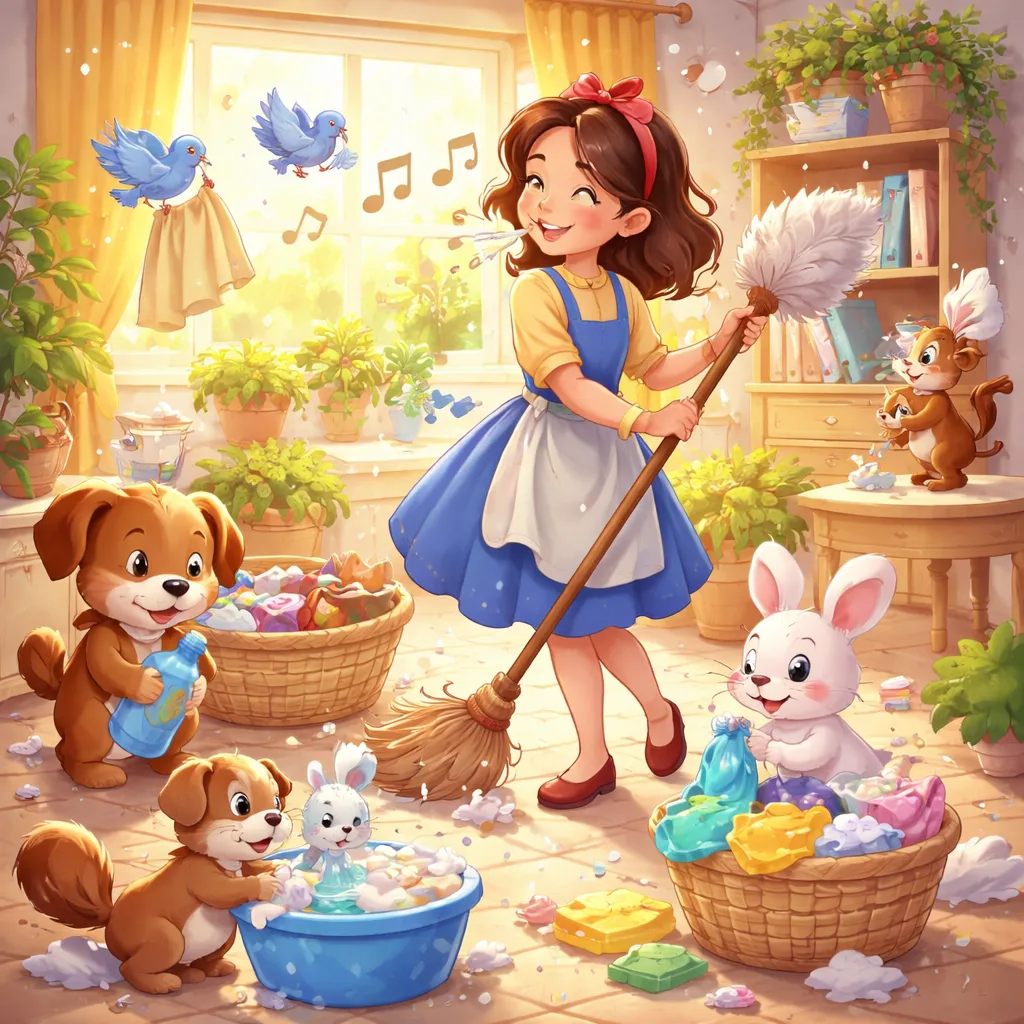

Some songs have the power to change how we feel about work. The English song: Whistle While You Work (from Snow White) offers exactly that kind of magic. Snow White sings this cheerful tune to her animal friends as she cleans the dwarfs' cottage. She turns a boring task into a joyful game. For families learning English together, this song provides a wonderful way to explore daily routines, action words, and the power of a positive attitude. Let us discover how this classic tune can transform your family's approach to chores and language learning.
What Is the Story Behind This Famous Song?
The English song: Whistle While You Work (from Snow White) appears in Disney's 1937 classic, Snow White and the Seven Dwarfs. After fleeing her wicked stepmother, Snow White discovers a tiny cottage in the woods. She finds seven small chairs and seven small beds. The cottage is messy and dusty. Snow White decides to clean it as a surprise for the dwarfs who live there.
She notices that animals are watching her through the windows. At first they seem shy. But Snow White sings to them, and soon they come inside to help. The animals include birds, squirrels, deer, raccoons, and many others. They work together to clean the entire cottage. Birds carry laundry. Squirrels dust with their tails. Turtles scrub the floor. Everyone works happily because they whistle while they work.
Frank Churchill composed the music, and Larry Morey wrote the lyrics. The song became an instant hit and remains one of Disney's most beloved tunes. Its message about finding joy in work has inspired generations of listeners. Understanding this background helps families appreciate why the song continues to resonate with children and adults alike.
The Complete Lyrics of the Song
Reading the words helps us understand the song's cheerful message. Here are the lyrics to the English song: Whistle While You Work (from Snow White). Let us look at them in sections.
Just whistle while you work
And cheerfully together we can tidy up the place
So hum a merry tune
It won't take long when there's a song to help you set the pace
And as you sweep the room
Imagine that the broom is someone that you love
And soon you'll find you're dancing to the tune
When tidying up the nursery, the kitchen or the garden up above
Just whistle while you work
Put on that grin and start right in to whistle loud and long
Just hum a merry tune
Just do your best and take a rest and sing yourself a song
When there's too much to do
Don't let it bother you, forget your troubles
Try to be just like a cheerful chick-a-dee
And whistle while you work
Learning New Words from the Song
The English song: Whistle While You Work (from Snow White) introduces many useful words. Let us explore them together.
First, "whistle" means to make music by blowing air through your lips. People whistle when they feel happy. Not everyone can whistle, but everyone can hum or sing. The song teaches that making music while working helps time pass quickly.
The song mentions "tidy up the place". Tidy means clean and organized. To tidy up means to put things in their proper places. This phrase appears often in family life. For example, "Let's tidy up your room" or "We need to tidy up before dinner".
Another word is "sweep". To sweep means to clean a floor with a broom. A broom has a long handle and bristles. Snow White sweeps the cottage floor. Children can learn this word when helping with household chores.
The song talks about a "nursery". A nursery is a child's room. The dwarfs' cottage has a bedroom area. In homes, a nursery might mean a baby's room. The word also appears in "nursery rhymes", which are songs for children.
"Garden up above" refers to the outdoor space. Gardens have plants, flowers, and sometimes vegetables. The animals in the movie come from the garden and forest.
Another lovely word is "chick-a-dee". A chickadee is a small bird with a cheerful song. The song suggests we should be like this happy bird. Learning animal names through songs makes them easy to remember.
Exploring Pronunciation and Rhythm
The English song: Whistle While You Work (from Snow White) offers wonderful practice with English rhythm. The bouncy tune makes it easy to feel the natural stress patterns.
Listen to the opening line "Just whistle while you work". The rhythm goes JUST WHIST-le while you WORK. The strongest beats fall on "just", "whist", and "work". Clapping along helps children feel this pattern. English speakers emphasize certain syllables, and songs train our ears to hear them.
The line "cheerfully together we can tidy up the place" has a faster rhythm. Breaking it into smaller chunks helps. "Cheerfully together" then "we can tidy up the place". Practicing phrases like this builds fluency.
The song also uses playful sounds. "Chick-a-dee" has three quick syllables. CHICK-a-DEE. The strong beat falls on the first and last syllables. Saying animal names with correct rhythm helps children sound more natural when speaking English.
Finding Grammar Patterns in the Lyrics
The English song: Whistle While You Work (from Snow White) offers useful grammar examples. One pattern appears in the opening line. "Just whistle while you work" uses the imperative form. This gives friendly advice or instruction. We use imperatives often in daily life. For example, "Wash your hands" or "Listen to this song".
The song also uses "while" to show two things happening at the same time. "Whistle while you work" means do both together. We use "while" constantly in English. For example, "Sing while you clean" or "Listen while you drive".
Another pattern appears with "imagine that the broom is someone that you love". This uses the present tense to describe an imaginary situation. "Imagine" introduces a make-believe scenario. We use this structure for creative thinking. For example, "Imagine you are a bird" or "Imagine we live in a castle".
The song also uses "don't let it bother you". This is a negative imperative. "Don't" plus a verb tells someone not to do something. It gives advice about what to avoid. For example, "Don't worry" or "Don't forget your lunch".
The line "try to be just like a cheerful chick-a-dee" uses "try to" plus a verb. This structure shows effort toward a goal. For example, "Try to be kind" or "Try to finish your homework".
Fun Learning Activities for the Whole Family
Listening to the English song: Whistle While You Work (from Snow White) can inspire many family activities. Here are some ideas to try together.
First, have a chore party. Choose a room that needs tidying. Play the song and work together while it plays. See how much you can accomplish during one song. When the song ends, admire your work. Talk about how music made the task feel easier. Use sentences like "The music helped me work faster" or "I felt happier while cleaning".
Second, try the broom dancing game. Give everyone a broom or mop. Play the song and dance while pretending to clean. Swing the broom like a dance partner. Spin and twirl. This connects movement with language and makes cleaning feel like play.
Third, create an animal helpers story. After listening to the song, imagine which animals would help your family clean. Would squirrels dust? Would birds carry laundry? Draw pictures and write simple sentences. "The squirrel dusts with his tail" or "The bird carries the cloth". This builds imagination and writing skills.
Creating Printable Materials at Home
Families can make simple learning tools based on the English song: Whistle While You Work (from Snow White). These activities help reinforce new ideas.
Create chore cards with pictures. Draw or print images of common chores. Sweeping, dusting, making beds, washing dishes, tidying toys. On each card, write the action word and a simple sentence. "Sweep the floor" or "Make the bed". Use these cards to assign chores and practice vocabulary.
Make an animal action matching game. On one set of cards, write animal names from the song. Bird, squirrel, deer, raccoon, turtle, chickadee. On another set, write actions they might do. Fly, scurry, leap, wash, crawl, sing. Match each animal to an action and say the sentence. "The bird flies" or "The squirrel scuttles".
Create a fill-in-the-blank page using song lyrics. Remove key words like "whistle", "work", "tidy", "sweep", and "broom". Leave blanks where those words belong. Listen to the song together and fill in the missing words. This builds listening and spelling skills.
Connecting the Song to Daily Life
The English song: Whistle While You Work (from Snow White) teaches a valuable lesson about attitude. Work feels different when we approach it with joy. This applies to everything in life, not just cleaning.
Talk with your children about tasks they dislike. Maybe it's homework or brushing teeth. Brainstorm ways to make those tasks more fun. Can you sing while doing homework? Can you pretend your toothbrush is a magic wand? Use English to share these ideas. "I could sing my spelling words" or "I can pretend my toothpaste is fairy dust".
The song also teaches about teamwork. Snow White and the animals work together. In families, teamwork makes chores faster and more fun. Use the song to inspire family teamwork. "Let's whistle while we work together" or "Everyone helps and we finish quickly".
Parents can model the song's message. When doing your own chores, hum or whistle. Say things like "I'm going to whistle while I cook dinner" or "This laundry will go faster with music". Children learn attitudes from watching us. When they see us enjoying work, they learn to do the same.
Educational Games to Play Together
Games make learning with the English song: Whistle While You Work (from Snow White) exciting. Here are some simple games to try.
Play the action guessing game. One person acts out a chore without speaking. They pretend to sweep, dust, wash dishes, or make a bed. Others guess the action and say it in a sentence. "You are sweeping the floor" or "You are making the bed". This builds vocabulary through movement.
Try the animal helper game. Name a chore, and everyone suggests an animal that could help. "Who can help sweep?" "A squirrel could use its tail!" "A bird could carry dust!" This builds creativity and animal vocabulary.
Play the rhythm clapping game. Clap the rhythm of different lines from the song. Others guess which line you are clapping. This builds listening skills and phonological awareness.
Why This Song Helps English Learning
The English song: Whistle While You Work (from Snow White) helps learners in special ways. The message connects directly to the learning process itself. Learning English takes work. But finding joy in that work makes it easier. The song teaches children to approach language learning with a cheerful attitude.
The simple vocabulary matches what beginners need. Words like work, tidy, sweep, broom, and room appear in daily conversations. Learning them through song makes them easy to recall later.
The repetition in the song also helps. Key phrases like "whistle while you work" appear multiple times. Repetition builds memory without effort. By the end of the song, children can sing the main message themselves.
The cheerful melody creates positive associations. When children feel happy, their brains learn better. The song's upbeat mood supports language acquisition naturally.
Making Music Part of Your Routine
Families can make songs a regular part of English time. Choose one song each week to explore together. Listen during morning routines or while doing chores.
The English song: Whistle While You Work (from Snow White) works perfectly for cleanup time. Play it whenever the family needs to tidy up. Let the music transform work into play. Soon children will associate the song with happy cleaning moments.
Remember that language learning happens best in joyful moments. When children associate English with music, movement, and family fun, they want more. Keep singing, keep cleaning, and keep whistling while you work together. The chores get done faster, and the language learning happens naturally along the way.