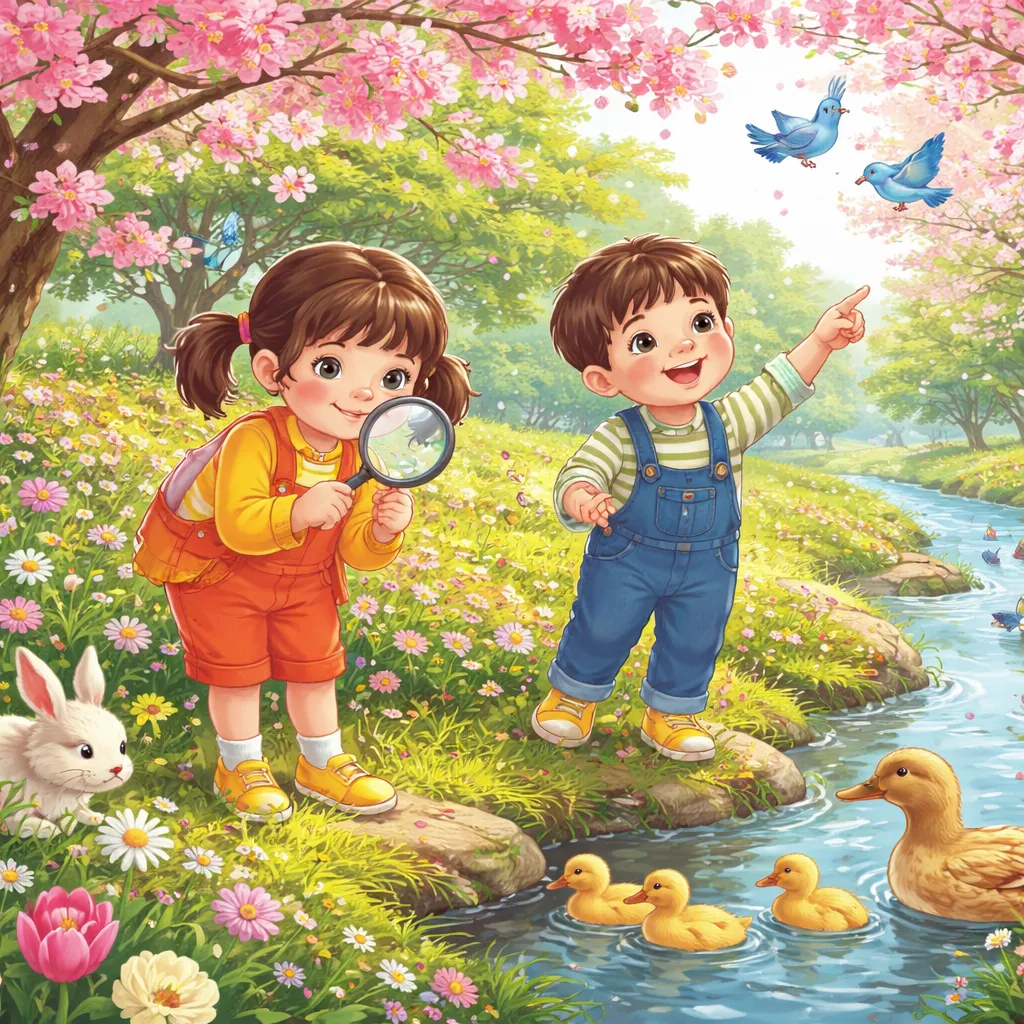

Have you ever gone on a treasure hunt, looking for clues to find a hidden prize? Imagine if the treasure was a whole season! When the cold winter starts to fade, how do you know spring has arrived? In China, there is a very cheerful, playful song that turns the search for spring into a fun, musical detective game. It’s a song that teaches you exactly where to look. Let’s go exploring with the classic tune “Where Is Spring?” (春天在哪里, Chūntiān zài nǎlǐ).
About the Song
Let’s read the curious, rhyming words of this famous song.
春天在哪里呀?春天在哪里?
春天在那青翠的山林里。
这里有红花呀,这里有绿草,
还有那会唱歌的小黄鹂。
春天在哪里呀?春天在哪里?
春天在那湖水的倒影里。
映出红的花呀,映出绿的草,
还有那会唱歌的小黄鹂。
English Translation:
Where is spring? Where is spring?
Spring is in the green mountains and forests.
There are red flowers here, and green grass here,
And also the little oriole that can sing.
Where is spring? Where is spring?
Spring is in the reflection of the lake.
Reflecting red flowers, reflecting green grass,
And also the little oriole that can sing.
This song is a beloved Chinese children’s song from the 1980s. It was composed by Pan Zhenwei (潘振声) with lyrics by Wu Tianqi (吴天奇). The song is structured as a joyful question-and-answer. A child asks, “Where is spring?” and then the song provides clear, visual answers: look in the green mountains, at the red flowers and green grass, and listen for the singing oriole. Then, look at the lake’s reflection to see spring’s beauty mirrored. The song is active, encouraging children to use their eyes and ears to discover the signs of the season in the world around them. It is a staple of springtime in Chinese schools and homes.
What the Song is About
The song paints a picture of an active, sensory search. The singer is curious and asks the main question twice: “Where is spring?” This shows they are really looking. Then, they find the first answer. Spring is hiding in the green mountains and forests. What proof is there? The singer points them out: red flowers, green grass, and a little yellow oriole bird that is singing a happy song.
But spring is in more than one place! The singer then finds spring again, this time in the reflection on the surface of a lake. The same beautiful things—the red flowers, green grass, and the idea of the singing bird—are seen mirrored in the water. The song doesn’t tell a story with a plot. Instead, it is a guide. It teaches you the clues that mean spring has arrived: new colors, new life, and new sounds. It’s about becoming a detective of beauty and noticing the small, joyful changes in nature.
Who Made It & Its Story
“Where Is Spring?” was created in the 1980s by composer Pan Zhenwei, a famous figure in Chinese children’s music, and lyricist Wu Tianqi. The song was written for and popularized by Chinese children’s television and radio programs. It quickly became a classic because it perfectly captured the excitement of spring in a way that was easy for children to learn and sing. The song’s simple, clear structure made it an effective educational tool for teaching about seasons and nature observation. It reflects a time when Chinese children’s music focused on positive, uplifting themes connected to the natural world and happy childhood. The song remains a seasonal anthem, played every spring as a reminder of renewal and joy.
This song has remained a springtime favorite for three vibrant reasons. First, its melody is incredibly bouncy, catchy, and full of energy, making it impossible not to smile and move while singing. Second, it is highly interactive and educational—it asks a direct question and gives clear, repeatable answers, turning learning into a game. Third, it empowers children as observers. The song doesn’t just describe spring; it gives children a checklist (look for green, red, listen for birds) so they can go out and confirm the findings themselves, building confidence and connection to nature.
When to Sing It
This song is perfect for active, outdoor exploration. You can sing it loudly on a family hike or walk in the park, pointing to the “red flowers” and “green grass” as you see them. You can chant it in the classroom when learning about seasons, acting out the parts. You can also sing it on a car ride, playing a game to see who can spot the signs of spring first, matching the song’s clues.
What Children Can Learn
This investigative, joyful song is a wonderful teacher about nature, language, and observation.
Vocabulary
The song teaches us key nature and color words. “Spring” (春天, chūntiān) is the season between winter and summer when plants grow. “Green” (青翠, qīngcuì / 绿, lǜ) is the color of grass and leaves. “Mountain” (山, shān) is a very high hill. “Forest” (林, lín) is a large area covered with trees. “Red flower” (红花, hónghuā) is a bloom with red petals. “Grass” (草, cǎo) is the green plant that covers the ground. A “lake” (湖水, húshuǐ) is a large area of water surrounded by land. “Reflection” (倒影, dàoyǐng) is an image seen in water or a mirror. An “oriole” (黄鹂, huánglí) is a yellow songbird.
Let’s use these words! You can say, “The forest was quiet and peaceful.” Or, “We saw our reflection in the calm lake.” New word: Phenology. This is the study of seasonal changes in nature, like when flowers bloom. The song is a simple lesson in phenology!
Language Skills
This song is a masterful lesson in asking questions about location and using location words. The core of the song is the question “春天在哪里?” (Where is spring?). This uses the structure: Subject (春天) + 在 (is at) + 哪里 (where). It’s the standard way to ask where something is in Chinese.
The answer uses the location word “在” (is at/ in) to tell us: “春天在…山林里” (Spring is in the mountains and forests). The “里” (lǐ) means “inside,” showing location. The song also uses the existential verb “有” (there is/are) to list what exists in that place: “这里有红花…” (Here there are red flowers…). This pattern is perfect for describing scenes.
Sounds & Rhythm Fun
Listen to the bouncy, skipping, energetic rhythm of the melody. The song is in a lively 2/4 or 4/4 time, which makes it perfect for marching or hopping. The question “春天在哪里呀?” is sung with a rising, curious tone. The answer has a more declarative, happy melody. The song uses playful fillers like “呀” (ya) to make it sound more like spoken excitement. The Chinese lyrics have a very clear, catchy rhyme: “里” (lǐ) and “里” (lǐ), “林” (lín) and “鹂” (lí), “草” (cǎo) and “鹂” (lí).
The rhythm is peppy and light. Try a happy skip: 春 天 在 哪 里 呀?春 天 在 哪 里?(chūntiān zài nǎlǐ ya? chūntiān zài nǎlǐ?). The melody is based on a simple, repeating question-answer pattern that is incredibly easy to remember. This repetitive, call-and-response-like musical pattern is what makes the song so effective as a learning tool. You can write your own “Where is it?” song! Use the same bouncy rhythm. Try: “Where is happiness? Where is happiness? It’s in the family laughing together. There’s a shared joke, and a helping hand, and the feeling of being close forever.”
Culture & Big Ideas
“Where Is Spring?” is a product of the modern Chinese children’s music movement that blossomed in the late 20th century. It connects to the ancient Chinese tradition of celebrating spring festivals, such as the Spring Festival (Chinese New Year) and Qingming Festival (Tomb-Sweeping Day), which are times for outdoor activities and appreciating nature’s rebirth. The song reflects the educational philosophy of learning through play and direct experience. It also subtly teaches the concept of reflection—both literally in the water and metaphorically, as we reflect on beauty. The song embodies the hope and optimism associated with spring, a time for new beginnings, which is a powerful theme in Chinese culture.
The song conveys three important ideas. First, it’s about active, engaged observation. Knowledge (finding spring) comes from looking closely at the world, not just being told. Second, it expresses that beauty is often found in everyday, simple things—common flowers, grass, birdsong. You don’t need to go far; spring is right here. Third, it highlights the interconnectedness of senses and places. Spring isn’t in one spot; it’s in the mountains, the reflections, the sounds. It’s a multi-sensory experience that connects different parts of the landscape.
Values & Imagination
Imagine you are the spring detective. You have a magnifying glass. What do you look at first? The ground for new green shoots? The trees for buds? Now, imagine you find the “little oriole that can sing.” Can you hear its song? Is it a melody? A whistle? Draw a “Wanted” poster for Spring. Instead of a criminal, draw a friendly face for Spring. In the “description” box, list the clues from the song: “Last seen in green mountains. Associates with red flowers and green grass. Known to be accompanied by a singing yellow oriole. May be found reflected in lakes.” This turns the search into a creative project.
The song encourages curiosity, close observation of nature, and appreciation for the simple, renewing joys of each season. A lovely idea is to go on a “Spring Scavenger Hunt.” With your family, take the song’s clues (find something green, something red, hear a bird, see a reflection) and go for a walk. Check off each clue as you find it. Take pictures or draw what you see. This turns the song into a real-world adventure.
So, as the last note about the singing oriole fades, think about the joyful discovery in this simple tune. It is a vocabulary lesson in nature and color. It is a grammar lesson in asking “where” and describing location. It is a music lesson in a bouncy, questioning rhythm. From the first curious question to the final reflected image, it wraps lessons in observation, finding beauty in the everyday, and the interconnectedness of nature in a tune that makes you want to run outside and investigate. “Where Is Spring?” teaches us that answers are found by looking, that the world is full of clues, and that the changing seasons are the most wonderful treasure hunt of all.
Your Core Takeaways
You are now an expert on the song “Where Is Spring?” (春天在哪里). You know it is a modern Chinese children’s song that turns finding spring into a question-and-answer game. You’ve learned words for colors and nature like “green mountains” and “oriole,” and you’ve practiced asking “where” questions and using location words in Chinese. You’ve felt its bouncy, energetic rhythm and created your own search song. You’ve also discovered the song’s role in seasonal celebration and its messages about active observation, finding beauty in simple things, and the multi-sensory experience of nature.
Your Practice Missions
First, host a “Spring Concert” walk. Go outside with your family. As you walk, sing the song. Whenever you sing a clue (“red flowers”), everyone must point to a real example. If you hear a bird, stop and say, “There’s the singing oriole!” This makes the song an interactive, real-time exploration.
Second, create a “Spring in My Neighborhood” collage. Using old magazines, newspapers, or your own drawings, create a collage that shows where spring is in your area. Include the song’s clues (something green, something red, a bird, water). Add your own clues too! Present your collage and explain where you found spring. This activity encourages artistic expression and personalized observation, extending the song’s mission.