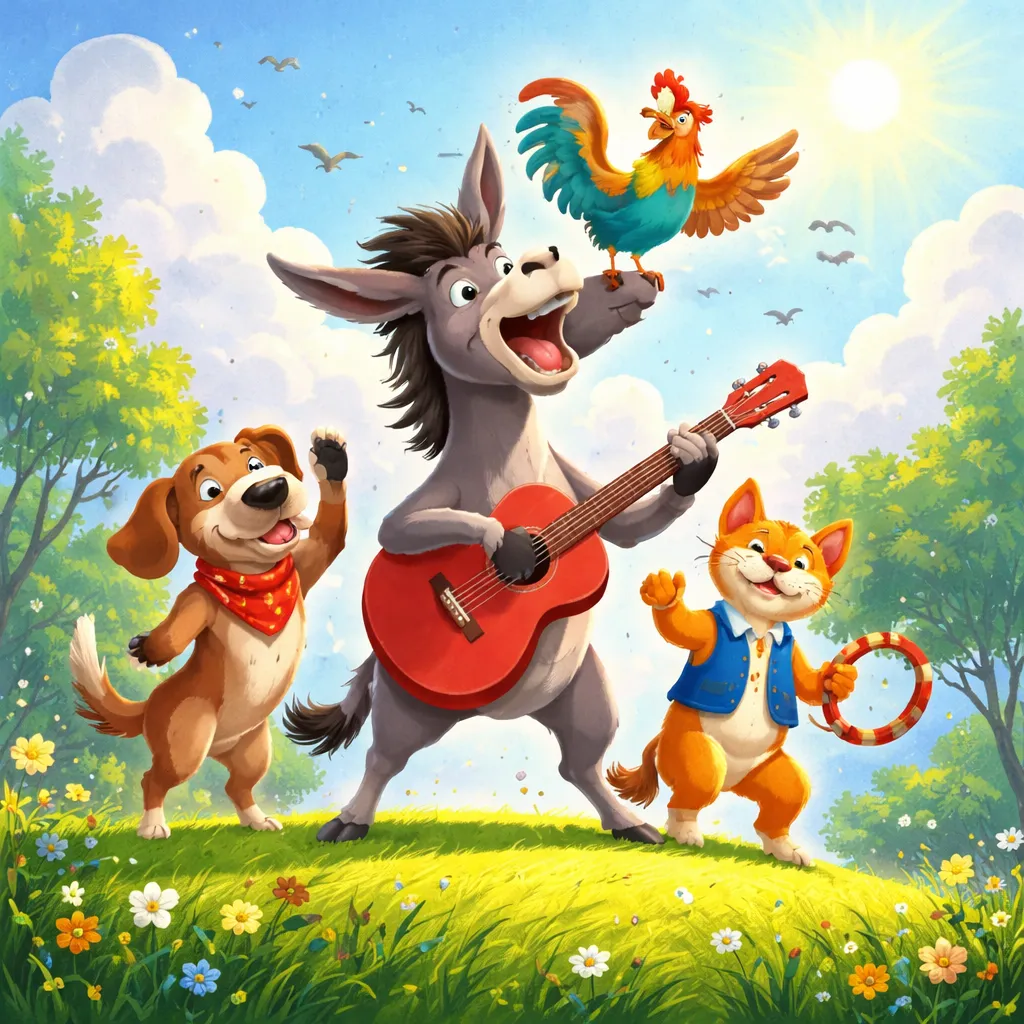

Imagine you and your best friends decide to go on a big adventure. You pack a small bag. You walk down a long road. The sun is shining, and you have no plans, just the whole wide world ahead of you. Wouldn’t that feel exciting? Now, imagine your friends are a dog, a cat, a rooster, and a donkey, and you all love to sing! This is the story of a famous song. Let’s hit the road and learn the Russian song “The Song of the Bremen Town Musicians (Песня бременских музыкантов).”
About the Song
Here is the energetic and famous chorus of this beloved song:
Ничего на свете лучше нету,
Чем бродить друзьям по белу свету.
Тем, кто дружен, не страшны тревоги,
Нам любые дороги дороги!
Нам любые дороги дороги!
Ла-ла-ла-ла-ла-ла-ла-ла-ла-ла,
Ла-ла-ла-ла-ла-ла-ла-ла-ла-ла!
English Translation:
There is nothing better in the world,
Than for friends to wander the wide world.
For those who are friendly, worries are not scary,
Any road is dear to us!
Any road is dear to us!
La-la-la-la-la-la-la-la-la-la,
La-la-la-la-la-la-la-la-la-la!
This is the iconic, joyful main song from the 1969 Soviet cartoon “The Bremen Town Musicians,” a rock-and-roll inspired musical based on the Brothers Grimm tale. The music was composed by the brilliant Gennady Gladkov, with lyrics by the poet Yuri Entin. The song is sung by the Troubadour and his animal friends—the Donkey, Dog, Cat, and Rooster. It is a bold declaration of their choice to live freely, travel, and stick together. It is a song about friendship, adventure, and the unbeatable joy of being on the road with your best pals.
What the Song is About
The song is a happy anthem of freedom. The friends sing loud and clear that “there is nothing better in the world” than wandering the wide world with your friends. They look at the road stretching ahead and feel excitement, not fear. They know that as long as they are together, no troubles can scare them.
They sing that “any road is dear to us.” This means every path, even a difficult one, is good because they are walking it together. The song is full of movement and confidence. It tells the story of leaving a boring old life behind to chase adventures, laughter, and music under the open sky. The famous “la-la-la” part is a pure burst of musical joy.
Who Made It & Its Story
The song was created for a groundbreaking cartoon that turned a classic fairy tale into a modern musical comedy. The team of Gennady Gladkov (music) and Yuri Entin (lyrics) created a tune that mixed pop, rock, and bard styles, which was very new for Soviet animation. It became a cultural phenomenon. It is loved for three powerful reasons. First, its melody is incredibly catchy, upbeat, and has a driving, marching rhythm that makes you want to walk, dance, and sing along with a big smile. Second, it perfectly captures the spirit of youthful freedom and rebellion against a boring, settled life, encouraging listeners to value friendship and adventure over playing it safe. Third, its lyrics are deceptively simple but contain a deep, optimistic philosophy: that with friends by your side, the journey itself is the best destination, and no worry is too big.
When to Sing It
This song is the perfect anthem for any adventure. You can sing it loudly with friends at the start of a hiking trip or a long walk in the park, stomping your feet to the beat. You can blast it in the car during a family road trip, shouting the “la-la-la” part together. You can also sing it when you feel a little nervous about trying something new, to remind yourself that with friends, you can be brave.
What Children Can Learn
This energetic and philosophical song is a fantastic teacher for learning action verbs in the command form and vocabulary about journeys and friendship.
Vocabulary
The song teaches us powerful words about freedom and togetherness. “Nothing” (Ничего / nee-che-VO). “In the world” (на свете / na SVE-tye). “Better” (лучше / LOOSH-she). “Than” (чем / chem). “To wander” (бродить / bra-DEET’). “Friends” (друзьям / droo-ZYAM). “White world” (белу свету / BYEH-loo SVEH-too) – this is a poetic way to say “the wide world.” “Those who are” (Тем, кто / tym, kto). “Friendly” (дружен / DROO-zhen). “Not scary” (не страшны / nye STRASH-ny). “Worries” (тревоги / tree-VO-gee). “Any” (любые / lyu-BEE-ye). “Roads” (дороги / da-RO-gee). “Dear” (дороги / da-RO-gee) – this is a play on words! The same word “дороги” means both “roads” and “dear.”
Let’s use these words! You can talk about an adventure: “С друзьями любые дороги дороги!” (With friends, any roads are dear!) New word: Путешествие (poo-tee-SHEH-stvi-ye). This means “journey.” You can say, “Наше путешествие начинается!” (Our journey is beginning!)
Language Skills
This song is excellent for learning the imperative mood (command form) used for encouragement and the use of the dative case to express “for whom” something is good or dear.
Concept Definition: We are learning special forms of verbs used to tell someone what to do in a friendly, encouraging way, like “Don’t lose!” or “Sing!” We are also learning a special ending for words that show who receives an action or for whom something is true, like “for friends” or “dear to us.”
Features and Types: The command form for “you” (singular/friendly) often ends in “-й” or “-и”. “Терять” (to lose) becomes “не теряй” (don’t lose!). “Петь” (to sing) becomes “пой” (sing!). The dative case often answers “to whom?” or “for whom?”. “Друг” (friend) becomes “друзьям” (to/for friends). “Мы” (we) becomes “нам” (to/for us).
Example from the song: Command: “Не теряй” (Don’t lose!), “Пой” (Sing!). Dative: “друзьям бродить” (for friends to wander), “нам дороги” (dear to us).
How to Spot Them: Here is the “Friendly Boss” trick. Look for verbs that sound like a direct, short instruction. Ask: “Is the singer telling someone to do something in a cheerful way?“ For the dative, look for words ending in “-ам”, “-ям”, or “-ем”. Ask: “Is this showing who gets to do something or for whom something is good?“
How to Use Them: A great way to encourage a friend is the “[Command verb]!” formula. To say something is good for someone, use the “[Dative word] + [is good].“ pattern.
Example from the song: “Не теряй, пой!“ (Don’t lose, sing!)
Example you can make: “Смотри, друг!“ (Look, friend!) “Мне весело. Родителям приятно.“ (It’s fun for me. It’s nice for the parents.)
Sounds & Rhythm Fun
The melody of “Песня бременских музыкантов” is a brilliant mix of a folk-like tune and a 1960s pop beat. It is fast, cheerful, and has a strong, marching rhythm that makes you want to walk with purpose. The melody is very memorable and swings up and down.
The sounds are bold and full of character. The repeated, catchy “ла-ла-ла” part is pure, joyful nonsense that everyone can sing. The words “дороги дороги” are a fun play on words that sound musical. The rhythm is steady and driving, like footsteps on a long road. This strong, swinging rhythm is perfect for creating your own adventure chant. Try marching and singing: “Мы идём, мы поём, нам так весело вдвоём! Эй-ей-ей, смелей, скорей за друзей!“ (We walk, we sing, it’s so fun for us together! Hey-ey-ey, be braver, quicker, for our friends!)
Culture & Big Ideas
This song is a cornerstone of Soviet animation and popular music. The 1969 cartoon was revolutionary, using modern music (jazz, rock) and a more rebellious, freedom-loving hero (the Troubadour). The song became an unofficial anthem for young people valuing friendship and personal freedom, and it remains hugely popular at parties and concerts today.
The song conveys three powerful, uplifting ideas. First, it champions friendship as the ultimate source of strength and security, explicitly stating that “for those who are friendly, worries are not scary.” Second, it romanticizes the journey over the destination, promoting curiosity, adventure, and a love for the unknown path as the greatest joy in life. Third, it expresses a bold, optimistic choice to prioritize happiness and freedom (“wandering”) over a conventional, safe, but potentially boring life, encouraging listeners to define their own path.
Values & Imagination
Imagine you are the Troubadour. You have your guitar. Your friends are beside you: the strong Donkey, the clever Dog, the graceful Cat, and the loud Rooster. The castle gates are behind you. The forest road is ahead. You all look at each other, smile, and start walking. As you walk, you start to sing. “Ничего на свете лучше нету…” The music fills the air. You are not rich. You have no castle. But you have the whole sky above and the whole road ahead. You have your friends and your song. That is everything. Draw this scene: a winding road through a forest. Draw the four animal friends and the Troubadour walking together, maybe with musical instruments. Draw big, bright notes coming from their mouths. This shows the song’s spirit of shared adventure.
The song encourages us to value our friends as adventure partners, to be brave in choosing our own path, and to find joy in the journey itself. It teaches that the best things in life are not things, but experiences shared with people you love. A wonderful activity is to form your own “Бременские Музыканты” (Bremen Town Musicians) band. Each person chooses an “instrument” (a spoon, a shaker, a pot). Choose a leader (the Troubadour). March around the room playing your instruments and singing the “la-la-la” part. This turns the song into a celebration of teamwork and music.
So, from the open road to the joyful “la-la-la,” the Russian song “The Song of the Bremen Town Musicians (Песня бременских музыкантов)” is an anthem of freedom and friendship. It is a vocabulary lesson in words for journeys and camaraderie. It is a language lesson in using friendly commands (“пой!”) and the dative case (“нам”). It is a music lesson in a driving, marching, swinging tune. It teaches us to walk bravely with friends, love the adventure, and sing our hearts out.
Your Core Takeaways
You are now an expert on the Russian song “The Song of the Bremen Town Musicians (Песня бременских музыкантов).” You know it is a joyful anthem from a cartoon about animal friends and a troubadour who choose a life of freedom, travel, and music on the open road. You’ve learned Russian words like “друзьям,” “бродить,” “тревоги,” “дороги,” and the command “пой,” and you’ve practiced the imperative mood for encouragement and the dative case to express “for whom.” You’ve felt its fast, cheerful, and marching rhythm that makes you want to move. You’ve also discovered the song’s message about friendship as strength, the joy of the journey, and the courage to choose your own happy path.
Your Practice Missions
First, play the “Командир Дружбы” (Friendship Commander) game. Take turns with a friend being the “Troubadour” who gives cheerful commands. Use the command form you learned. Say: “Смотри на дорогу! Пой громко! Не бойся!“ (Look at the road! Sing loudly! Don’t be afraid!). Your friend can march in place while following the commands. This mission helps you practice the song’s grammar for giving upbeat instructions.
Second, start your “Поход за Свободой” (Freedom Hike). Gather your stuffed animal “band.” Plan a short walk around your home or yard. As you start, sing the main chorus: “Ничего на свете лучше нету…” (You can just hum the tune or say the “la-la-la”). Point to the road ahead and declare: “Нам любые дороги дороги!“ This mission lets you act out the song’s core idea of beginning an adventure with your friends, no matter how small.