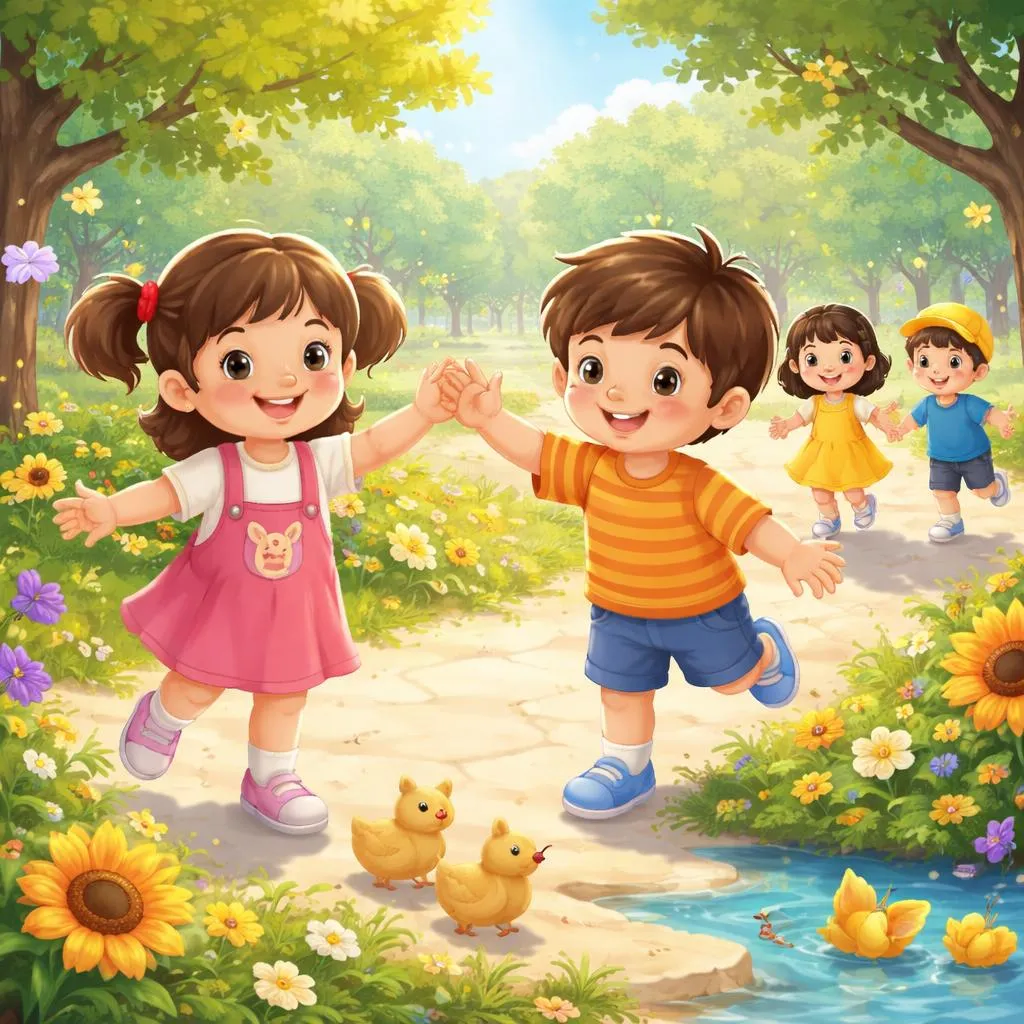

Have you ever been in a new classroom or a big playground and wanted to make a new friend? Sometimes, it can feel a little shy to just walk up and say hello. In China, there is a wonderful song that turns this important moment into a fun, musical game. It gives you the exact steps to follow! Let’s learn about the interactive song “Find Friends” (找朋友, Zhǎo péngyou).
About the Song
Let’s read the simple, action-filled words of this famous song.
找呀找呀找朋友,
找到一个好朋友。
敬个礼呀握握手,
你是我的好朋友。
再见!
English Translation:
Look, look, look for a friend,
Found a good friend.
Salute and shake hands,
You are my good friend.
Goodbye!
This song is a classic Chinese children’s song and game from the mid-20th century. It is a staple in Chinese kindergartens and early childhood education. The song provides a clear, polite script for social introduction. A child sings while walking around, performs the actions described in the lyrics (saluting, shaking hands), and directly addresses another child, calling them a “good friend.” The game ends with a cheerful “Goodbye!” It is a perfect tool for teaching young children basic social etiquette, cooperation, and the joy of making connections through music and play.
What the Song is About
The song paints a picture of a simple, successful social adventure. The singer is on a mission: to look for a friend. They sing “look, look, look” as they walk around, showing they are actively searching.
Soon, they succeed! They find someone and declare, “Found a good friend.” Then, they follow two polite actions: they salute (a sign of respect) and they shake hands (a sign of greeting and agreement). After these actions, they look at the new person and say clearly, “You are my good friend.” This makes the new connection official and positive. Finally, they say “Goodbye!” to end the interaction politely, perhaps to go and find another friend. The song is a mini-drama about the beginning and end of a friendly meeting, all set to music.
Who Made It & Its Story
“Find Friends” is a traditional Chinese children’s song, so its original author is unknown. It became widely used in Chinese kindergartens and primary schools in the latter half of the 20th century. The song was created as an educational tool during a time when collective activities and social harmony were strongly emphasized in early education. It reflects the cultural value placed on community, proper manners, and teaching social skills from a very young age. The song’s simple, repetitive structure and clear actions made it incredibly effective, and it has remained a fundamental part of growing up in China for generations.
This interactive song has remained essential for three wonderful reasons. First, it turns the sometimes-awkward process of making friends into a structured, fearless game. The music tells you exactly what to do and say. Second, it teaches physical and verbal manners (saluting, shaking hands, using polite language) in a way that is fun and easy to remember. Third, it is incredibly inclusive and active. Every child gets a turn to be the seeker and the friend, ensuring everyone participates and feels welcomed.
When to Sing It
This song is perfect for group gatherings and playdates. You can sing it at the beginning of a playdate with new children, using it as a fun way for everyone to meet. You can play it as a game in a circle with family, taking turns being the one who “finds” a friend. You can also sing it softly to yourself when you feel shy about saying hello, to remember the friendly steps.
What Children Can Learn
This social-skills song is a classroom of important lessons. Let’s explore what it teaches.
Vocabulary
The song teaches us key social and action words. “Find” (找, zhǎo) means to look for and discover something. A “friend” (朋友, péngyou) is a person you like and enjoy spending time with. “Good” (好, hǎo) here means kind or nice. To “salute” (敬礼, jìnglǐ) is to raise your hand to your forehead in a formal gesture of respect. To “shake hands” (握手, wòshǒu) is to hold someone’s hand and move it up and down as a greeting. “Goodbye” (再见, zàijiàn) is what you say when you are leaving.
Let’s use these words! You can say, “I want to find my red crayon.” Or, “We shake hands when we meet someone new.” New word: Etiquette. This means the rules for polite behavior in social situations. The song teaches simple friendship etiquette.
Language Skills
This song is a great lesson in using simple verbs for actions and the structure “你是我的…” (You are my…). The song starts with the repeated action verb “找” (look for). It then uses the verb “找到” (found), which is “找” plus a result complement, showing the action is completed.
The key sentence is “你是我的好朋友” (You are my good friend). This uses the structure: Subject (你, you) + Verb 是 (are) + Possessive (我的, my) + Noun Phrase (好朋友, good friend). It’s a clear, declarative sentence used to state a relationship. The song also uses action-measure words like “个” in “敬个礼” (give a salute).
Sounds & Rhythm Fun
Listen to the cheerful, marching, game-like rhythm of the melody. The song is in a bright 4/4 time. The repetition of “找呀找呀” (look, look, look) mimics the action of searching. The melody is simple and rises slightly on “找到一个好朋友” (found a good friend), creating a feeling of happy success. The lyrics have a clear, bouncy rhyme in Chinese: “友” (yǒu) and “手” (shǒu), and the same rhyme carries through to “朋友” at the end.
The rhythm is steady and walking. Try a stepping pace: 找 呀 找 呀 找 朋 友 (zhǎo ya zhǎo ya zhǎo péngyou). The tune is easy to remember because it follows the natural rhythm of the words and actions. This simple, repetitive, and action-oriented musical pattern is what makes the song so effective as a game. You can create your own greeting song! Use the same structure. Try: “Look, look, look for a helper, found a helpful helper. Give a smile and say ‘thank you,’ you are my great helper. Thanks!”
Culture & Big Ideas
“Find Friends” is a cornerstone of collective early education in Chinese culture. It comes from a pedagogical tradition that values group harmony, structured activity, and explicit teaching of social norms. The song connects to the importance of “礼貌” (lǐmào, politeness) and “团结” (tuánjié, unity) in Chinese society. It is often used during activities for the Mid-Autumn Festival or school opening days, when building a sense of community is key. The song reflects the idea that social skills are not just caught but can be kindly and playfully taught. It is a musical reflection of the value placed on friendship and respectful interaction within a group.
The song conveys three important ideas. First, it’s about proactive social initiation. It teaches that it’s okay to take the first step to look for a friend, and that there is a kind way to do it. Second, it expresses that friendship is built on mutual respect. The actions of saluting and shaking hands symbolize treating each other with equality and courtesy. Third, it highlights the temporary and recurring nature of social bonds. Saying “goodbye” is part of the game, teaching that interactions can have a polite beginning and end, and you can always start again—just like the next round of the song.
Values & Imagination
Imagine you are the one looking for a friend. You are walking around a sunny playground. Who will you choose? How do you feel when you stop in front of someone? Now, imagine you are the one found. How do you feel when someone salutes you, shakes your hand, and calls you their good friend? Draw a picture of the moment. Draw two children facing each other. One is saluting. Their hands are clasped in a handshake. Draw a big speech bubble that says, “你是我的好朋友!” (You are my good friend!). Draw smiles on both faces.
The song encourages bravery in making the first move, respect in greetings, and the joy of inclusive play. A lovely idea is to host a “Friendship Circle” at home. With your family, form a circle. One person walks around the outside singing the song (in English or Chinese!). At “found a good friend,” they tap someone on the shoulder. Both people step into the center, do the actions, and say the line. Then the first person joins the circle, and the new person becomes the seeker. This turns the song into a real, inclusive game for everyone.
So, as the final “Goodbye!” rings out, think about the social magic in this simple game-song. It is a vocabulary lesson in friendship and actions. It is a grammar lesson in stating relationships and using action verbs. It is a music lesson in a cheerful, marching rhythm. From the first search to the final farewell, it wraps lessons in courage, respect, and joyful connection in a tune that turns strangers into friends. “Find Friends” teaches us that friendship can be a game everyone can play, that manners are the key to kindness, and that a simple song can give you all the words you need to make a new friend.
Your Core Takeaways
You are now an expert on the song “Find Friends” (找朋友). You know it is a Chinese children’s game-song that teaches how to make a friend through polite actions. You’ve learned words like “find,” “salute,” and “shake hands,” and you’ve practiced the sentence “You are my good friend.” You’ve felt its cheerful, stepping rhythm and created your own greeting verse. You’ve also discovered the song’s role in Chinese education and its messages about taking social initiative, showing mutual respect, and the playful nature of building connections.
Your Practice Missions
First, play the “Find Friends” game. Gather your family or a group of friends. Teach them the song and the actions. Play multiple rounds so everyone gets to be the seeker. This is the best way to experience the song as it was meant to be—a live, social game.
Second, create a “Friendship Passport.” Make a small booklet. Each time you play the game or make a new friend in real life, draw a small picture of that friend or write their name in your passport. Decorate the page. This extends the song’s theme into a lasting record of the friends you’ve “found.”