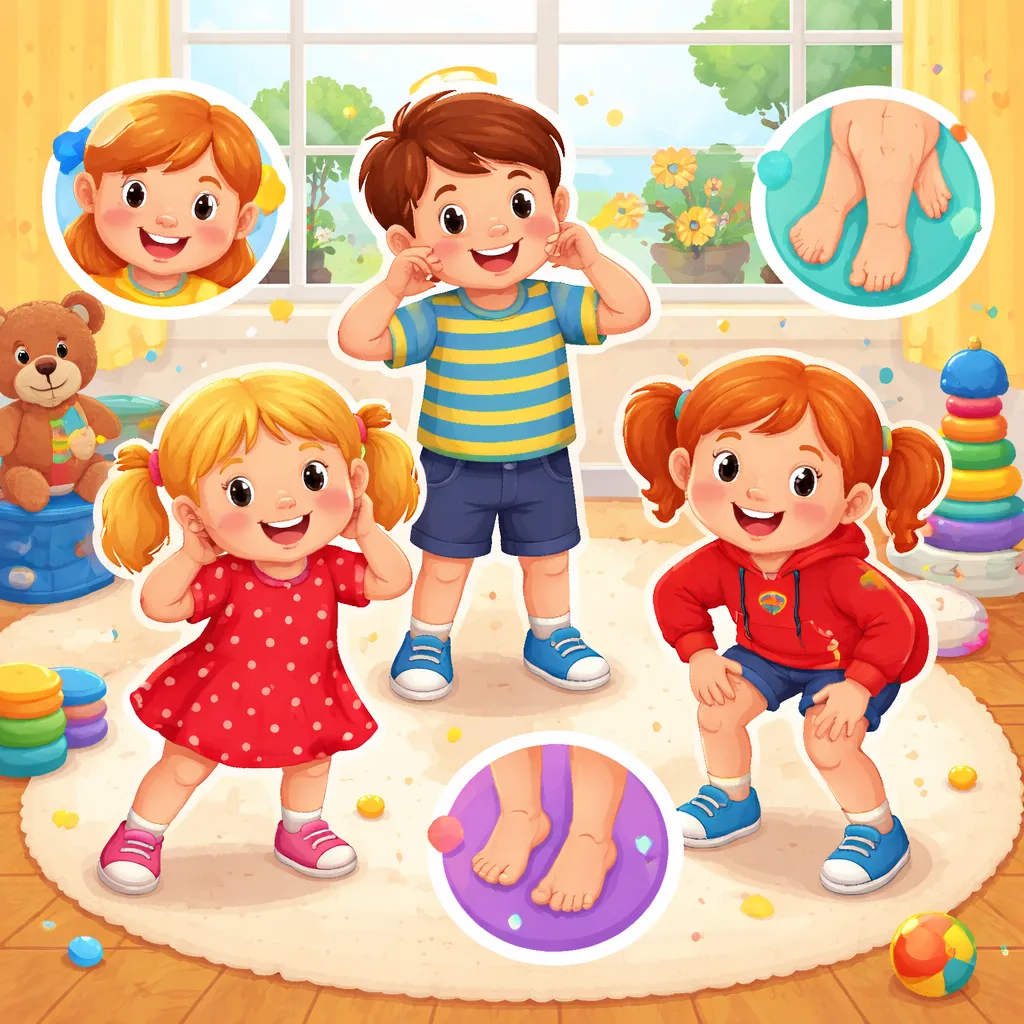

Your body is an amazing machine, and every part of it has a name! You know your head, your knees, and your toes. But can you point to them and say their names in another language? There is a super fun song that is also a game to help you do just that. Let’s get ready to touch, point, and sing the Russian song “Head, Shoulders, Knees and Toes (Голова, плечи, колени и пальцы).”
About the Song
Here are the lyrics for the energetic Russian version of this worldwide action song:
Голова, плечи, колени и пальцы,
Колени и пальцы.
Голова, плечи, колени и пальцы,
Колени и пальцы.
Глаза и уши и рот и нос.
Голова, плечи, колени и пальцы,
Колени и пальцы!
English Translation:
Head, shoulders, knees and toes,
Knees and toes.
Head, shoulders, knees and toes,
Knees and toes.
Eyes and ears and mouth and nose.
Head, shoulders, knees and toes,
Knees and toes!
This is the beloved Russian-language adaptation of the traditional English children’s action song. The song is a call-and-response game for your whole body. It takes the familiar tune and uses it to teach the Russian words for body parts in a fast, fun, and unforgettable way. It is a staple in Russian kindergartens, playgroups, and homes, turning language learning into a joyful physical challenge.
What the Song is About
The song is a speed game for your hands and your memory. You start by singing the first line: “Голова, плечи, колени и пальцы.” As you sing each word, you must quickly touch that part of your body. Your hands go to your head, then your shoulders, then your knees, then your toes. The next line repeats “Колени и пальцы” (Knees and toes), and you touch those parts twice.
Then comes the fun middle part: “Глаза и уши и рот и нос.” (Eyes and ears and mouth and nose). Your fingers fly to your eyes, ears, mouth, and nose. Finally, the song speeds up as you repeat the first verse, trying to touch all the parts faster and faster. The song is about matching a word to an action as quickly as you can, training your brain and your body to work together.
Who Made It & Its Story
“Head, Shoulders, Knees and Toes” is a traditional children’s song of unknown origin that spread across the English-speaking world in the 20th century. The Russian version, “Голова, плечи, колени и пальцы,” is a direct and perfect translation that became equally popular. It is loved for three big reasons. First, it is a powerful kinesthetic learning tool, linking physical movement directly to vocabulary, which helps children remember words much faster. Second, it is an energetic and inclusive game that gets everyone moving, laughing, and trying to keep up, perfect for burning energy and building coordination. Third, it has a simple, infinitely repeatable structure that can be sung slower for learning and faster for a hilarious challenge, always ending in giggles.
When to Sing It
This song is the perfect quick activity for any time you need to move and learn. You can sing it as a warm-up in the morning to wake up your body and your brain. You can sing it with friends during a playdate for a fun, active challenge to see who can keep up. You can also sing it as a cool-down after running around, helping to focus and calm down while still being engaged.
What Children Can Learn
This fast-paced action song is a wonderful teacher for learning body part vocabulary and practicing listening skills in Russian.
Vocabulary
The song teaches us clear, essential words for parts of the body. “Head” (Голова / ga-la-VA). “Shoulders” (Плечи / PLE-chi). “Knees” (Колени / KO-le-ni). “Toes” (Пальцы / PAL’-tsy – this also means ‘fingers’ in Russian). “Eyes” (Глаза / gla-ZA). “Ears” (Уши / U-shi). “Mouth” (Рот / Rot). “Nose” (Нос / Nos).
Let’s use these words! You can point and say: “Это мой нос.” (This is my nose.) New word: Тело (TYE-la). This means “body.” You can say, “Моё тело знает эту песню!” (My body knows this song!)
Language Skills
This song is excellent for learning about plural nouns for body parts, as many come in pairs (shoulders, knees, eyes, ears), and the use of the connecting word “и” (and) to list multiple items in a sequence.
Concept Definition: We are learning about words for more than one of something, especially things that come in twos like eyes and ears. We are also learning about a special small word, “и” (and), that we use to connect things together in a list.
Features and Types: Many body parts in the song are plural because we have two of them. “Плечо” (one shoulder) becomes “Плечи” (shoulders). “Глаз” (one eye) becomes “Глаза” (eyes). The word “и” is a conjunction. It acts like a plus sign (+) between words.
Example from the song: Plural Body Parts: “Плечи, колени…” Listing with “и”: “Голова, и уши и рот и нос.”
How to Spot Them: Here is the “Pair Finder” trick. Look for body part words that end with “-и” or “-а” like “плечи” or “глаза”. Ask: “Do I have one or two of these on my body?“ For the connector, look for the small word “и” between other words. Ask: “Is this word linking two other words together like a chain?“
How to Use Them: A great way to name your body is the “Мои [Body Parts]” (My [Body Parts]) formula. Use the plural form for pairs. To list them, use “и” between the last two items.
Example from the song: “Глаза и уши и рот и нос.“
Example you can make: “Мои руки и мои ноги.“ (My arms and my legs.)
Sounds & Rhythm Fun
The melody of “Голова, плечи…” is incredibly catchy, bouncy, and repetitive. The rhythm is steady and march-like, perfect for tapping along or touching body parts on the beat.
The sounds are clear and distinct. Each body part word has a strong syllable that you naturally touch on: “gla-va,” “PLE-chi,” “KO-le-ni,” “PAL’-tsy.” The repetition of “Колени и пальцы” helps solidify those two words. The middle section, “Глаза и уши и рот и нос,” has a wonderful rhythmic run of “и” (and) that makes it a tongue-twister when you sing it fast. This makes the song a fantastic memory and pronunciation game. You can use the same rhythm to learn other groups. Try a clothing song: “Шапка, куртка, носки и ботинки, носки и ботинки…“ (Hat, jacket, socks and boots, socks and boots…).
Culture & Big Ideas
This song is a global classic, and in Russia, it is deeply woven into early childhood education and pediatric care. Doctors and nurses might use it during check-ups to make children comfortable, and it is a guaranteed activity in any детский сад (DET-skiy sad, kindergarten) for developing motor skills and language together.
The song conveys three important developmental ideas. First, it builds body awareness and coordination, requiring children to listen to a word, identify the corresponding body part, and coordinate a precise movement to touch it, all in sequence. Second, it strengthens the connection between auditory processing (hearing the word) and physical response (touching the part), a key learning pathway. Third, it introduces the fun of a speed challenge in a safe, non-competitive way, as children compete against themselves to go faster, fostering persistence and a sense of personal achievement.
Values & Imagination
Imagine you are a scientist exploring a new robot. The robot is you! Your mission is to learn the name of every important part. You sing the activation code: “Голова, плечи, колени и пальцы!” As you say each name, you press the corresponding button on the robot—you touch your own head, shoulders, knees, and toes. The robot is booting up!
Now for the sensor check: “Глаза и уши и рот и нос.” You check the camera lenses (eyes), the microphones (ears), the speaker (mouth), and the air sensor (nose). All systems are go! The song gets faster and faster as you run the final diagnostic. Can your robot-arms keep up with the commands? Draw a picture of yourself as a robot or a fantastical creature. Label your drawing with the Russian words: “Голова,” “Плечи,” “Колени,” “Пальцы,” “Глаза,” “Уши,” “Рот,” “Нос.” This connects the fun game to a creative project.
The song encourages us to know and appreciate our amazing bodies, to see learning as an active game, and to challenge ourselves to get better and faster with a smile. A wonderful activity is to play “Зеркало” (Mirror). Stand with a friend face-to-face. One person is the leader and sings the song, doing the actions. The other person must be the mirror and copy every move exactly at the same time. Then switch!
So, from the top of your head to the tips of your toes, the Russian song “Head, Shoulders, Knees and Toes (Голова, плечи, колени и пальцы)” is a joyful, full-body language adventure. It is a vocabulary lesson in body parts. It is a language lesson in plural nouns and listing words with “и”. It is a music lesson in a fast, action-paced rhythm. It teaches us to listen, move, and learn all at once.
Your Core Takeaways
You are now an expert on the Russian song “Head, Shoulders, Knees and Toes (Голова, плечи, колени и пальцы).” You know it is a fast action game where you touch your head, shoulders, knees, toes, eyes, ears, mouth, and nose as you sing their Russian names. You’ve learned Russian words like “голова,” “плечи,” “колени,” “пальцы,” “глаза,” “уши,” “рот,” and “нос,” and you’ve practiced using the plural forms for paired body parts and the connecting word “и” (and) to list things. You’ve felt its bouncy, speeding-up rhythm. You’ve also discovered the song’s message about knowing your own body, connecting words with actions, and the fun of a personal speed challenge.
Your Practice Missions
First, play the “Найди и Прикоснись” (Find and Touch) scavenger hunt. Ask a family member to call out a Russian body part from the song. Your job is to find that part on your own body AND on a teddy bear or doll, and touch both as fast as you can! Say the word out loud as you touch: “Плечи!” This mission helps you connect the word to the body part on different “creatures.”
Second, have a “Сверхбыстрая Песня” (Super-Fast Song) challenge. Set a timer for 30 seconds. See how many times you can sing the entire song correctly while doing all the actions. Try to beat your own record! Do it once slowly to learn, then go faster and faster. This mission lets you master the vocabulary through playful, repeated speed practice, just like in the song.