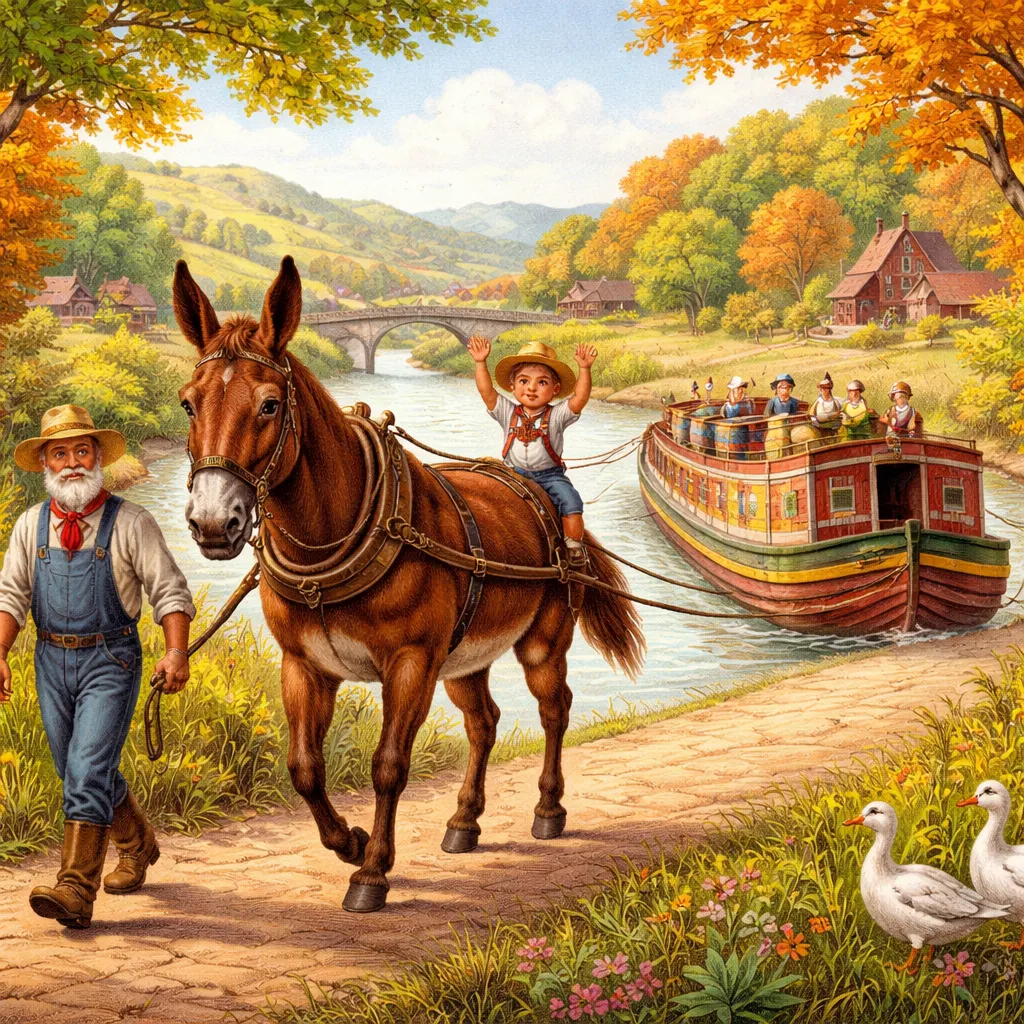

Imagine a time before trucks, trains, or planes. How did people move heavy things like wood and coal across a whole state? They used water! There is a famous, bouncing song about a man, his mule, and their long, slow journey on a man-made river. It’s a song about hard work, friendship, and a very important water road. Let’s learn about the folk song “Erie Canal.”
About the Song
Let’s read the rhythmic, story-filled words of this classic work song.
I’ve got a mule, her name is Sal,
Fifteen miles on the Erie Canal.
She’s a good old worker and a good old pal,
Fifteen miles on the Erie Canal.
We’ve hauled some barges in our day,
Filled with lumber, coal, and hay.
And we know every inch of the way,
From Albany to Buffalo.
Chorus:
Low bridge, everybody down!
Low bridge, for we’re coming to a town.
And you’ll always know your neighbor,
And you’ll always know your pal,
If you’ve ever navigated on the Erie Canal.
This song is a traditional American folk song, also known as “Low Bridge, Everybody Down” or “Fifteen Miles on the Erie Canal.” It is a rhythmic work song that tells the story of a canaler—a driver of a canal boat—and his mule, Sal, as they transport goods along the historic Erie Canal in New York State. The song was written in the early 20th century, with music by Thomas S. Allen and lyrics that capture the life and camaraderie of the canal workers. The Erie Canal, opened in 1825, was a engineering marvel that connected the Great Lakes to the Atlantic Ocean, transforming travel and trade in America.
What the Song is About
The song paints a vivid picture of a day’s work on the canal. The singer is a canaler. He introduces his partner, a mule named Sal. They travel a set distance of fifteen miles along the towpath next to the canal. He praises Sal as both a strong worker and a good friend, a “pal.”
He describes the cargo they have carried on their flat-bottomed boat, or barge: “lumber, coal, and hay.” He knows the route perfectly, from the city of Albany to the city of Buffalo. The most famous part is the warning in the chorus: “Low bridge, everybody down!” The bridges over the canal were very low. If you were standing on the boat, you had to duck quickly or get knocked into the water! The song says that sharing this experience of hard work and sudden danger created a strong bond between everyone who worked on the canal.
Who Made It & Its Story
The song “Erie Canal” (also called “Low Bridge, Everybody Down”) was written by Thomas S. Allen and published in 1913. Allen was a Tin Pan Alley songwriter, and he wrote the song in a folk style to celebrate the bygone era of canal travel, which was being replaced by railroads. While it sounds like an old work song passed down by boatmen, it was actually a commercial composition that perfectly captured the spirit and rhythm of that life. The song became a standard in American folk music, recorded by artists like Pete Seeger and Bruce Springsteen, ensuring the story of the canal workers would be remembered.
This song has remained a favorite for three wonderful reasons. First, its melody has a steady, clip-clopping rhythm that mimics the walking of the mule, making it fun and easy to sing. Second, it tells a very specific and fascinating story about a unique time in American history, teaching about transportation, work, and geography. Third, it celebrates the themes of teamwork, friendship, and shared experience, which are values that everyone can understand and appreciate.
When to Sing It
This song is perfect for active, rhythmic moments. You can sing it while taking a walk, stomping your feet to the “clip-clop” beat of the mule. You can sing it as a family while on a long car trip, imagining you’re moving slowly along the canal. You can also chant it while doing a chore that has a steady rhythm, like sweeping or wiping a table, pretending you’re hauling a barge.
What Children Can Learn
This rhythmic slice of history is a wonderful teacher. Let’s travel its length and see what we can learn.
Vocabulary
The song teaches us specific historical and work words. A “mule” is a strong animal, a mix between a horse and a donkey, used for pulling heavy loads. A “canal” is a human-made waterway for boats. A “barge” is a flat-bottomed boat for carrying heavy goods. “Lumber” is wood that has been cut into boards. “Haul” means to pull or transport something heavy. “Navigate” means to find your way and steer a boat. A “towpath” is the path alongside a canal where mules walk to pull the boats.
Let’s use these words! You can say, “The workers used a mule to haul the cart.” Or, “We learned about the Panama Canal in school.” New word: Towpath. This is the path where the mule walks to pull the boat.
Language Skills
This song is a great lesson in using the present perfect tense to talk about life experience and the imperative mood for warnings. The singer uses the present perfect to describe his and Sal’s career: “We’ve hauled some barges in our day.” This tense connects past actions to the present, showing it’s their life’s work.
The chorus uses the imperative for an urgent, friendly warning: “Low bridge, everybody down!” This is a command for immediate action. The song also uses the simple present tense to state facts about their routine: “I’ve got a mule… She’s a good old worker.”
Sounds & Rhythm Fun
Listen to the steady, clip-clopping, walking rhythm of the melody. The song perfectly mimics the slow, plodding walk of a mule on the towpath. The verses have a clear, bouncy rhyme scheme: “Sal” and “Canal,” “pal” and “Canal,” “day” and “hay,” “way” and “Buffalo” (a near-rhyme).
The rhythm is a steady 4/4 time, like marching. Try clapping a steady beat: I’VE got a MULE, her NAME is SAL. The melody is simple, repetitive, and tells a story, which makes it easy to remember. The chorus has a different, more urgent melody for the warning. This combination of a steady work rhythm and a sudden, shouted warning is what makes the song so memorable and fun. You can write your own transportation song! Use the same clip-clop rhythm. Try: “I’ve got a bike, her name is Ray, ten blocks on the parkway. She’s a good old rider, takes me all the way, ten blocks on the parkway. Watch out, car, I’m coming through! Watch out, for I’m passing you! And you’ll always know your buddy, when you’re sharing the road, if you’ve ever pedaled with a heavy load!”
Culture & Big Ideas
“Erie Canal” is a celebration of American industrial and transportation history. It comes from the era of canal building in the early 19th century, which was a revolutionary way to move goods and people. The song reflects the values of hard work, partnership between human and animal, and the close-knit community of workers who faced the same challenges. It is a musical monument to the workers whose labor helped build the nation’s economy.
The song conveys three important ideas. First, it’s about teamwork and partnership. The canaler and Sal are a team, depending on each other to get the job done. Second, it highlights adaptation and warning. The “low bridge” is a constant danger that requires quick thinking and communication, a metaphor for overcoming obstacles. Third, it’s about pride in shared experience and skill. The singer knows “every inch of the way” and takes pride in the specialized knowledge of his trade, and in the community it creates.
Values & Imagination
Imagine you are the canaler walking next to Sal. What do you see? The calm canal water? Trees along the bank? What do you hear? The mule’s hooves, the water lapping? How does the rope feel in your hands? Now, imagine you’re on the barge. You hear the shout “LOW BRIDGE!” What do you do? Duck! How close does the bridge come? Draw a picture of the scene. Show the mule on the towpath, the barge on the canal, and a very low bridge coming up. Draw the canaler on the boat, ducking just in time.
The song inspires appreciation for hard work, teamwork, and history. A lovely idea is to have a “Teamwork Haul.” With your family, choose a heavy object (a couch cushion, a full laundry basket). Everyone works together to move it slowly across the room, chanting a steady “heave, ho” or singing the song. Talk about how working together makes hard jobs easier, just like Sal and the canaler.
So, as the last note of this canal song fades, think about the journey it describes. It is a vocabulary lesson in historical transport. It is a grammar lesson in sharing experiences and giving warnings. It is a music lesson in a steady, clip-clopping rhythm. From the introduction of Sal to the final bond of the canal community, it wraps lessons in partnership, vigilance, and shared pride in a tune that feels as steady and enduring as the canal itself. “Erie Canal” teaches us that hard work can have a rhythm, that friends come in all shapes (even mules!), and that sharing a challenge creates a community that lasts.
Your Core Takeaways
You are now an expert on the song “Erie Canal.” You know it was written by Thomas S. Allen about the life of a canaler and his mule on the historic New York waterway. You’ve learned words like “barge,” “towpath,” and “navigate,” and you’ve practiced using the present perfect tense and imperative warnings. You’ve felt its clip-clopping rhythm and created your own transportation verse. You’ve also discovered the song’s role in celebrating American history, its messages about teamwork, adapting to obstacles, and the pride of skilled work.
Your Practice Missions
First, stage a “Canal Journey.” Clear a path in your home (the canal). One person is the mule (maybe on hands and knees), one is the canaler walking beside, and one is on the “barge” (a blanket that the mule pulls). Sing the song as you move. When the singer shouts “Low bridge!”, the person on the barge must duck! This active play brings the song to life.
Second, map the “Erie Canal.” With a grown-up’s help, look at a map of New York State. Find Albany and Buffalo. Trace the path of the Erie Canal between them (it goes from Buffalo on Lake Erie to Albany on the Hudson River). Then, draw your own simple map of the canal. Draw pictures of the cargo (lumber, coal, hay) at one end and the cities at the other. This connects the song to real geography and history.