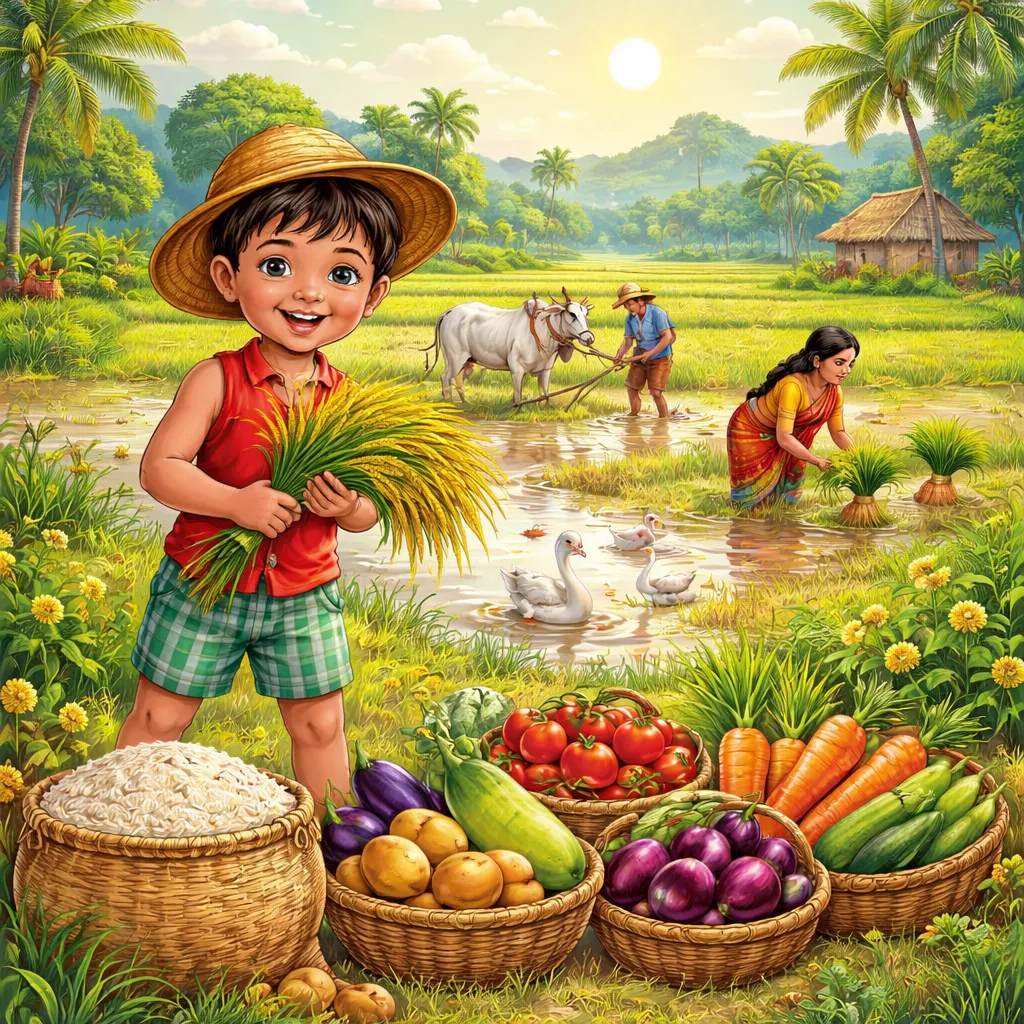

Have you ever helped to plant a tiny seed in a pot of soil? Have you watered it and watched for the first green shoot to push through? That small seed holds the promise of a whole plant! Now imagine a field full of thousands of seeds. Who cares for them? In Bangladesh and West Bengal, a land of fertile green fields, there is a humble song about the person who does this vital work. Let’s walk through the fields with the Bengali Song: The Little Farmer (কৃষক).
About the Song
Here is a verse from this grounded and important song in Bengali and English:
কৃষক, কৃষক, পরিশ্রমী কৃষক
(Krishok, krishok, porishromi krishok)
Farmer, farmer, hard-working farmer
তোমার হাতের ছোঁয়ায় ফলে ফসল
(Tomar hater chhuay fole foshol)
By the touch of your hand, fruits and crops yield
ধান ক্ষেতে, সব্জি ক্ষেতে
(Dhan khete, sobji khete)
In the paddy field, in the vegetable field
তোমার শ্রমে ভরে পাতিল
(Tomar shrome bhore patil)
Through your labor, the bowl fills
This song’s original name uses the Bengali word “কৃষক” (Krishok), which means “farmer.” It is a traditional and deeply respectful Bengali song. The song is a tribute to the farmer’s essential work. The music is often steady, earthy, and carries a feeling of patient effort. The Bengali Song: The Little Farmer (কৃষক) is a musical thank you, honoring the daily labor that turns seeds into the food that fills our plates and bowls.
What the Song is About
The song is a song of gratitude. First, it addresses the farmer with great respect, calling them “hard-working.” It highlights the magical connection between the farmer’s work and the result: “By the touch of your hand, fruits and crops yield.” The farmer’s skilled hands plant, tend, and harvest. The song lists the places of this work: “In the paddy field, in the vegetable field.” We can see vast green rice paddies and neat rows of vegetables. Finally, it connects the labor directly to our meals: “Through your labor, the bowl fills.” The empty bowl on our table is filled only because of the farmer’s effort under the sun. The whole song is about recognizing the source of our food and the dignity of the work that brings it to us.
Who Made It & Its Story
This song comes from the heart of Bengali folk tradition, where agriculture is the foundation of life. The original creator is unknown, as it is a song born from the people who live close to the land. Bangladesh and West Bengal are largely agricultural regions, with rice being the staple crop. The Bengali Song: The Little Farmer (কৃষক) is a core part of the culture’s respect for its food providers. It is cherished for three fundamental reasons. First, it teaches children, in a very direct way, the origin of the food they eat, fostering gratitude and reducing waste. Second, it celebrates hard work and perseverance as noble and essential values. Third, its melody is often simple and repetitive, like the rhythms of farm work, making it easy to remember and hum while doing chores, connecting daily life to the larger cycle of growth.
When to Sing It
You can sing this song while helping to wash vegetables for dinner, thinking of the farmer who grew them. It’s perfect to hum while watering plants at home or in a garden. You could also sing it during a meal, as a quiet moment of thanks before eating.
The Bengali Song: The Little Farmer (কৃষক) plants a seed of understanding about our world. But to help that understanding grow, we need to learn more. This song is our garden of knowledge. It teaches us words for farming and growth, shows us how to talk about cause and effect, and shares the deep cultural connection to the land. Let’s tend to this garden and see what we can harvest.
What Children Can Learn
Vocabulary
This song helps us learn words for farming, growth, and results.
Cultivate: To prepare and use land for growing crops. A farmer cultivates the soil.
Yield: The amount of crop produced. A good harvest has a high yield.
Irrigate: To supply water to land or crops. Farmers irrigate fields to help plants grow.
Harvest: The process of gathering a ripe crop. The harvest is the farmer’s reward.
Perseverance: Continued effort to do something despite difficulty. Farming requires great perseverance.
Sustenance: Food and drink regarded as a source of strength. Farmers provide our sustenance.
Language Skills
This song beautifully shows Cause and Effect through phrases like “by the touch” and “through your labor.” It explains how one action (the farmer’s work) leads to a result (food in our bowl).
What Is It?: Think of cause and effect as the “why and what happens.” One event (the cause) makes another event (the effect) happen. The farmer’s labor causes the bowl to fill.
Finding the Secret: Look for words that link an action to a result. Words like “by,” “through,” “because of,” or “so” can be clues. Ask: “What made this happen? What was the result?”
Using It:
◦   You can use the structure: [Cause] + leads to + [Effect]. or [Effect] + happens through + [Cause].

◦   Examples: “By planting seeds, we get flowers.” “Through hard work, we succeed.”

◦   The song says: “By the touch of your hand… crops yield.” “Through your labor, the bowl fills.” The farmer’s work is the cause, the food is the effect.
Sounds & Rhythm Fun
Listen to the earthy rhythm. The Bengali Song: The Little Farmer (কৃষক) often has a steady, deliberate, and grounded beat. It might sound like the rhythmic motion of digging or sowing seeds. The melody is usually simple and repetitive, like a work song that helps pass the time in the fields. This steady, un-rushed rhythm reflects the patient nature of farming and makes the song’s message of gratitude and hard work easy to absorb. You can use this same steady, patient rhythm to make up a song about any step-by-step task that takes time, like cleaning your room.
Culture & Big Ideas
This song is the heartbeat of Bengal’s agricultural identity. A major festival that celebrates this is Nabanna (New Rice), a harvest festival where the first rice of the season is cooked and shared with joy. The song is a daily echo of this celebration. The Bengali Song: The Little Farmer (কৃষক) teaches three vital ideas. First, Interdependence: We depend on farmers, and farmers depend on the earth and sun. We are all connected in a cycle of life. Second, The Dignity of Labor: There is great honor and importance in working with your hands to create something essential for everyone. Third, Patience and Process: Good things, like a full harvest, cannot be rushed. They follow the natural rhythm of seasons and care.
Values & Imagination
Imagine you are the little farmer. Feel the soil under your feet. Smell the rain on the field. How do you feel when you see the first sprouts? This song teaches you to appreciate the work behind your food and to never waste it. It shows the value of patience and caring for something over a long time. A simple idea: The next time you eat, look at your food for a few seconds. Think of the journey it took—from a seed cared for by a farmer, to the market, to your home. You can even say a quiet “thank you” in your mind.
Your Core Takeaways
The Bengali Song: The Little Farmer (কৃষক) is a heartfelt lesson in gratitude, patience, and the cycles of nature. You learned farming words like “cultivate,” “yield,” and “harvest.” You discovered how to understand and express cause and effect, how one action leads to a result. You felt the song’s steady, patient rhythm. You also connected the farmer’s work to Bengali harvest festivals like Nabanna. Most importantly, the song teaches that our food is a gift of hard work, that patience brings great rewards, and that we should always be thankful to those whose labor fills our bowls.
Your Practice Missions
- Be a “Cause and Effect” Gardener. Plant a bean in a cup with soil. As you care for it, say out loud the cause and effect. Example: “Because I gave it water (cause), the soil is wet (effect).” “Through placing it in the sun (cause), it will grow tall (effect).” Watch the effects of your care.
- Create a “Thank