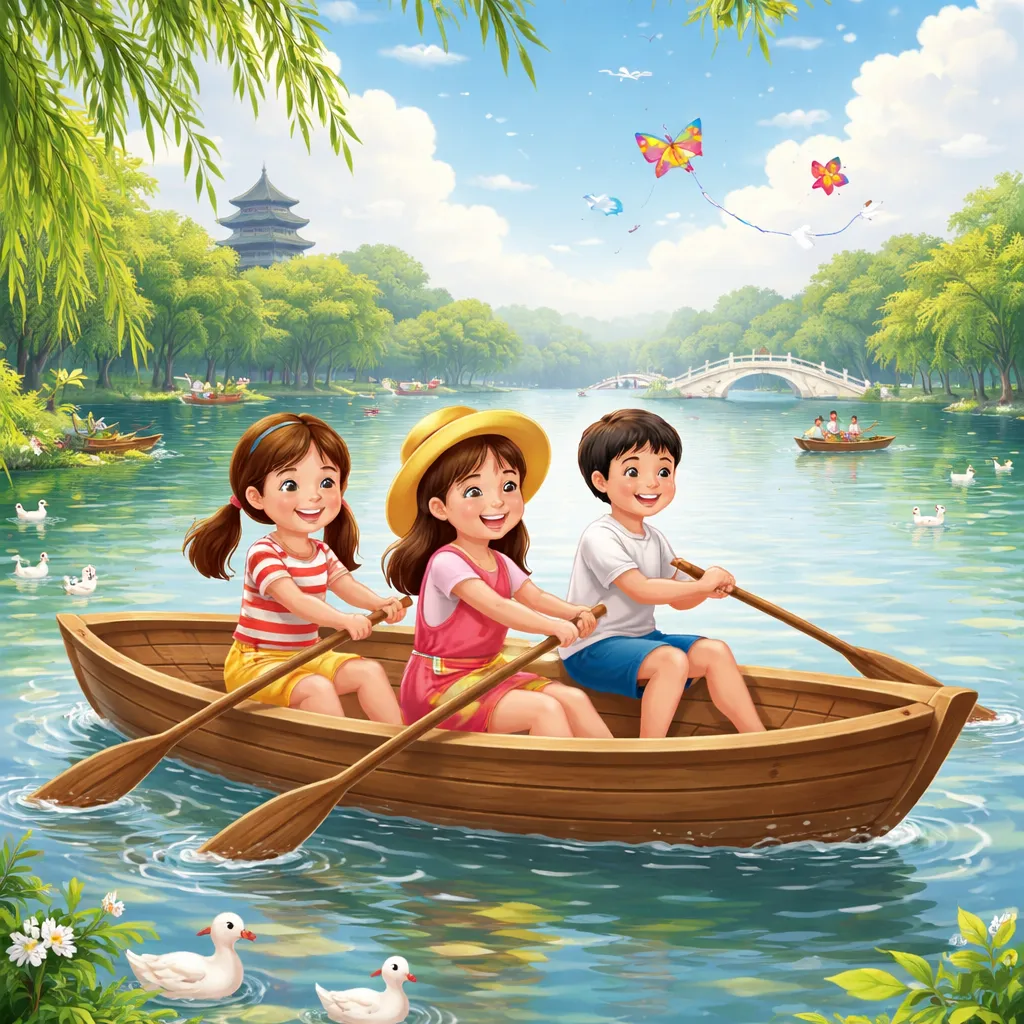

Imagine a perfect sunny day. You are with your best friends, gently rocking in a small boat on a sparkling lake. The water laps at the sides, and you feel completely carefree and happy. In China, there is a very famous, beautiful song that captures exactly that feeling of a perfect childhood afternoon. It’s a song that makes you feel like you’re there, in the boat, under the sun. Let’s set sail with the classic song “Let’s Swing the Oars” (让我们荡起双桨, Ràng wǒmen dàngqǐ shuāngjiǎng).
About the Song
Let’s read the joyful, scenic words of the first verse of this beloved song.
让我们荡起双桨,
小船儿推开波浪。
海面倒映着美丽的白塔,
四周环绕着绿树红墙。
小船儿轻轻飘荡在水中,
迎面吹来了凉爽的风。
English Translation:
Let us swing the oars,
The little boat pushes aside the waves.
The sea’s surface reflects the beautiful white pagoda,
Surrounded by green trees and red walls.
The little boat gently floats on the water,
A cool breeze blows toward our faces.
This song is a classic Chinese children’s song from the 1955 film “The Red Detachment of Children” (《祖国的花朵》). The lyrics were written by Qiao Yu (乔羽), and the music was composed by Liu Zhi (刘炽). It is a slow, lyrical, and nostalgic tune that describes a group of children rowing a boat on Beihai Park’s lake in Beijing. The song paints a vivid picture of the scenery—the white pagoda, the green trees, the red walls—and the physical sensation of rowing and feeling the cool breeze. It captures a moment of pure, idyllic childhood happiness and friendship, set against the backdrop of a peaceful, beautiful China. It is one of the most enduring and beloved songs in Chinese collective memory.
What the Song is About
The song paints a picture of a perfect, shared moment in nature. The singer invites everyone to join in: “Let us swing the oars.” They are in a small boat, and as they row, the boat pushes the waves aside. They look at the water and see the reflection of a beautiful white pagoda. Looking around, they see the shore is lined with green trees and traditional red walls.
Then, the focus turns to the feeling. The boat is gently floating, not rushing. A cool, pleasant breeze blows towards them, cooling their faces. The song doesn’t tell a story with a plot. Instead, it freezes a single, perfect moment: the act of rowing together, the beauty of the surroundings, and the physical comfort of the breeze. It’s about friendship, shared activity, and the deep peace and joy that comes from being in a beautiful place with good company.
Who Made It & Its Story
“Let’s Swing the Oars” was created for the 1955 film “The Red Detachment of Children,” which was about the happy lives of children in the new China. The lyricist Qiao Yu and composer Liu Zhi were two of the most renowned songwriters of the era. The song was inspired by a real outing the film’s young actors took on Beihai Park’s lake. The song’s immense popularity quickly separated it from the film. It became an anthem of innocent childhood and simple joys, often evoking strong nostalgia in adults. It is a staple in school music textbooks and is performed by children’s choirs across China. The song represents an idealized, peaceful vision of childhood that has resonated for generations.
This song has remained a timeless classic for three beautiful reasons. First, its melody is effortlessly flowing, gentle, and incredibly easy to sing, making it feel both uplifting and calming. Second, the lyrics are a masterpiece of simple, evocative imagery that immediately transports the listener to the scene, engaging all the senses (sight, touch, movement). Third, it captures a universal feeling of carefree, shared happiness that anyone, regardless of when they grew up, can understand and yearn for, making it a powerful piece of shared cultural nostalgia.
When to Sing It
This song is perfect for calm, happy, and reflective moments. You can sing it softly on a family boat ride or while sitting by a lake or pond, matching the lyrics to the view. You can hum it on a breezy day, feeling the wind on your face and remembering the song’s “cool breeze.” You can also sing it in a group, like a class or family, allowing the harmonious melody to create a feeling of shared peace and togetherness.
What Children Can Learn
This descriptive, sensory song is a gentle teacher about language, observation, and emotion.
Vocabulary
The song teaches us specific action and descriptive words. To “swing” (荡, dàng) means to move back and forth or to row with a sweeping motion. “Oars” (桨, jiǎng) are long poles with flat ends used to row a boat. A “boat” (小船儿, xiǎochuán er) is a small vehicle for traveling on water. “Waves” (波浪, bōlàng) are ridges of water on the surface of the sea or a lake. To “reflect” (倒映, dàoyìng) means to show an image on a surface like water or a mirror. A “pagoda” (白塔, báitǎ) is a tall, tiered tower common in East Asia. A “breeze” (风, fēng) is a gentle wind.
Let’s use these words! You can say, “The calm lake reflected the mountains perfectly.” Or, “A cool breeze made the hot day feel better.” New word: Idyllic. This means extremely happy, peaceful, or picturesque, like a perfect scene. The song describes an idyllic afternoon.
Language Skills
This song is a masterful lesson in using the imperative mood for invitations and the present continuous tense to describe ongoing scenes. The song starts with an invitation: “Let us swing the oars.” This is a friendly way to suggest doing something together.
The song then uses the present continuous tense to describe what is happening: the boat is pushing the waves, the pagoda is reflected, the trees are surrounding, the boat is floating, the breeze is blowing. This tense makes the scene feel alive and happening right now as we sing. The song also uses descriptive phrases (美丽的白塔, 绿树红墙) placed after the verb to paint details.
Sounds & Rhythm Fun
Listen to the gentle, swaying, wave-like rhythm of the melody. The song is in a calm 6/8 time, which gives it a rocking, boat-like feel. The melody flows up and down smoothly, like the motion of rowing. The Chinese lyrics have a soft, clear rhyme: “桨” (jiǎng) and “浪” (làng), “塔” (tǎ) and “墙” (qiáng), “中” (zhōng) and “风” (fēng).
The rhythm is steady and lilting. Try a gentle sway: 让 我 们 荡 起 双 桨 (ràng wǒmen dàngqǐ shuāngjiǎng). The melody is simple and memorable, with a slight rise on “cool breeze” (凉爽的风) that makes you almost feel the air. This flowing, repetitive, and serene musical pattern is what makes the song so easy to remember and so soothing to sing. You can write your own “perfect moment” song! Use the same gentle rhythm. Try: “Let us ride our bicycles, down the path beneath the trees. The sky above is bright and blue, stirred by a gentle, rustling breeze.”
Culture & Big Ideas
“Let’s Swing the Oars” is a cherished piece of 20th-century Chinese cultural memory. It comes from the post-1949 era when new art forms were celebrating the joys of life in peace. The specific setting—Beihai Park in Beijing—connects the song to centuries of Chinese history and imperial gardens, making the activity feel part of a long tradition. The song evokes the Qingming Festival (Tomb-Sweeping Day), a time for spring outings and enjoying nature. It reflects the cultural values of harmony with nature, the importance of collective activity (rowing together), and the appreciation of simple, aesthetic pleasures. The song is a musical snapshot of an idealized, innocent childhood that represents hope and happiness for the nation’s future.
The song conveys three profound ideas. First, it’s about the joy of shared, mindful activity. The happiness comes not from a destination, but from the act of rowing together and noticing the beauty around them. Second, it expresses harmony between people and their environment. The children are not separate from the scenery; they are part of it, rowing gently, enjoying the breeze, surrounded by beauty. Third, it highlights the importance of sensory awareness and living in the moment. The song encourages us to see reflections, feel breezes, and notice colors, teaching that happiness is often found in paying attention to the present.
Values & Imagination
Imagine you are in the little boat. Can you feel the oars in your hands? Can you hear the soft splash as they dip into the water? Look down at the water. Can you see the perfect reflection of the white pagoda? Now, feel the breeze on your face. Is it cool? Does it smell like water and trees? Draw a picture of the song’s view. Draw the boat from above, with two children rowing. Around the boat, draw the waves in circles. At the top of the page, draw the white pagoda and the green trees and red walls, and then draw their upside-down reflection in the water below. This captures the song’s central image of reflection and peace.
The song encourages teamwork, appreciation for natural and historical beauty, and mindfulness in enjoying simple pleasures. A lovely idea is to have a “Sensory Walk.” With your family, go to a park or even your backyard. Sit quietly for a minute. Then, each person shares one thing they see, one thing they hear, and one thing they feel (like the breeze or sun). This activity trains the kind of observation the song is built on.
So, as the last note about the cool breeze fades, think about the perfect peace in this old melody. It is a vocabulary lesson in boating and scenery. It is a grammar lesson in making invitations and describing ongoing scenes. It is a music lesson in a swaying, lilting rhythm. From the first invitation to row to the final feeling of the wind, it wraps lessons in shared joy, environmental harmony, and mindful presence in a tune that feels like a deep, happy sigh. “Let’s Swing the Oars” teaches us that happiness is a boat to be shared, that beauty is all around us if we look, and that the coolest breeze is the one that blows on a perfect day with friends.
Your Core Takeaways
You are now an expert on the song “Let’s Swing the Oars” (让我们荡起双桨). You know it is a 1955 Chinese classic about children rowing a boat on Beihai Park’s lake. You’ve learned words like “oars,” “pagoda,” and “breeze,” and you’ve practiced the imperative for invitations and the present continuous tense. You’ve felt its gentle, swaying rhythm and created your own verse. You’ve also discovered the song’s role as a piece of cultural nostalgia and its messages about shared mindful activity, harmony with nature, and the importance of sensory awareness.
Your Practice Missions
First, stage a “Boat Imagination” session. With your family, sit in a row on the floor as if in a boat. Pretend to hold oars and row in unison. Sing the song as you “row,” and when you get to “cool breeze,” everyone stops and takes a deep breath in. This connects the song’s actions to your imagination and breathing.
Second, create a “Reflection” artwork. The song highlights the reflection of the pagoda. Find a calm bowl of water or a mirror. Place an object (like a toy or a flower) next to it. Draw or paint two pictures: one of the object, and one of its perfect reflection. Write the line from the song: “海面倒映着美丽的…” (The sea’s surface reflects the beautiful…). This activity focuses on the song’s key image and the concept of reflection, both in art and in thought.