
Look up at the night sky. What do you see? Tiny, twinkling points of light that have inspired wonder for thousands of years. In China, one of the very first songs a child learns is a gentle, familiar tune about these celestial lights. It’s a musical hug that connects children to the vast universe. Let’s explore the beloved Chinese children’s song “Little Star” (小星星, Xiǎo Xīngxing).
About the Song
Let’s read the simple, poetic words of this famous lullaby in both Chinese and English.
一闪一闪亮晶晶, 满天都是小星星。 挂在天上放光明, 好像许多小眼睛。
一闪一闪亮晶晶, 满天都是小星星。
English Translation: Twinkle, twinkle, little star, How I wonder what you are. Up above the world so high, Like a diamond in the sky.
Twinkle, twinkle, little star, How I wonder what you are.
This song is a fascinating blend of cultures. The melody is originally from the 18th-century French folk song “Ah! vous dirai-je, Maman”. The same tune is used for the English “Twinkle, Twinkle, Little Star” and the “Alphabet Song.” The Chinese lyrics were adapted to this melody, creating the version known as “小星星”. The Chinese lyrics, different from the English ones, paint their own beautiful picture: the stars twinkle, fill the sky, hang high to give light, and look like many little eyes. It is a perfect first song, teaching observation, rhythm, and a sense of calm wonder.
What the Song is About
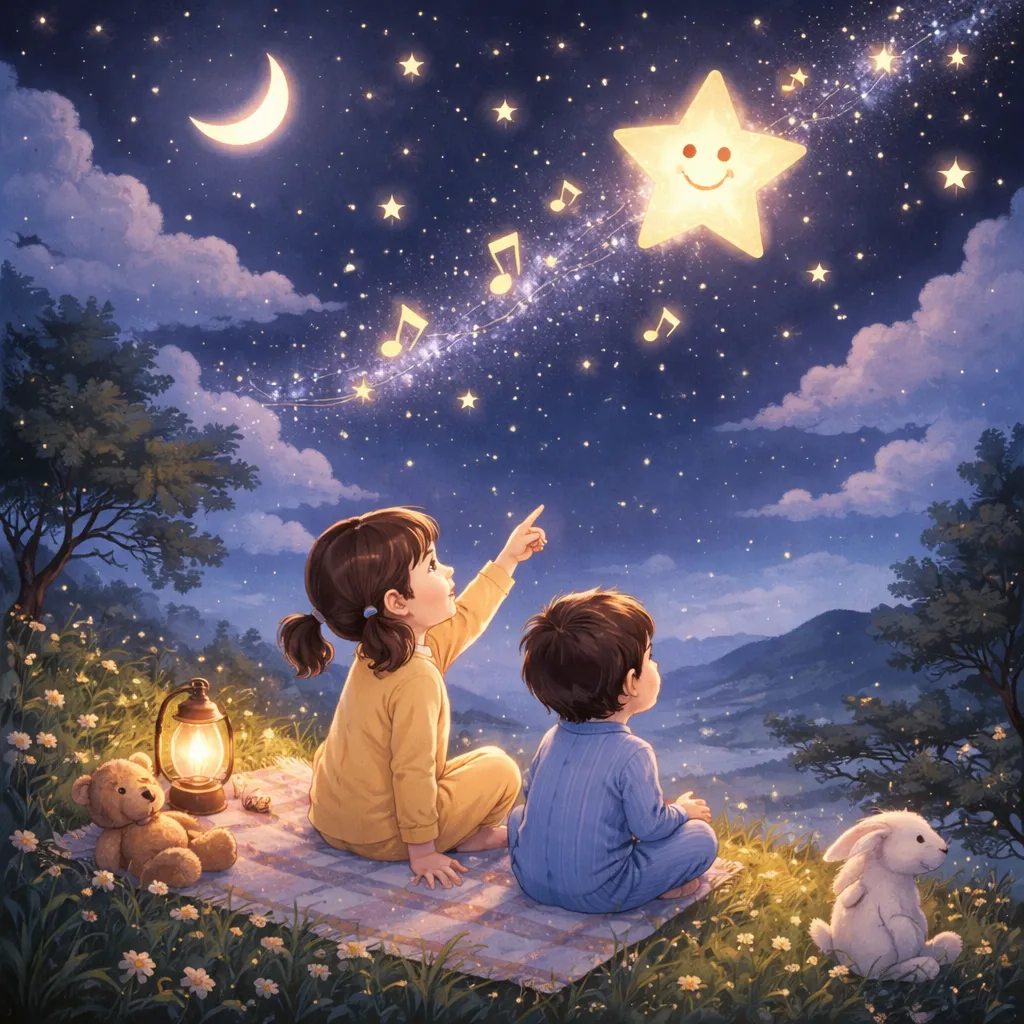
The song paints a serene, watchful picture of the night sky. The singer looks up and sees stars that “twinkle, twinkle” (一闪一闪). The sky is full of these “little stars.” They are not just there; they are “hanging in the sky, giving off light,” as if they have a job to do.
Then, the singer uses a lovely simile: the stars are “like many little eyes.” This makes the sky feel alive and friendly, as if the stars are watching over us. The song doesn’t tell a story with a beginning and end. Instead, it captures a single, universal moment: a child gazing at the stars, feeling small but connected, and using simple, repetitive words to express that awe. It’s about the quiet joy of looking up and wondering.
Who Made It & Its Story
The melody for “Little Star” is a traditional French tune. The original Chinese lyrics are a folk adaptation, and a popular modern version was standardized by Wang Yuran (王雨然). The song’s journey—from a French melody to a global children’s staple—shows how simple, beautiful music can cross any border. In China, it is as fundamental as a nursery rhyme, used in kindergartens, homes, and even in early music education. Its gentle, ascending and descending scale makes it ideal for teaching basic pitch. The song’s popularity in China reflects the cultural importance of family, education, and appreciating nature’s simple beauties.
This lullaby has remained the ultimate first song for three shining reasons. First, its melody is perhaps the simplest and most recognizable in the world, using only the first six notes of the scale, which are easy for any voice to sing. Second, the Chinese lyrics are perfectly crafted for a child’s perspective, using concrete images (twinkling, eyes) to describe an abstract scene. Third, it creates a universal, bonding moment of peace. Whether sung by a parent at bedtime or a teacher in a circle, it instantly calms and connects.
When to Sing It
This song is perfect for quiet, thoughtful moments. You can sing it very slowly and softly as a lullaby at bedtime, while looking at a starry night light or a picture. You can hum it on a clear night when you can actually see the stars, trying to match the “twinkle” in the melody to the stars’ flickering. You can also sing it gently in a group, swaying from side to side like a slow, peaceful dance.
What Children Can Learn
This simple, cross-cultural song is a galaxy of gentle lessons. Let’s see what it teaches.
Vocabulary
The song teaches us beautiful descriptive words. “Star” (星, xīng) is a bright point of light in the night sky. “Twinkle” (一闪一闪, yī shǎn yī shǎn) means to shine with a light that quickly changes from bright to faint. “Sky” (天, tiān) is the space above the earth. “Light” (光, guāng) is the brightness that lets us see. “Eye” (眼睛, yǎnjing) is the part of the body we use to see. “Many” (许多, xǔduō) means a large number of.
Let’s use these words! You can say, “The diamond seemed to twinkle in the sun.” Or, “There are many flowers in the garden.” New word: Celestial. This means relating to the sky or outer space. Stars are celestial objects.
Language Skills
This song is a masterful lesson in using repetition for emphasis and the simile for description. The song starts with the repeated words “一闪一闪” (twinkle, twinkle). This repetition emphasizes the action and makes the image stronger.
The song then uses a simile: the stars are like (好像, hǎoxiàng) many little eyes. This is comparing two different things (stars and eyes) using “like” or “as” to show they are alike in some way (both are small, bright, and watching). The song also uses the present simple tense to describe a general truth: stars twinkle, they are in the sky, they give light.
Sounds & Rhythm Fun
Listen to the slow, gentle, rocking rhythm of the melody. The song is in a calm 4/4 time. The most famous feature is the melody’s simple, step-by-step motion up and down the first six notes of the scale (do, re, mi, fa, so, la). The Chinese lyrics have a soft, clear rhyme: “晶” (jīng) and “星” (xīng), “明” (míng) and “睛” (jīng).
The rhythm is steady and soothing. Try a slow, even sway: 一 闪 一 闪 亮 晶 晶 (yī shǎn yī shǎn liàng jīng jīng). The melody is so simple that it is often one of the first tunes children learn to play on a piano or a xylophone. This simple, repetitive, and soothing musical pattern is what makes the song a universal lullaby. You can write your own “twinkle” song about something else! Use the same melody. Try: “Sparkle, sparkle, little wave, on the ocean blue. Rising up and falling down, a water dance for you.”
Culture & Big Ideas
“Little Star” (小星星) is a foundational piece of modern Chinese children’s culture. It connects to the ancient Chinese tradition of astronomy and stargazing, which was important for making calendars and navigating. The song also reflects the value of education and gentle guidance in Chinese upbringing—it’s often one of the first things taught. The song’s theme connects to the Mid-Autumn Festival, a time when families gather, gaze at the moon, and appreciate the beauty of the night sky together. It is a gentle introduction to the vastness of the universe, framed in a way that feels safe, close, and full of friendly “little eyes” watching over the child.
The song conveys three beautiful ideas. First, it’s about cultivating wonder and observation. The song encourages looking closely at the natural world and appreciating its simple magic. Second, it expresses a sense of companionship with nature. By comparing stars to eyes, the song makes the universe feel personal and caring, not cold and distant. Third, it highlights the comfort of repetition and routine. The predictable, rocking melody and repeated lines are inherently calming, teaching that there is safety and peace in gentle, familiar patterns.
Values & Imagination
Imagine you are lying on a soft blanket, looking up at the night sky. Can you feel the cool air? Can you hear the quiet? Now, imagine the stars beginning to twinkle. One by one, they wake up. Do they really look like little eyes? What are they seeing? Draw a picture of the song’s sky. Don’t just draw yellow dots. Draw stars with little friendly faces, winking. Draw a child on the ground, looking up, with a thought bubble showing the stars as eyes. This captures the song’s imaginative heart.
The song encourages calm observation, a sense of wonder, and feeling connected to the larger universe. A lovely idea is to have a “Starry Night” talk. With your family, turn off the lights and use a flashlight to project star shapes on the ceiling (or simply look at a picture of stars). Sing the song softly. Then, each person shares one thing they wonder about when they look at the stars. This extends the song’s sense of curiosity.
So, as the last note of this gentle melody fades, think about the universal comfort in this simple tune. It is a vocabulary lesson in describing the night sky. It is a grammar lesson in using similes and repetition. It is a music lesson in the most fundamental, soothing melody. From the first “twinkle” to the final image of starry eyes, it wraps lessons in wonder, companionship with nature, and peaceful routine in a tune that feels like a warm blanket for the soul. “Little Star” teaches us that the biggest wonders can be found in the smallest, most familiar things, and that a song sung in one language can light up the night for children all over the world.
Your Core Takeaways
You are now an expert on the Chinese song “Little Star” (小星星). You know it uses a French melody and has Chinese lyrics about stars twinkling like eyes in the sky. You’ve learned words like “twinkle” and “sky,” and you’ve practiced using similes and repetition. You’ve felt its gentle, rocking rhythm and even created your own verse. You’ve also discovered the song’s place in Chinese childhood and its messages about wonder, nature as a friend, and the comfort of gentle routines.
Your Practice Missions
First, host a “Bilingual Lullaby” night. Learn to sing the first verse in both Chinese and English. With your family, sing the Chinese version first, then the English. Talk about how the lyrics are different but the feeling is the same. This celebrates the song’s cross-cultural journey.
Second, create a “Star Simile” artwork. The song says stars are “like many little eyes.” Create a piece of art that shows something in nature as something else. For example, draw clouds like sheep, or rain like tears. Write your simile on the artwork. Share it. This activity encourages creative thinking and poetic expression, just like the songwriter.