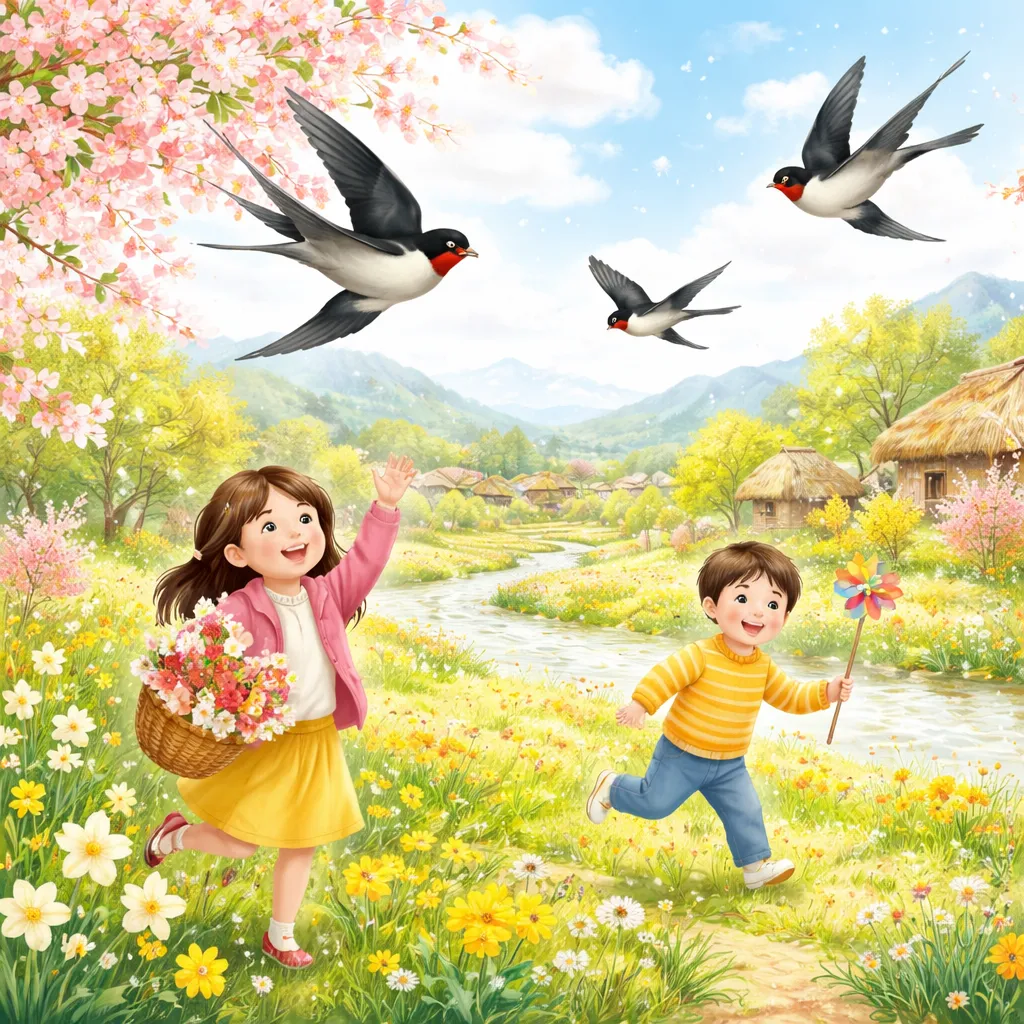

Have you ever noticed the birds that come back to your neighborhood when the weather gets warm? In many parts of the world, the return of a certain bird is a sure sign that spring has arrived. In China, a small, graceful bird with a forked tail is the star of a very famous, gentle song that celebrates this beautiful change. Let’s learn about the seasonal anthem “The Little Swallow” (小燕子, Xiǎo yànzi).
About the Song
Let’s read the simple, joyful words of this classic song.
小燕子,穿花衣,
年年春天来这里。
我问燕子你为啥来?
燕子说:
这里的春天最美丽。
English Translation:
Little swallow, wearing flowery clothes,
Comes here every spring.
I ask the swallow, “Why do you come?”
The swallow says:
“Spring here is the most beautiful.”
This song is a beloved Chinese children’s song from the mid-20th century. It is a staple in Chinese kindergartens and primary schools. The song is a short, melodic conversation between a child and a swallow. The lyrics personify the swallow, describing it as wearing “flowery clothes” (its beautiful plumage) and having a voice to answer the child’s question. The swallow’s reply praises the beauty of spring in its homeland. The song captures the gentle wonder of observing nature’s cycles and the special bond between people and the migratory birds that return each year. Its sweet, flowing melody makes it easy and pleasant to sing.
What the Song is About
The song paints a picture of a friendly, curious meeting in springtime. A child sees a little swallow. The child notices the swallow’s beautiful, patterned feathers and calls them “flowery clothes.” The child knows that this swallow comes back to this same place every single spring.
The child is curious and asks the swallow a direct question: “Why do you come here?” The swallow answers in a clear, happy voice. It says, “The spring here is the most beautiful.” The song is a tiny, perfect story about anticipation (waiting for the swallow), observation (noticing its beauty), curiosity (asking why), and receiving a simple, poetic answer that explains the magic of the season. It’s about finding friendship and wonder in the natural world.
Who Made It & Its Story
“The Little Swallow” is a modern Chinese children’s song. The lyrics were written by Wang Yun (王云), and the music was composed by Wang Lu (王路) in 1956. It was written for a Chinese film. The song quickly became separated from the movie and entered the mainstream as a standalone children’s song. Its immense popularity is tied to its theme of spring and renewal, which resonated deeply in Chinese culture, where the coming of spring is a major celebration. The song is also associated with the Swallow (燕子, yànzi), a bird considered a lucky symbol of happiness and homecoming in China. The song’s gentle, uplifting message made it a favorite for generations of children.
This song has remained a classic for three beautiful reasons. First, its melody is sweet, simple, and incredibly easy to sing, flowing as smoothly as a swallow in flight. Second, it personifies a common bird in a friendly, relatable way, turning a simple animal observation into a charming mini-story. Third, it beautifully captures the universal childhood feeling of wonder at seasonal change, making it a timeless song of spring that anyone, anywhere, can understand and enjoy.
When to Sing It
This song is perfect for moments of seasonal joy and outdoor observation. You can sing it on the first warm day of spring, looking up at the sky for birds. You can hum it on a family walk in a park, imagining conversations with the animals you see. You can also sing it as a gentle, happy song at home, celebrating the beauty of nature and the changing seasons.
What Children Can Learn
This poetic, seasonal song is a gentle teacher about language, nature, and culture.
Vocabulary
The song teaches us descriptive and nature-related words. A “swallow” (燕子, yànzi) is a small bird with pointed wings and a forked tail, known for its long migrations. “Flowery clothes” (花衣, huāyī) means clothing with a flower pattern; here it describes the bird’s speckled or colorful feathers. “Every year” (年年, niánnián) means each year without fail. “Spring” (春天, chūntiān) is the season between winter and summer. “Ask” (问, wèn) means to say something to get an answer. “Beautiful” (美丽, měilì) means very pretty.
Let’s use these words! You can say, “The garden is most beautiful in the spring.” Or, “The bird had flowery feathers of blue and red.” New word: Migrate. This means to move from one region or habitat to another according to the seasons. Swallows migrate in spring and fall.
Language Skills
This song is a wonderful lesson in using the simple present tense for habits and the structure for direct speech and questions. The song uses the simple present to describe the swallow’s habitual action: it “comes here every spring.” This tense is for routines and facts.
The song then uses direct speech. The child asks a question using “我问燕子…” (I ask the swallow…), and the quote follows. The swallow’s answer is given with “燕子说…” (The swallow says…). This structure lets us hear the exact words of the characters. The song also uses a superlative (最美丽, zuì měilì) to say something is the “most beautiful.”
Sounds & Rhythm Fun
Listen to the flowing, gentle, waltz-like rhythm of the melody. The song is in a calm 3/4 time, which gives it a lilting, rocking feel. The melody rises and falls smoothly, like a swallow dipping and soaring in the air. The Chinese lyrics have a soft, clear rhyme: “衣” (yī) and “里” (lǐ), “来” (lái) and “丽” (lì).
The rhythm is steady and graceful. Try a gentle sway: 小 燕 子,穿 花 衣 (xiǎo yànzi, chuān huāyī). The tune is based on a simple, memorable phrase that repeats with slight variations. This flowing, repetitive, and sweet musical pattern is what makes the song so easy to remember and so soothing to sing. You can write your own seasonal animal song! Use the same gentle rhythm. Try: “Little robin, with red breast, comes each spring to make a nest. I ask robin, ‘Why do you stay?’ Robin says, ‘I’ve come to play!’”
Culture & Big Ideas
“The Little Swallow” is a cherished piece of modern Chinese cultural heritage. It connects to the ancient Chinese tradition of closely observing nature and marking the seasons, which is fundamental to agricultural life and festivals. The swallow is a beloved symbol in China, often seen as a harbinger of spring and good fortune, and its nest near a home is considered very lucky. The song’s theme aligns with the celebration of the Spring Festival (Chinese New Year) and the Qingming Festival, times of renewal and outdoor activity. The song reflects the cultural values of harmony with nature, the joy of seasonal cycles, and the appreciation of simple, everyday beauty.
The song conveys three beautiful ideas. First, it’s about the joy of anticipation and return. The reliable, yearly return of the swallow brings comfort and happiness, teaching us to look forward to nature’s rhythms. Second, it expresses friendly curiosity about the natural world. The child feels comfortable asking the bird a question, showing a sense of kinship with nature. Third, it highlights appreciating and praising one’s home. The swallow’s answer is essentially, “I come because this place is wonderful,” which is a lovely expression of local pride and love for one’s environment.
Values & Imagination
Imagine you are the child in the song. You are standing in a warm, sunny field. You see the little swallow darting through the air. How does its “flowery” coat shine in the sun? Now, imagine you are the swallow. You have flown a very, very long way. Why did you choose this particular field? What makes its spring so beautiful? Draw a picture of the conversation. Draw a child looking up with a question mark above their head. Draw a swallow perched on a branch, with a speech bubble coming from its beak that says, “春天最美丽!” (Spring is the most beautiful!). Draw flowers and green grass to show why.
The song encourages observation of nature, appreciation for the seasons, and a sense of wonder and friendship towards animals. A lovely idea is to have a “Spring Welcome” activity. With your family, go outside or look out a window. Sing the song. Then, each person points out one sign of spring they can see, hear, or smell. This connects the song’s theme to your own sensory experience of the season.
So, as the last note about the beautiful spring fades, think about the gentle hope in this old tune. It is a vocabulary lesson in seasons and description. It is a grammar lesson in asking questions and stating facts. It is a music lesson in a flowing, waltzing melody. From the first image of the swallow in its flowery clothes to the final declaration of spring’s beauty, it wraps lessons in anticipation, curiosity, and love of home in a tune that feels like a warm spring breeze. “The Little Swallow” teaches us to watch for nature’s return, to ask friendly questions, and to always remember that the spring at home is the most beautiful of all.
Your Core Takeaways
You are now an expert on the song “The Little Swallow” (小燕子). You know it is a modern Chinese children’s song about a swallow returning every spring because it finds the season beautiful. You’ve learned words like “swallow,” “spring,” and “beautiful,” and you’ve practiced the simple present tense and using direct speech. You’ve felt its gentle, waltzing rhythm and created your own seasonal verse. You’ve also discovered the song’s cultural connections and its messages about joyful anticipation, friendly curiosity, and appreciating the beauty of one’s home.
Your Practice Missions
First, host a “Swallow’s Flight” dance. The song has a waltzing rhythm. With your family, play the song and try a simple, slow waltz step or just sway gently with arm movements like wings. How does the music make you feel? Does it feel like flying? This connects your body to the song’s graceful melody.
Second, create a “Seasonal Bird Diary.” The song celebrates the swallow’s return in spring. Choose a common bird in your area. With a grown-up’s help, learn about it. Draw a picture of the bird. Then, write or draw one thing it might “say” about why it likes your hometown’s season. This activity encourages local nature observation and creative storytelling, inspired by the song.