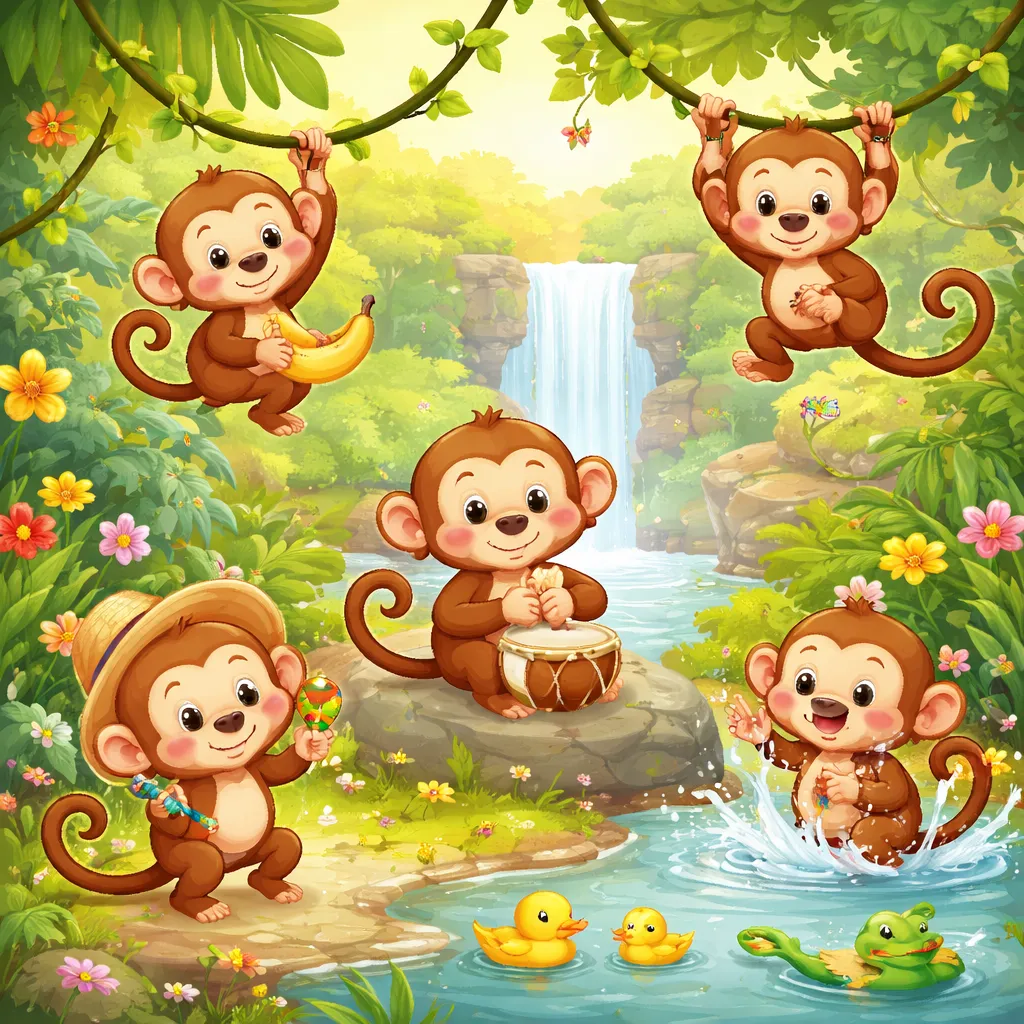

Have you ever tried to climb a tree, swing from a branch, or make a funny face to make someone laugh? There’s an animal that is the champion of all these things! In Korea, a country that loves fun and clever stories, there is a playful song about this energetic creature. Let’s swing into fun with the Korean Song: The Little Monkey (원숭이).
About the Song
Here is a playful verse from this beloved song in Korean and English:
원숭이 원숭이 장난꾸러기
(Wonsungi wonsungi jangnankkureogi)
Monkey, monkey, little mischief-maker
나무에 올라가 바나나 먹어
(Namue ollaga banana meogeo)
Climbs the tree, eats a banana
재롱부리며 즐겁게 놀아
(Jaerongburimyeo jeulgeopge nora)
Playing tricks, having fun
우리의 친구 원숭이
(Uriui chingu wonsungi)
Our friend, the monkey
This song’s original Korean name is “원숭이” (Wonsungi), which means “monkey.” It is a very popular and cheerful Korean children’s song. The song is a happy, bouncing picture of a monkey’s playful day. The music is often quick, bouncy, and full of playful energy. The Korean Song: The Little Monkey (원숭이) is a musical game, celebrating curiosity, agility, and the joyful, mischievous spirit of our clever animal friend.
What the Song is About
The song is a cheerful description of a monkey’s antics. First, we call it a “little mischief-maker,” which is a loving way to say it’s playful and funny. We see its skills: “Climbs the tree, eats a banana.” Monkeys are excellent climbers and love fruit. The song shows its personality: “Playing tricks, having fun.” Monkeys are curious and love to play. Finally, we call it “our friend,” showing we see the monkey as a playful companion, not a scary wild animal. The whole song is about the joy of play, the fun of being clever and active, and the friendship we can feel with animals.
Who Made It & Its Story
This song is a modern Korean children’s song, likely created in the 20th century. While the specific creator isn’t widely known, it fits into the genre of songs that teach about animals in a fun way. Monkeys are not native to Korea, so the song comes from a place of global curiosity and learning about animals from other parts of the world, often seen in zoos or in stories. The Korean Song: The Little Monkey (원숭이) is loved for three playful reasons. First, it is incredibly fun and active to sing, encouraging children to move and play. Second, it highlights positive traits like cleverness and playfulness. Third, its melody is catchy, bouncy, and easy to remember, making it a favorite for singing during playtime.
When to Sing It
You can sing this song while climbing on playground equipment or swinging. It’s perfect to chant when you’re eating a banana or another piece of fruit. You could also sing it with friends during a game of tag, pretending to be quick, clever monkeys.
The Korean Song: The Little Monkey (원숭이) teaches us about play and cleverness. But to be as smart as a monkey, we can learn more too! This song is a jungle gym of knowledge. It introduces us to new words, shows us how to talk about habits, and shares the value of play. Let’s climb into this lesson.
What Children Can Learn
Vocabulary
This song helps us learn words for animals, actions, and character.
Primate: The group of mammals that includes monkeys, apes, and humans. A monkey is a type of primate.
Agile: Able to move quickly and easily. Monkeys are very agile in trees.
Curious: Eager to know or learn something. Monkeys are curious animals.
Habitat: The natural home of an animal. The jungle is a monkey’s habitat.
Social: Living in groups; liking to be with others. Monkeys are very social animals.
Adaptable: Able to adjust to new conditions. Monkeys are adaptable and clever.
Language Skills
This song is a great example of using the Present Simple Tense for Habits and General Truths. We use this tense to talk about things that happen regularly or are generally true.
What Is It?: Think of the Present Simple as the “Usually Does” tense. It describes habits, routines, and facts. The monkey climbs trees. It eats bananas.
Finding the Secret: Look for verbs that describe regular actions or general facts. They are in their base form (with an ‘s’ for he/she/it). Ask: “Does this describe a habit or something that is always true?”
Using It:
◦   Formula: [Subject] + [verb] (with 's' for he/she/it).

◦   Examples: “A monkey climbs trees. I eat fruit. The sun rises in the east.”

◦   In the song: “Climbs the tree, eats a banana.” These are presented as the monkey’s regular habits.
Sounds & Rhythm Fun
Listen to the chattering, jumping rhythm! The Korean Song: The Little Monkey (원숭이) has a very quick, bouncy, and syncopated beat. It might sound like the chattering and quick movements of a monkey. The melody is playful and often has little jumps and turns, making it fun to sing. This energetic, unpredictable rhythm makes the song exciting and helps the playful lyrics stick in your memory. You can use this same bouncy, jumpy rhythm to make up a song about any playful animal or activity.
Culture & Big Ideas
While monkeys are not native to Korea, they appear in global stories and media that Korean children enjoy, like the classic tale of the Monkey King. The song reflects a global curiosity about intelligent animals. In Korean culture, values like cleverness (재주, jaeju) and playfulness are appreciated. The Korean Song: The Little Monkey (원숭이) teaches three important ideas. First, The Importance of Play: Playing is not just fun; it’s how monkeys (and children!) learn about the world and develop skills. Second, Cleverness and Curiosity: Being curious and trying to solve problems (like how to get a banana) is a form of intelligence. Third, Social Connection: Monkeys are social creatures, reminding us that playing and having fun is often best when shared with friends.
Values & Imagination
Imagine you are the little monkey. What does the tree bark feel like under your hands? How do you decide which banana is the best? What funny trick would you play? This song teaches you to value curiosity, playfulness, and friendship. It shows that being active and using your brain to solve problems is a great way to live. A simple idea: Try to solve a small problem in a playful way today. For example, if a toy is under the bed, use a “monkey tool” like a long spoon to reach it instead of just your hand. You are thinking like a clever primate!
Your Core Takeaways
The Korean Song: The Little Monkey (원숭이) is a bouncy, joyful lesson in play, cleverness, and friendship. You learned words like “primate,” “agile,” and “curious.” You discovered how to use the Present Simple tense to talk about habits and general truths. You moved to the song’s quick, playful rhythm. You also connected the monkey to universal values of curiosity and play. Most importantly, the song teaches that playing is a way of learning, that being clever and curious is a superpower, and that having fun with friends makes life an adventure.
Your Practice Missions
- Be a “Habit Reporter.” Watch a pet, a bird outside, or even a family member for a minute. Report one thing they “usually do” using the Present Simple tense. Example: “The bird sings every morning. My sister reads before bed.” This practices observing and describing habits.
- Create a “Monkey Playground.” Use pillows, blankets, chairs, and safe household items to build an obstacle course or a “jungle gym” in your room. Time yourself or a friend going through it. As you climb and crawl, describe your actions like a monkey: “I swing here! I climb this!” This turns the song’s energy into active, imaginative play.














