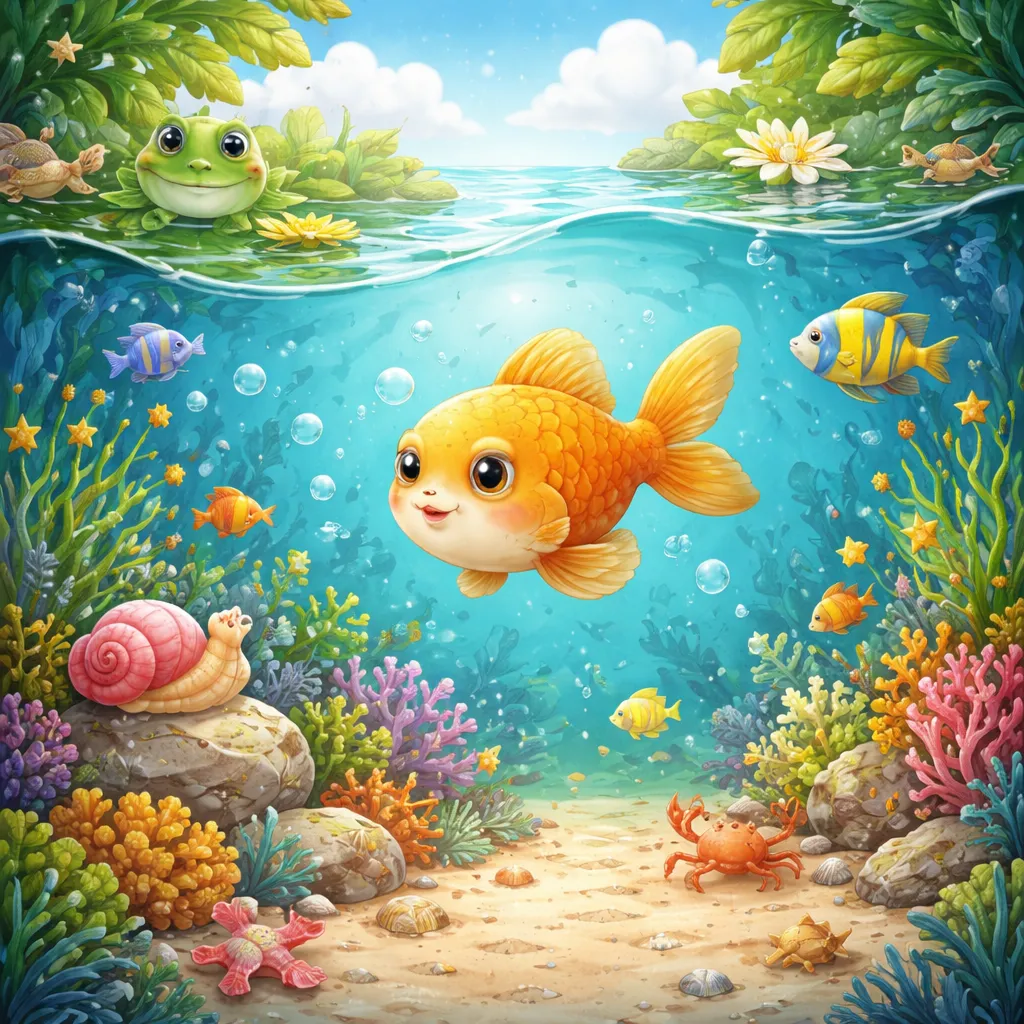

Have you ever watched a fish swim in a bowl or a pond? It moves so smoothly, its tail swishing side to side, gliding through the water without a sound. In Germany, there is a gentle, flowing song all about a little fish’s swim. It is a song that moves like water. Let’s make swimming motions with our hands and learn the graceful song “The Little Fish (Das kleine Fischlein).”
About the Song
Here are the flowing, descriptive lyrics of a beloved traditional German children’s song, often sung as a finger play:
Das kleine Fischlein, schwimmt im See,
schwimmt hin und her, das tut nicht weh.
Das kleine Fischlein, das ist fein,
schwimmt um die Ecke, schwimmt ganz allein.
English Translation:
The little fish, swims in the lake,
swims here and there, that does not hurt.
The little fish, that is fine/nice,
swims around the corner, swims all alone.
This is a classic German-language children’s song from Germany. The song paints a calm picture of a fish’s peaceful life. “The little fish, swims in the lake,” it begins, placing us in a cool, clear scene. This fish is happily moving. “Swims here and there, that does not hurt,” the song tells us, showing a gentle, pain-free journey. Then, we learn more about this fish. “The little fish, that is fine/nice,” it says, almost giving the fish a compliment. Finally, the fish goes on a little adventure: “swims around the corner, swims all alone.” The song is a simple, soothing look at independence and graceful movement in the water.
What the Song is About
The song is a quiet picture of a fish’s underwater world. Imagine a clear, blue lake. A small, shiny fish with silver scales swims slowly. “The little fish, swims in the lake.” Its fins move softly, pushing it through the cool water.
It is exploring. “Swims here and there, that does not hurt.” It zigzags between green plants and over smooth stones, feeling happy and free. The fish is doing just fine on its own. “The little fish, that is fine/nice,” the song says, as if we are smiling at it. Then, it goes on a solo trip. “Swims around the corner, swims all alone.” It disappears behind a big rock or a sunken log, exploring a new part of the lake by itself. The song is about gentle movement, feeling content, and the quiet adventure of being alone.
Who Made It & Its Story
“Das kleine Fischlein” is a traditional German folk and finger play song. Its creator, like many folk songs, is unknown, passed down through families and kindergartens. The song is part of Germany’s rich tradition of “Kinderlieder” that use simple, repetitive language and hand movements to teach about nature, animals, and basic concepts. The diminutive “-lein” ending in “Fischlein” is a classic, affectionate way to talk about something small and dear in German, showing a tender view of nature.
This gentle song is loved for three beautiful reasons. First, it is a wonderful, calm way to learn German words for places (See/lake), actions (schwimmt/swims), and descriptions (fein/fine). Second, it pairs a smooth, flowing melody with simple hand motions that mimic swimming, creating a peaceful, mindful activity that helps with coordination and focus. Third, it presents a positive, reassuring image of independence (“schwimmt ganz allein”), helping children feel comfortable with the idea of doing things calmly on their own.
When to Sing It
This song is perfect for quiet, focused moments. You can sing it softly during bath time, moving a toy fish or your hands through the water like the little fish. You can hum it as a calming finger play before rest time, using just your fingers to “swim” on a table. You can also sing it on a visit to an aquarium or a lake, watching the real fish move “hin und her” (here and there).
What Children Can Learn
This flowing song is a wonderful teacher about underwater life, descriptive words, and gentle movement in German.
Vocabulary
The song teaches us lovely words for animals, places, actions, and descriptions in German. “The” (Das). “Little” (kleine). “Little fish” (a sweet way to say it: Fischlein). “Swims” (schwimmt). “In the” (im). “Lake” (See). “Here and there” (hin und her). “That” (das). “Does” (tut). “Not” (nicht). “Hurt” (weh). “That is” (das ist). “Fine” or nice (fein). “Around the” (um die). “Corner” (Ecke). “Swims” (schwimmt). “Quite” or very (ganz). “Alone” (allein).
Let’s use these words! You can describe any animal: “Der Vogel fliegt.” (The bird flies.) You can say how you feel: “Das ist fein!” (That is fine/nice!). New word: Flosse. This is the German word for “fin,” the part a fish uses to “schwimmt hin und her.”
Language Skills
This song is excellent for learning about describing words (adjectives) in German. Words like “kleine” (little) and “fein” (fine/nice) tell us more about the noun. They describe the fish. Also, the phrase “das tut nicht weh” (that does not hurt) is a very useful sentence pattern.
Concept Definition: An adjective is a describing word. It tells us more about a person, place, or thing. It answers questions like “What kind?” or “How is it?”. In the song, the fish is not just any fish. It is a “kleine” (little) fish. And the fish’s situation is “fein” (fine/nice). These words add color and detail.
Features and Types: Adjectives can describe many things. “Kleine” describes size (how big?). “Fein” describes a feeling or quality (how is it?). In German, adjectives often come right before the noun they describe. They can also come after “ist” (is) to describe the subject: “Das ist fein.”
How to Spot Them: Here is a simple “tell-me-more” trick. Ask about the noun: “What kind of fish?” The answer “little fish” has the describing word “little.” Ask: “How is the fish/the situation?” The answer “fine/nice” is the describing word. In the song, “kleine” tells us what kind of fish, and “fein” tells us how it is.
How to Use Them: A great way to describe things is the “Describing Formula”. The patterns are: “[Describing Word] + [Noun]” or “[Thing] + ist + [Describing Word].”
Example from the song: “Das kleine Fischlein” (The little fish). “Das ist fein.” (That is fine.)
Example you can make: “Ein großer Baum.” (A big tree.) “Der Apfel ist rot.” (The apple is red.)
Sounds & Rhythm Fun
Listen to the smooth, wavy rhythm of the melody. The song often has a gentle, swaying tune that feels like water rocking. The word “schwimmt” (swims) is repeated, creating a flowing, liquid sound that matches the action. The words “See” (lake) and “weh” (hurt) rhyme perfectly, making the first two lines stick together in a satisfying way. The phrase “hin und her” (here and there) has a lovely back-and-forth sound, like the fish’s tail moving side to side.
The rhythm is calm and steady, perfect for slow, sweeping hand movements that mimic swimming. The repetition of the melody and structure makes it very easy to remember and hum. This musical pattern is perfect for creating your own calm animal song. You can write your own “Das kleine Vögelchen” (The Little Birdie) song! Try: “Das kleine Vögelchen, fliegt im Wind, fliegt hin und her, das tut geschwind. Das kleine Vögelchen, das ist froh, fliegt über Wolken, fliegt ganz so.” (The little birdie, flies in the wind, flies here and there, that does quickly. The little birdie, that is happy, flies over clouds, flies just so.)
Culture & Big Ideas
“Das kleine Fischlein” connects to the German appreciation for nature, lakes (“Seen”), and gentle, introspective play. Germany has many beautiful lakes, and activities like swimming and observing water life are common. The song reflects a cultural comfort with quiet and solitary activity (“ganz allein”), seeing it as a positive state of peace and independence, not loneliness. It is a song that calms the mind.
The song conveys three gentle, important ideas. First, it encourages mindful observation of nature, focusing on the smooth, pain-free (“das tut nicht weh”) movement of a creature in its element. Second, it introduces the concept of contentment and being “fine” (“fein”) with a simple, independent activity, promoting self-sufficiency. Third, it celebrates gentle, exploratory movement (“schwimmt um die Ecke”), seeing the world as a place with interesting corners to discover, even when alone.
Values & Imagination
Imagine you are a small, shiny fish. You are “das kleine Fischlein” in a big, cool lake. “The little fish, swims in the lake,” you think, feeling the water flow over your scales. You move your tail. “Swims here and there, that does not hurt.” You glide between tall water plants, feeling peaceful and free. You are happy. “The little fish, that is fine/nice.” You feel good in your watery home. Then, you see a dark shape ahead—a big rock! “Swims around the corner, swims all alone.” You bravely swim around it to see what’s on the other side, enjoying your quiet adventure. How does the water feel? What do you see around the corner? Draw the little fish’s journey. Draw a wavy blue lake. Draw a small, smiling fish in the middle. Draw a dotted line showing it swimming “hin und her.” Then, draw the fish peeking around a big rock or a corner. Write the words “kleine,” “fein,” and “ganz allein” on your picture. This shows the song’s feeling and action.
The song encourages us to move calmly and gracefully, to find joy in our own company, and to appreciate the quiet beauty of water animals. A wonderful activity is the “Quiet Fish” observation. If you have a pet fish or see fish in a pond, watch one for a minute. See how it moves “hin und her.” Sit quietly and just observe. Then, softly sing the song to yourself. This connects you to the song’s spirit of peaceful, focused watching.
So, from the gentle swim to the solo adventure, this song is a dive into a calm, underwater world. It is a vocabulary lesson in animals, places, and describing words. It is a language lesson in using adjectives like “kleine” and “fein.” It is a music lesson in a smooth, rhyming, watery melody. “The Little Fish (Das kleine Fischlein)” teaches us to move gracefully, to feel fine on our own, and to explore our world with quiet curiosity.
Your Core Takeaways
You are now an expert on the song “The Little Fish (Das kleine Fischlein).” You know it is a gentle German song about a little fish swimming happily alone in a lake. You’ve learned German words like “Fischlein,” “See,” “schwimmt,” “hin und her,” “fein,” and “ganz allein,” and you’ve practiced using describing words like “kleine” and “fein.” You’ve felt its smooth, flowing rhythm and created your own calm animal verse. You’ve also discovered the song’s message about peaceful movement, contentment, and the fun of quiet, independent exploration.
Your Practice Missions
First, play the “Was ist das?” (What is that?) description game. Look at three objects near you. Describe each one in German using the pattern “[Describing Word] + [Noun]” or “[Thing] + ist + [Describing Word].” For example, “ein kleiner Ball” (a small ball) or “Das Buch ist interessant” (The book is interesting). This mission helps you use adjectives, just like “kleine” and “fein” in the song.
Second, be a “Schwimmendes Fischlein” (Swimming Little Fish). Find a space on the floor. Sit or lie down. Move your arms slowly and smoothly like swimming, first to one side (“hin”), then to the other (“her”). As you move, say or sing the lines “schwimmt hin und her, das tut nicht weh.” Then, pretend to swim “around the corner” of an imaginary rock. This mission lets you use your body to understand the fish’s gentle, back-and-forth movement from the song.