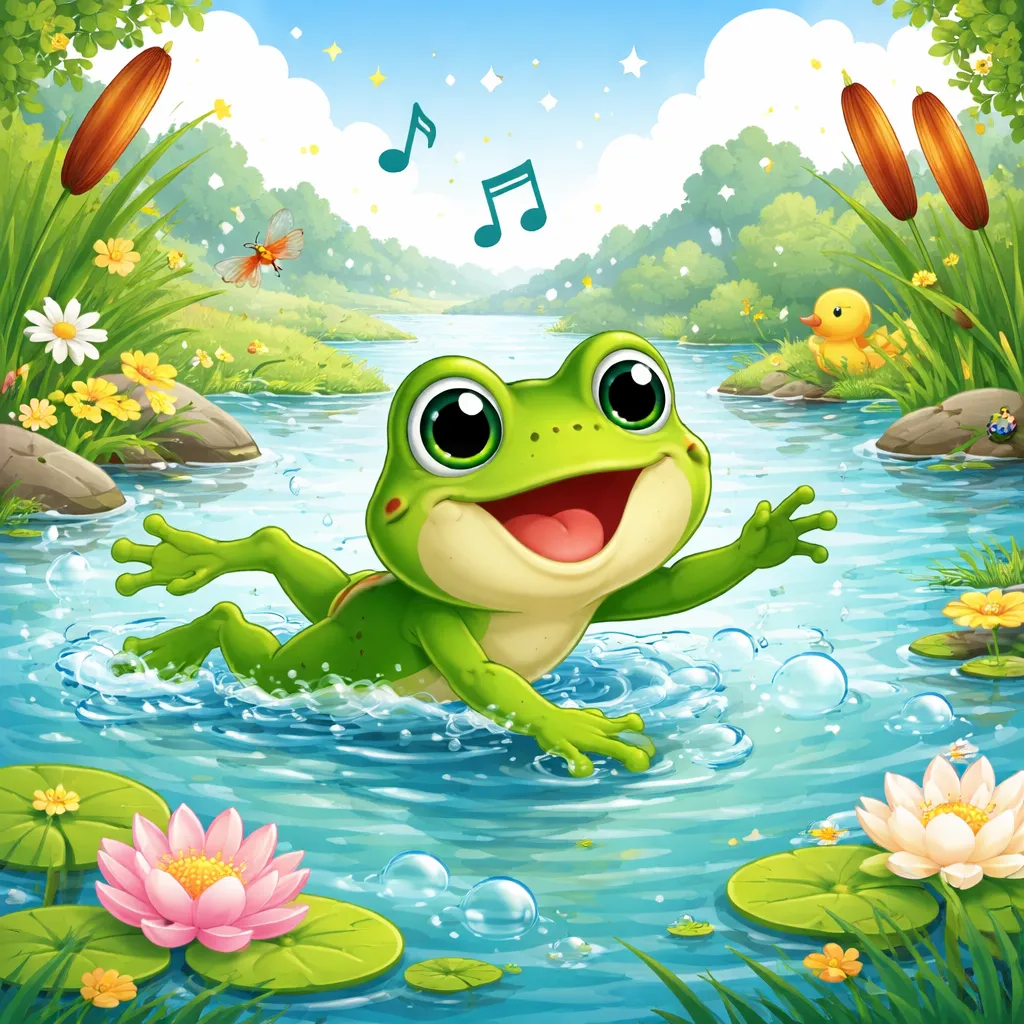

Have you ever seen a frog at the edge of a pond? It sits very still on a big leaf, then suddenly—SPLASH!—it jumps into the water with a happy kick. In Germany, there is a playful song all about a frog’s fun day. It is a song you can act out with your whole body. Let’s get ready to hop and sing “The Little Frog (Der kleine Frosch).”
About the Song
Here are the lively, descriptive lyrics of a well-loved traditional German children’s song, which is also a fun action rhyme:
Der kleine Frosch, der kleine Frosch,
der sitzt auf einem großen Stein.
Der kleine Frosch, der kleine Frosch,
der schwimmt im Wasser schnell herein.
Der kleine Frosch, der kleine Frosch,
der macht quak, quak, quak.
English Translation:
The little frog, the little frog,
he sits on a big stone.
The little frog, the little frog,
he swims quickly into the water.
The little frog, the little frog,
he makes quack, quack, quak.
This is a classic German-language children’s action song from Germany. The song is a short story about a frog’s simple, happy actions. “The little frog, the little frog,” the song begins, repeating the name in a fun, catchy way. We meet our main character. What is he doing? First, “he sits on a big stone.” Imagine a green frog resting calmly on a grey rock by the water. But he does not stay still for long. Next, “he swims quickly into the water.” With a quick push, he dives into the cool pond. And what sound does he make? “He makes quak, quak, quak.” The song shows us a frog’s world: sitting, swimming, and singing his croaky song.
What the Song is About
The song is a mini adventure of a little green friend. Picture a sunny pond. A small, green frog with big eyes and long legs is relaxing. “The little frog, the little frog, he sits on a big stone.” He is perfectly still, feeling the warm sun on his back.
Then, he decides it is time for a swim. He gives a little wiggle. “The little frog, the little frog, he swims quickly into the water.” He pushes off the rock with his strong legs and glides smoothly into the water, making little ripples. He is a fast swimmer! After his swim, he pops his head above the water. He opens his mouth and sings his special song. “The little frog, the little frog, he makes quak, quak, quak.” The sound echoes across the pond. The song is about the simple, joyful actions of a frog’s life: resting, moving, and making noise.
Who Made It & Its Story
“Der kleine Frosch” is a traditional German folk and action song, deeply popular in playgroups and kindergartens. Its creator is unknown, passed down through generations of children. The song is part of a rich German tradition of “Bewegungslieder” (movement songs) that combine singing with physical activity to help children learn about the world and their own bodies. Frogs (“Frösche”) are common and beloved characters in German children’s culture, often found in stories, songs, and near the many ponds and rivers in the countryside.
This active song is loved for three fun reasons. First, it is a fantastic, energetic way to learn three common German action verbs: “sitzt” (sits), “schwimmt” (swims), and “macht” (makes). Second, it uses a repetitive, call-and-response structure that is easy to remember and perfect for group singing and acting out, making language learning physical and memorable. Third, it celebrates the fun of imitating animals and their movements, encouraging children to observe nature and express themselves through play.
When to Sing It
This song is perfect for active, imaginative play. You can sing it loudly during a splashy bath time, pretending your toy is the frog swimming. You can chant it with friends at the playground, taking turns being the frog that sits, swims, and says “quak.” You can also sing it on a walk near a pond or lake, looking for real frogs doing the actions in the song.
What Children Can Learn
This action-packed song is a wonderful teacher about animals, verbs, and German grammar.
Vocabulary
The song teaches us important words for animals, actions, places, and sounds in German. “The” (Der). “Little” (kleine). “Frog” (Frosch). “He sits” (er sitzt / der sitzt). “On a” (auf einem). “Big” (großen). “Stone” (Stein). “He swims” (er schwimmt / der schwimmt). “In the” (im). “Water” (Wasser). “Quickly” (schnell). “In” or “into” (herein). “He makes” (er macht / der macht). “Quack” (quak).
Let’s use these words! You can describe any animal: “Der Vogel sitzt.” (The bird sits.) “Der Fisch schwimmt.” (The fish swims.) New word: Amphibian. This is the special name for animals like frogs that can live both in water and on land, just like the frog in the song who sits on a stone and swims in the water.
Language Skills
This song is excellent for learning about German nouns and their genders. Every German noun has a gender: masculine (der), feminine (die), or neuter (das). The song shows us a masculine noun: “der Frosch” (the frog). The word “der” is its article, like a little tag that says “this is a masculine word.”
Concept Definition: In German, nouns (names of people, places, things, animals) have a gender. It is like giving each noun a special color or team. The word for “the” changes depending on this team. For the “der” team (masculine), we use “der” for “the.” In our song, the frog is on the “der” team, so we say “der Frosch” and “der kleine Frosch.”
Features and Types: There are three main “teams” or genders for nouns. The “der” team (masculine) often includes many male people, animals, and also many other things. The “die” team (feminine) and the “das” team (neuter) are for other nouns. You have to learn the article with the noun, like a pair. “Der Frosch” (the frog), “die Ente” (the duck), “das Pferd” (the horse).
How to Spot Them: Here is a simple “noun tag” trick. When you learn a new German noun, always learn the word for “the” that goes with it. See them as a pair. In the song, the word “Frosch” always comes with its tag “der”. So, you remember “der Frosch” as one piece.
How to Use Them: A great way to talk about things is the “Team + Noun” formula. The pattern is: “[der/die/das] + [Noun].” This is how you name things in German.
Example from the song: “der Frosch” (the frog), “der Stein” (the stone), “das Wasser” (the water).
Example you can make: “der Hund” (the dog), “die Katze” (the cat), “das Haus” (the house).
Sounds & Rhythm Fun
Listen to the bouncy, jumpy rhythm of the melody. The song has a very clear, marching rhythm that matches the frog’s actions. The best part is the sound effect: “quak, quak, quak”! This is the classic German sound a frog makes, and it is so fun to say in a deep, croaky voice. The repetition of the line “Der kleine Frosch” at the start of each verse acts like a drumbeat, getting everyone ready for the next action. The words “Stein” (stone) and “herein” (into) have a similar “-ein” sound, creating a nice rhyme.
The rhythm is steady and strong, perfect for doing big actions: sitting down on “sitzt,” making swimming arms on “schwimmt,” and jumping on “quak.” The repeating first line makes the song very easy to remember and join in. This musical pattern is perfect for creating your own animal action song. You can write your own “Der kleine Vogel” (The Little Bird) song! Try: “Der kleine Vogel, der kleine Vogel, der sitzt auf einem Ast. Der kleine Vogel, der kleine Vogel, der fliegt in Himmel schnell davon. Der kleine Vogel, der kleine Vogel, der macht piep, piep, piep.” (The little bird… sits on a branch… flies quickly into the sky… makes tweet, tweet, tweet.)
Culture & Big Ideas
“Der kleine Frosch” connects to the German love for nature (“Naturliebe”) and active, educational play. Germany has many forests, rivers, and ponds, and learning about local animals like frogs is a common part of childhood. The song also reflects the pedagogical value of “learning through play,” where songs teach language, coordination, and knowledge about the world in a joyful, physical way. It is a staple in “Kindergarten” and “Turnen” (gymnastics/play) groups.
The song conveys three important, active ideas. First, it encourages careful observation of animals and their habitats, noting where they live (on a stone, in water) and what they do. Second, it teaches about action sequences (“first he sits, then he swims, then he calls”), helping children understand order and storytelling. Third, it promotes joyful physical activity and imitation, allowing children to experience the world by “being” the frog through sitting, swimming, and vocalizing motions.
Values & Imagination
Imagine you are a little, green frog. You are “der kleine Frosch” on a big, warm stone. “The little frog, the little frog, he sits on a big stone,” you think, feeling the sun. Below you is cool, refreshing water. You get ready. “The little frog, the little frog, he swims quickly into the water.” You push with your strong legs and glide silently under the water, seeing plants and tiny fish. Then you come up for air. It is time to talk to your friends. “The little frog, the little frog, he makes quak, quak, quak.” Your croaky song travels far across the pond. How does the cool water feel? How does your stone feel under your feet? Draw the little frog’s world. Draw a big stone at the edge of a pond. Draw a happy, green frog sitting on it. Draw lines in the water to show him swimming. Draw music notes with “QUAK” written inside them. Write the words “sitzt,” “schwimmt,” and “quakt” next to the right actions. This shows the song’s story.
The song encourages us to observe nature closely, to move our bodies like the animals we see, and to enjoy making silly, joyful sounds. A wonderful activity is the “Frog Pond” game. Find a blue blanket or towel for the “water” and a grey pillow for the “stone.” Act out the song: sit on the stone, then “swim” on the blanket, then jump up and say “QUAK!” This connects you to the song’s spirit of imaginative, physical play.
So, from the sunny stone to the cool water and the loud “quak,” this song is a frog’s happy day. It is a vocabulary lesson in animals, actions, and places. It is a language lesson in German noun genders, starting with “der.” It is a music lesson in a bouncy, repetitive, action-filled melody. “The Little Frog (Der kleine Frosch)” teaches us to watch animals, copy their actions, and have fun with sounds and movement.
Your Core Takeaways
You are now an expert on the song “The Little Frog (Der kleine Frosch).” You know it is a German action song about a frog that sits, swims, and says quak. You’ve learned German words like “Frosch,” “sitzt,” “Stein,” “schwimmt,” “Wasser,” and “quakt,” and you’ve learned that German nouns like “der Frosch” have a gender. You’ve felt its jumpy, repetitive rhythm and created your own animal action verse. You’ve also discovered the song’s message about observing animal behavior, enjoying physical play, and the fun of making animal sounds.
Your Practice Missions
First, play the “Der, Die, Das” spotting game. Look around your room or outside. Point to three different objects and try to say their name in German with the right “team” article. You can guess! Say: “der Tisch?” (the table?), “die Tür?” (the door?), “das Fenster?” (the window?). Ask a grown-up or look it up later. This mission makes you a detective for German noun genders, just like you learned with “der Frosch.”
Second, be a “Frosch” actor. Perform the whole song with actions. Find a spot to be your “Stein” (stone)—sit down. Then “swim” on the floor quickly with your arms. Finally, jump up and shout “QUAK, QUAK, QUAK!” three times. Do it with a friend or for your family. This mission lets you use your whole body to understand the verbs “sitzt” and “schwimmt” from the song.