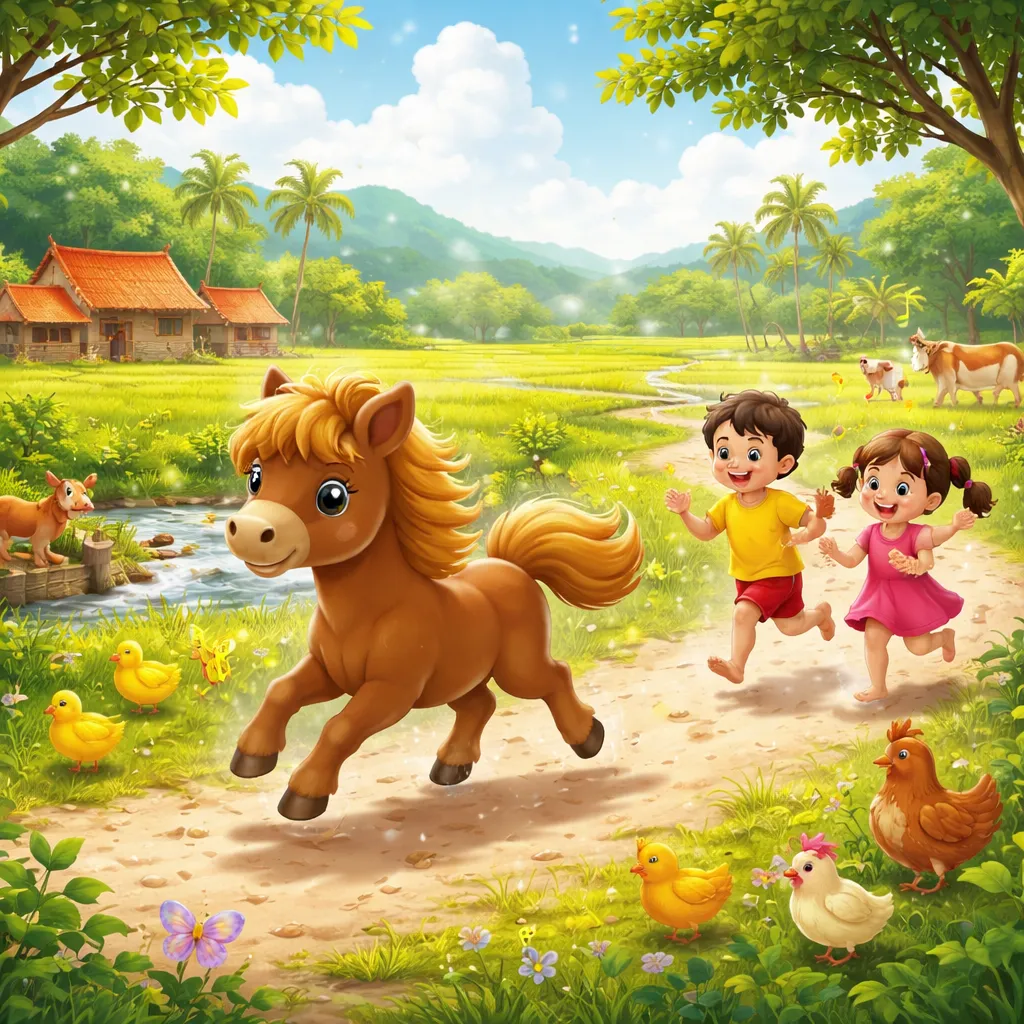

Have you ever watched a horse run? Its legs move so fast and strong, and its mane flows in the wind. In Indonesia, the word for horse is “kuda,” and there is a lively, energetic song about a little horse. It is a song all about speed and movement. Let’s feel the run with “The Little Horse (Kuda Kecil).”
About the Song
Here are the fast and fun lyrics of a popular traditional Indonesian children’s song about a little horse:
Kuda kecil, kuda kecil,
Lari, lari, lari!
Lari dengan sangat cepat,
Cepat sekali!
Di belakangnya, aku kejar,
Tapi tidak dapat.
Kuda kecil, kuda kecil,
Tunggu aku dong!
English Translation:
Little horse, little horse,
Run, run, run!
Run very fast,
So very fast!
Behind it, I chase,
But I cannot catch it.
Little horse, little horse,
Wait for me, please!
This is a classic and playful Indonesian folk song for children. The song is an excited shout to a fast little horse. The singer calls out to the “kuda kecil” and cheers it on: “Lari, lari, lari!” which means “Run, run, run!” The singer describes how the horse runs: “Lari dengan sangat cepat, Cepat sekali!” It runs very fast, so very fast! Then, the singer tries to join the fun. “Di belakangnya, aku kejar,” which means “Behind it, I chase.” But the little horse is too speedy! “Tapi tidak dapat.” But I cannot catch it. So, the singer calls out again, “Kuda kecil, kuda kecil, Tunggu aku dong!” asking the little horse to please wait. It is a song about play, speed, and friendly chasing.
What the Song is About
The song is a playful chase scene. You see a “kuda kecil” starting to move. It begins to run. You cheer for it, “Lari, lari, lari!” You watch it go faster and faster. “Lari dengan sangat cepat, Cepat sekali!” It runs so fast that its hooves are a blur.
You want to play too! You run after the horse. “Di belakangnya, aku kejar.” You are right behind it, trying to catch up. You run as fast as you can. But the horse is just too quick. “Tapi tidak dapat.” You just cannot catch it. It is winning the race! You call out to your fast friend, “Tunggu aku dong!” You are asking the little horse nicely to stop and wait for you. The song makes you feel the wind of running and the fun of a friendly chase.
When to Sing It
This song is perfect for active play and running games. You can sing it loudly while running on the playground, pretending to be the fast little horse. You can sing it in the car when you see fields, imagining a horse running beside you. You can also sing it during a game of tag, cheering “Lari, lari, lari!” as you chase your friends.
What Children Can Learn
This action-packed song is a wonderful teacher for learning action verbs, describing speed, and making simple requests in Indonesian.
Vocabulary
The song teaches us energetic Indonesian words for animals, actions, descriptions, and positions. “Horse” (Kuda). “Small/little” (kecil). “To run” (lari). “With” (dengan). “Very” (sangat). “Fast” (cepat). “Once/so (for emphasis)” (sekali). “Behind” (di belakang). “It” (-nya in “di belakangnya”). “I” (aku). “To chase” (kejar). “But” (tapi). “No/not” (tidak). “To get/catch” (dapat). “Wait” (tunggu). “Me” (aku). “Please (softening word)” (dong).
Let’s use these words! You can describe other fast things: “Mobil itu sangat cepat.” (That car is very fast.) “Aku lari di taman.” (I run in the park.) New word: Lambat. This means “slow.” You can say, “Kura-kura berjalan lambat.” (The turtle walks slowly.)
Language Skills
This song is excellent for learning to use action verbs like “lari” (to run) and “kejar” (to chase) to describe movement. It also teaches us how to use “dengan” (with) and “sangat” (very) to describe how an action is done, and how to make a friendly request with “Tunggu… dong” (Wait…, please).
Concept Definition: We are learning about action words (verbs) that show movement, like “lari” and “kejar”. We are also learning about words that describe the action, telling us how it is done, like “dengan sangat cepat” (with great speed/very fast). Finally, we see a friendly way to ask for something with “Tunggu… dong.”
Features and Types: The pattern for an action is simple: “[Subject] + [Action Verb].“ The pattern for describing the action is: “[Action Verb] + dengan + [Description].“ or “[Action Verb] + [Description] + sekali.“ The pattern for a friendly request is: “[Request Word] + [Person] + dong.“
Example from the song: Action: “Kuda lari.“ (The horse runs.) Description: “Lari dengan sangat cepat.“ (Runs very fast.) or “Cepat sekali!“ (So fast!) Request: “Tunggu aku dong!“ (Wait for me, please!)
How to Spot Them: Here is the “Action Finder” trick. Look for words that show something you can do, like running, jumping, or chasing. Ask: “Is this word showing a movement or an action?“ For descriptions, look for “dengan” or “sekali” after an action word. Ask: “Is this telling me how the action is happening?“
How to Use Them: A great way to talk about play is the “Do-How-Ask” formula. Do: “[Name] + [Action Verb].“ How: “[Action Verb] + dengan [description].“ Ask: “[Request] + dong.“
Example from the song: “Kuda lari. Lari dengan sangat cepat. Tunggu aku dong!“
Example you can make: “Adik melompat. Melompat dengan tinggi. Lihat aku dong!“ (Little sibling jumps. Jumps very high. Look at me, please!)
Sounds & Rhythm Fun
Listen to the galloping, energetic melody of the song. The tune for “Kuda Kecil” is often bouncy and quick, with a rhythm that sounds like a horse’s hooves hitting the ground: “clip-clop, clip-clop.” The repeated words make it easy and fun to sing with lots of energy.
The words create a feeling of speed. Saying “Kuda kecil” twice gets you ready. Then, the triple “Lari, lari, lari!” is like the sound of fast footsteps starting. The phrase “sangat cepat, Cepat sekali!” has strong, quick sounds that make you think of speed. Words like “kejar” (chase) and “tunggu” (wait) are fun to shout. The song ends with the friendly plea “Tunggu aku dong!,” which has a playful, asking tone. This galloping rhythm is perfect for creating your own fast animal song. Try a rabbit song: “Kelinci kecil, lompat, lompat, lompat! Lompat dengan sangat tinggi…“ (Little rabbit, jump, jump, jump! Jump very high…).
Culture & Big Ideas
“Kuda Kecil” connects to the image of horses as symbols of speed, freedom, and play in many cultures, including Indonesia. While not as common as in some countries, horses are admired, and traditional games and stories sometimes feature their speed and spirit.
The song conveys three exciting and important ideas. First, it celebrates energy, movement, and physical play, encouraging children to run, chase, and be active, just like the little horse. Second, it playfully explores the concept of friendly competition and not always winning, as the singer chases but cannot catch the horse (“tapi tidak dapat”), teaching about trying your best and having fun in the attempt. Third, it shows how to ask for cooperation and inclusion in a polite way with “Tunggu aku dong!” (Wait for me, please!), promoting social skills like asking to join play and not leaving others behind.
Values & Imagination
Imagine you are in a big, open field. You see a “kuda kecil.” It looks at you and starts to run. You shout, “Lari, lari, lari!” You watch it go faster. “Lari dengan sangat cepat, Cepat sekali!” It is running so fast its legs are a blur.
You want to race! You start to run too. “Di belakangnya, aku kejar.” You are chasing behind the horse. You run as fast as your legs can go. But the horse is faster. “Tapi tidak dapat.” You just cannot catch it. It’s okay! You laugh and call out, “Kuda kecil, kuda kecil, Tunggu aku dong!” You ask your fast friend to please wait so you can run together. How does it feel to run as fast as you can, even if you don’t win? Draw the race. Draw the “kuda kecil” running very fast (“sangat cepat”). Draw yourself running “di belakangnya” (behind it). Draw a speech bubble from your mouth saying “Tunggu aku dong!” This shows the song’s story of playful chasing and friendship.
The song encourages us to love moving our bodies, to enjoy playing games even if we don’t always win, and to use kind words like “please” (“dong”) when we want to play with others. A wonderful activity is the “Lari dan Kejar” (Run and Chase) game. Play a simple tag game. The person who is “it” can be the “kuda kecil” and run while everyone else chases, singing “Lari, lari, lari!” When someone needs a break, they can call out “Tunggu aku dong!” and everyone pauses. This connects the song’s verbs to real, active play.
So, from the horse running fast to us chasing and asking it to wait, this song is a lesson in energy and friendship. It is a vocabulary lesson in actions, speed, and requests. It is a language lesson in using action verbs, describing with “dengan,” and asking with “dong.” It is a music lesson in a galloping, energetic tune. “The Little Horse (Kuda Kecil)” teaches us to love running, to try our best, and to play together kindly.
Your Core Takeaways
You are now an expert on the Indonesian song “The Little Horse (Kuda Kecil).” You know it is an energetic song where a little horse runs very fast, someone chases it but cannot catch it, and asks the horse to please wait. You’ve learned Indonesian words like “kuda,” “lari,” “dengan,” “cepat,” “sangat,” “kejar,” “tidak dapat,” and “tunggu… dong,” and you’ve practiced using action verbs like “lari,” describing actions with “dengan sangat cepat,” and making friendly requests with “Tunggu… dong!” You’ve felt its galloping, fast rhythm. You’ve also discovered the song’s message about enjoying movement and play, trying hard even if you don’t win, and asking politely to play together.
Your Practice Missions
First, play the “Dengan Sangat Cepat” (Very Fast) game. Find an open space. Pick an action like “lari” (run), “lompat” (jump), or “berjalan” (walk). Do the action in different ways. First, do it “dengan sangat cepat” (very fast). Then, do it “dengan lambat” (slowly). Say what you are doing: “Aku lari dengan sangat cepat!” This mission helps you master describing how an action is done.
Second, have a “Balapan Kuda Kecil” (Little Horse Race) with a friend. Line up and pretend to be little horses. Say “Lari, lari, lari!” and race to a finish line. The one who gets there first can cheer, “Cepat sekali!” (So fast!). The other can say with a smile, “Tunggu aku dong!” Then, race back together. This mission lets you use the song’s key phrases in a fun, active game of chase and play.