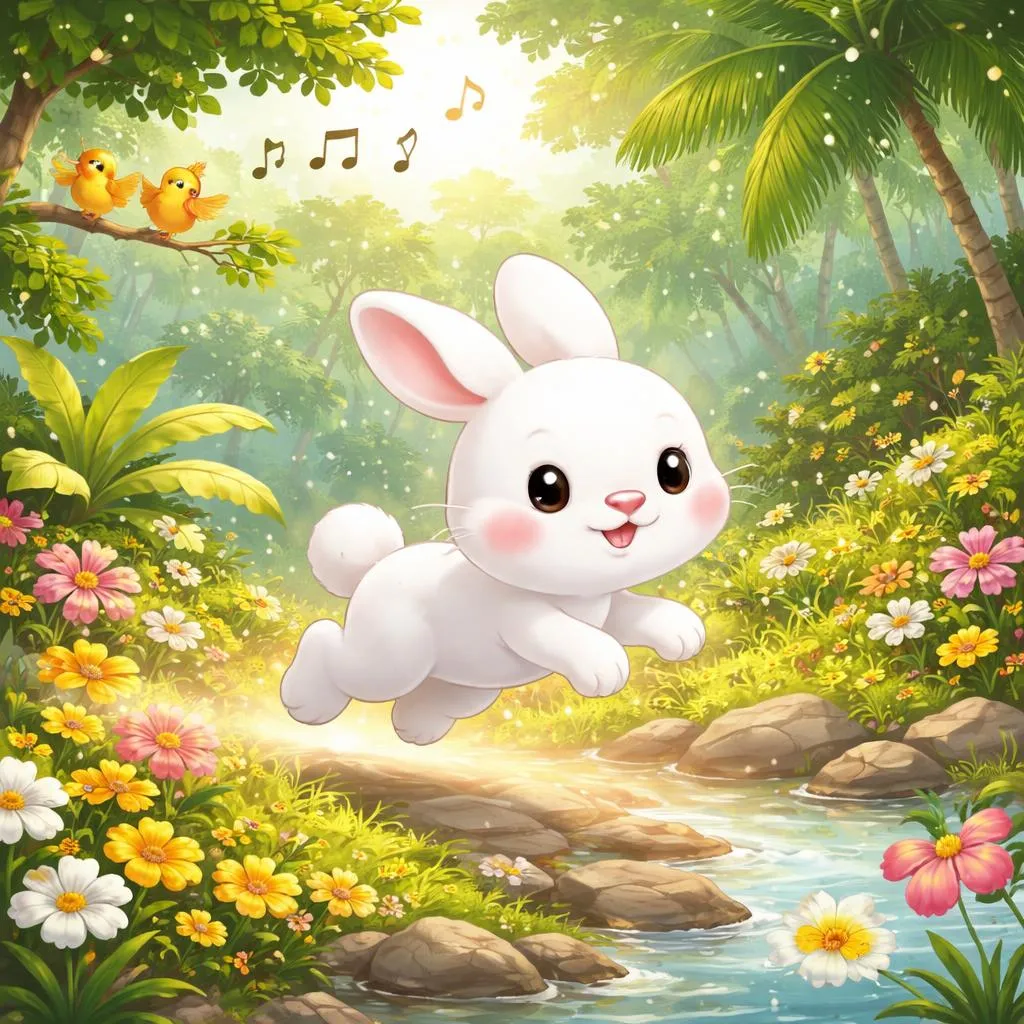

Have you ever watched a rabbit? They are soft, fluffy animals with long ears. They love to hop, hop, hop on their strong back legs. In Indonesia, the word for rabbit is “kelinci,” and there is a very happy and bouncy song about a little rabbit. It is a song full of hopping and counting. Let’s meet “The Little Rabbit (Kelinci Kecil).”
About the Song
Here are the lively and joyful lyrics of a popular traditional Indonesian children’s song about a little rabbit:
Kelinci kecil, kelinci kecil,
Lompat-lompat riang.
Di kebun yang hijau,
Selalu ceria.
Satu, dua, telinga kelinci.
Panjang dan tegak.
Kelinci kecil, temanku,
Ayo kita bernyanyi!
English Translation:
Little rabbit, little rabbit,
Happily jump-jump.
In the green garden,
Always cheerful.
One, two, rabbit ears.
Long and standing up.
Little rabbit, my friend,
Let’s sing!
This is a cheerful and active Indonesian folk song for children. The song is a happy picture of a rabbit playing in nature. First, we see the “kelinci kecil.” It is full of joy, jumping around. “Lompat-lompat riang.” It is in a green garden, always cheerful. Then, we play a little game. We count its famous ears: “Satu, dua, telinga kelinci.” We see they are long and stand up straight. Finally, we call the rabbit our friend and invite it to sing with us. It is a song about playing in nature, observing animals, and happy friendship.
What the Song is About
The song paints a picture of a playful rabbit in a beautiful place. You are in a green garden. “Di kebun yang hijau.” You see a little rabbit. It is the “kelinci kecil.” It is not walking. It is hopping! “Lompat-lompat riang.” It jumps happily here and there. It looks very cheerful, “selalu ceria.”
You look at the rabbit closely. What is the first thing you notice? Its ears! You point and count them: “Satu, dua, telinga kelinci.” One, two, rabbit ears. They are not small. They are “panjang dan tegak,” long and standing up straight. The rabbit is so cute and friendly. You think of it as a friend. “Kelinci kecil, temanku.” You are so happy that you want to share the fun. You say, “Ayo kita bernyanyi!” Let’s sing together! The song is a happy celebration of a playful animal friend.
When to Sing It
This song is perfect for active, playful moments. You can sing it while hopping around the living room or garden like a happy rabbit, touching your ears on “satu, dua.” You can sing it during a walk in a park or a green space, pointing out things that are green like the garden in the song. You can also sing it as a fun counting song with friends, using your fingers to count “satu, dua” along with the rabbit’s ears.
What Children Can Learn
This happy, bouncy song is a wonderful teacher for action words, simple counting, and words to describe nature and feelings in Indonesian.
Vocabulary
The song teaches us fun Indonesian words for animals, actions, and descriptions. “Rabbit” (Kelinci). “Small/little” (kecil). “To jump/hop” (lompat). “Happily/joyful” (riang). “In” (di). “Garden” (kebun). “That/which is” (yang). “Green” (hijau). “Always” (selalu). “Cheerful” (ceria). “One” (satu). “Two” (dua). “Ear” (telinga). “Long” (panjang). “And” (dan). “Standing up/erect” (tegak). “My friend” (temanku). “Let’s” (Ayo). “We” (kita). “To sing” (bernyanyi).
Let’s use these words! You can talk about play: “Aku lompat-lompat.” (I am jumping.) “Rumahku selalu ceria.” (My house is always cheerful.) New word: Wortel. This means “carrot.” You can say, “Kelinci suka wortel.” (Rabbits like carrots.)
Language Skills
This song is excellent for learning how to talk about actions that are happening right now and for using numbers to count things. It shows us a common way to describe an ongoing action and pairs it with simple numbers.
Concept Definition: We are learning about describing an action that is happening, like jumping, using the repeated verb “lompat-lompat.” This repetition shows the action is continuous. We are also learning to count objects, starting with “satu” (one) and “dua” (two), and to describe them with words like “panjang” (long).
Features and Types: For ongoing actions, Indonesian often repeats the verb. The pattern is: “[Subject] + [repeated verb] + [manner].” In the song, it’s “Kelinci kecil, lompat-lompat riang.” (The little rabbit, jump-jump happily.). For counting and describing, the pattern is: “Number + [object] + [description].” Like “Satu, dua, telinga kelinci. Panjang dan tegak.”
How to Spot Them: Here is the “Action Spotter” trick. Listen for a word that is said twice, like “lompat-lompat.” This often means the action is happening again and again, right now. Ask yourself: “Is this word an action, and is it repeated?” For counting, look for the words “satu” or “dua” at the start. Ask: “Is this sentence starting with a number?”
How to Use Them: A great way to describe play and count is the “Hop and Count” formula. The pattern for action is: “[Animal/Person] [verb-verb] [manner].” For counting: “Satu, dua, [object].”
Example from the song: Action: “Kelinci kecil, lompat-lompat riang.” Counting: “Satu, dua, telinga kelinci.”
Example you can make: “Anak kecil, lari-lari cepat.” (The little child, run-run fast.) “Satu, dua, tiga, bola.” (One, two, three, balls.)
Sounds & Rhythm Fun
Listen to the light, hopping melody of the song. The tune for “Kelinci Kecil” is bouncy and playful, with a rhythm that really feels like a rabbit hopping. The words “lompat-lompat” are often sung with little jumps in the tune, which makes it extra fun. The song makes you want to move!
The words have a happy, bouncy sound. The “lo” in “lompat” and “ri” in “riang” sound bright. The repeated “lompat-lompat” is fun to say and makes you think of quick hops. The counting part “satu, dua” is clear and simple. The rhythm is steady and hop-like, perfect for bouncing or clapping along. This energetic rhythm is perfect for creating your own hopping animal song. Try a frog song: “Katak kecil, katak kecil, Lompat-lompat di air… Satu, dua, mata katak…” (Little frog, little frog, Jump-jump in the water… One, two, frog eyes…).
Culture & Big Ideas
“Kelinci Kecil” connects to the appreciation of nature and animals found in many Indonesian children’s songs. While rabbits are not native to Indonesia’s tropical forests, they are popular in stories, as pets, and in animations, symbolizing gentleness, agility, and playfulness. The green garden (“kebun hijau”) is a common and cherished setting for play and family time.
The song conveys three joyful and engaging ideas. First, it encourages close observation and appreciation of animals by focusing on the rabbit’s specific actions (hopping) and physical features (long, upright ears), turning simple watching into a fun activity. Second, it seamlessly combines physical activity (“lompat-lompat”) with early learning (counting “satu, dua”), showing that moving your body and using your mind can be part of the same joyful game. Third, it fosters a sense of kinship with nature by addressing the rabbit directly as “my friend” (“temanku”) and inviting it to sing, promoting a view of animals as playful companions rather than just creatures to look at.
Values & Imagination
Imagine you are the little rabbit. You are a soft, white rabbit with the longest ears. You live in a beautiful “kebun yang hijau,” a garden full of green grass and plants. You feel so happy and free. You start to hop. “Lompat-lompat riang!” You hop in circles, you hop in zig-zags. The sun is warm. You are “selalu ceria,” always cheerful.
You stop to listen. Your big ears, “satu, dua, telinga kelinci,” stand up straight. “Panjang dan tegak.” You can hear all the garden sounds. Then, you hear a friendly voice. “Kelinci kecil, temanku, ayo kita bernyanyi!” A child is calling you a friend and wants to sing with you! You twitch your nose happily. How does it feel to have a friend who wants to sing and play with you in the green garden? Draw the happy rabbit. Draw a big, green garden at the bottom. Draw a cute rabbit in the middle, with its two very long ears standing up. Draw little lines around its feet to show it is hopping (“lompat-lompat”). Write the words “riang” and “ceria” near it. This shows the song’s happy feeling.
The song encourages us to play actively like the rabbit, to observe animals closely and kindly, to practice counting in a fun way, and to see the natural world as a place full of friendly creatures. A wonderful activity is the “Lompat dan Hitung” (Hop and Count) game. Find a safe, open space. Hop like a rabbit while singing “lompat-lompat riang!” Each time you hop, touch one of your ears and count: “satu!” (hop), “dua!” (hop), “satu!” (hop), “dua!” (hop). See how many hops you can do! This connects the song’s action and counting to your own movement.
So, from watching the rabbit hop to counting its ears and calling it a friend, this song is a celebration of joyful movement and friendship with nature. It is a vocabulary lesson in animals, actions, and counting. It is a language lesson in describing ongoing actions with repeated verbs and using numbers. It is a music lesson in a bouncy, hopping tune. “The Little Rabbit (Kelinci Kecil)” teaches us about playful observation, counting, and cheerful friendship.
Your Core Takeaways
You are now an expert on the Indonesian song “The Little Rabbit (Kelinci Kecil).” You know it is a bouncy song about a little rabbit hopping happily in a green garden, whose long ears we count, and who we call our friend to sing with. You’ve learned Indonesian words like “kelinci,” “lompat,” “kebun,” “hijau,” “satu,” “dua,” “telinga,” and “teman,” and you’ve practiced describing ongoing actions like “lompat-lompat” and counting “satu, dua.” You’ve felt its happy, hopping rhythm. You’ve also discovered the song’s message about observing nature playfully, combining movement with learning, and being a friend to animals.
Your Practice Missions
First, play the “Aksi Kelinci” (Rabbit Action) game. Stand up and be the rabbit! When you hear the word “lompat,” do a little hop. When you hear “satu, dua,” touch each of your ears. Now, ask a friend or family member to read or sing the song’s Indonesian lines slowly (“Kelinci kecil… lompat-lompat riang… Satu, dua, telinga kelinci…”). You do the actions! Then switch. This mission helps you connect the new words to physical movements, making them easier to remember.
Second, make a “Hitung Telinga” (Count the Ears) card. Take a piece of paper and draw two big, long rabbit ears at the top. Underneath the first ear, write a big “Satu.” Underneath the second ear, write a big “Dua.” Decorate your card with green like the garden. Use your card to teach someone how to say “one” and “two” in Indonesian. Point to the ears and say “Satu, dua, telinga kelinci!” This mission lets you use the song’s counting words in a creative way.