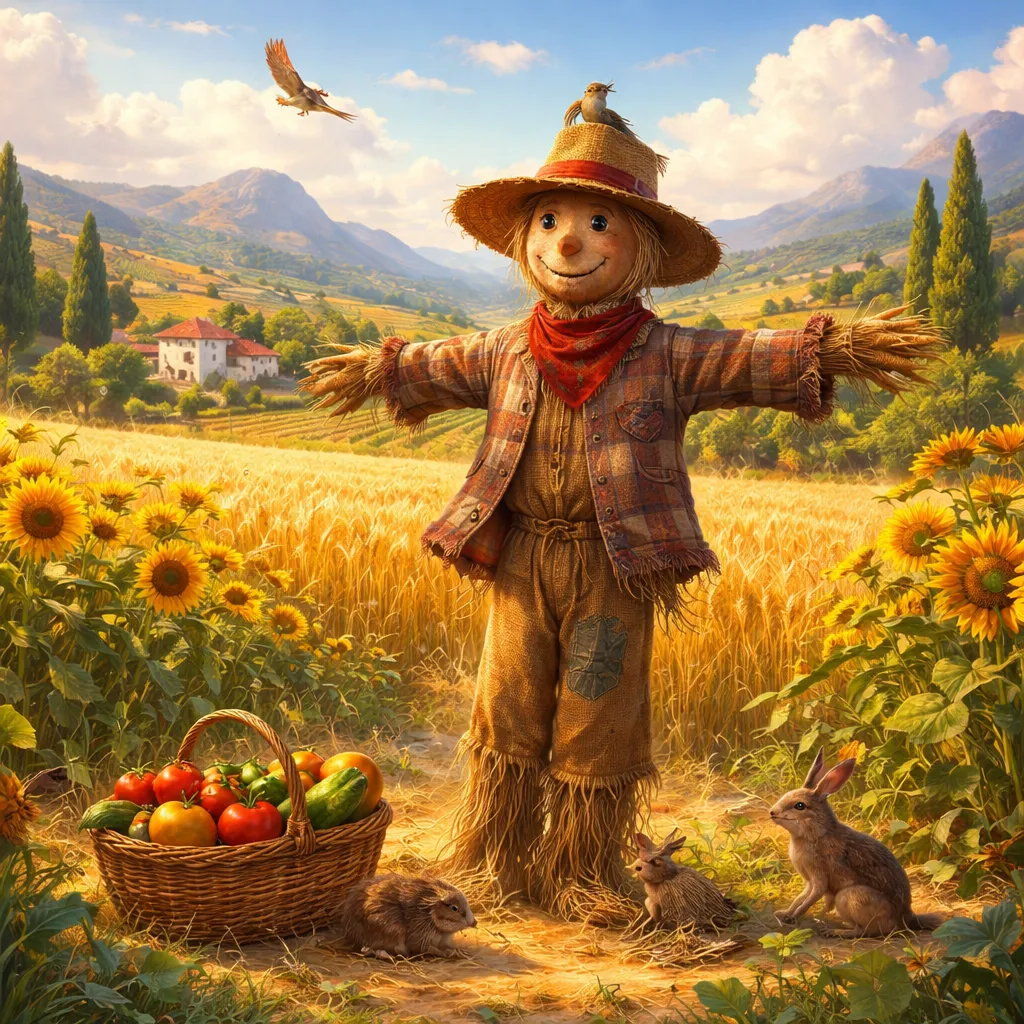

Have you ever seen a funny figure standing in a garden or a field? It might be made of old clothes and straw, with a hat on its head and arms stretched out wide. This is a scarecrow, a friendly guardian of the plants! In the Spanish countryside, there is a song that brings this quiet guardian to life with lots of movement. Let’s wave and march to the active tune of “The Scarecrow (El monigote).”
About the Song
Let’s read the lively, action-packed words of this traditional song.
El monigote, el monigote,
mueve un brazo, mueve el otro.
El monigote, el monigote,
mueve un pie, mueve el otro.
El monigote, el monigote,
mira a un lado, mira al otro.
El monigote, el monigote,
camina para adelante, camina para atrás.
English Translation:
The scarecrow, the scarecrow,
moves one arm, moves the other.
The scarecrow, the scarecrow,
moves one foot, moves the other.
The scarecrow, the scarecrow,
looks to one side, looks to the other.
The scarecrow, the scarecrow,
walks forward, walks backward.
This is a playful traditional Spanish children’s song from the folk traditions of Spain and Latin America. The word “monigote” means a crude doll or figure, like a scarecrow or a simple drawing of a person. The song is a fun call-and-action rhyme. It describes all the ways a scarecrow might move if it could come to life! The song lists simple, clear actions: moving arms, moving feet, looking around, and walking. The melody is usually upbeat, marching, and very easy to follow, making it perfect for getting children to move and sing along. It turns a still garden figure into a playful, dancing friend.
What the Song is About
The song paints a picture of a scarecrow waking up and starting to move. Imagine a quiet field in the morning sun. A scarecrow stands still on its pole. Then, as the song starts, magic happens! The scarecrow begins to move. First, it lifts its right arm. Then, it lifts its left arm. The arms, maybe made of sticks and an old shirt sleeve, swing slowly in the breeze. Then, the scarecrow starts to move its feet. It lifts its right foot, then its left foot, as if marching in place.
Next, the scarecrow becomes a careful guard. It turns its head, maybe a sack with a painted face, to look to the right. It looks all around to the left, watching for any birds that might want to eat the seeds. Finally, the scarecrow takes a walk! It steps one foot forward, then the other, moving ahead. Then, it steps one foot back, then the other, moving backward. It is patrolling its field! The song is about imagining life in a still object and celebrating simple movements we all can do.
Who Made It & Its Story
“El monigote” is a classic traditional Spanish folk song with no single known author. It comes from the rich tradition of children’s game-songs and rhymes used in Spanish-speaking communities for generations. The song reflects rural, agricultural life where scarecrows were a common sight in fields to protect crops. The song personifies the scarecrow, turning a simple farm tool into a character. This sparks children’s imagination about the world around them. It is also a fantastic “action song” used by parents and teachers to help children learn body parts, directions, and follow movement instructions in a fun, playful way. It is less about a specific story and more about playful movement and language learning through music.
This action song is loved for three energetic reasons. First, its instructions are incredibly clear and paired with a catchy, marching tune, making it easy and fun for children to follow and move along. Second, it is a brilliant tool for teaching basic Spanish vocabulary for body parts and actions in a totally natural and memorable way. Third, it encourages imaginative play and physical activity, turning a simple song into a full-body game that brings a familiar figure to life.
When to Sing It
This song is perfect for active, playful moments. You can sing and act it out loudly in the backyard or park, pretending to be a scarecrow coming to life. You can chant it during a music or movement class, following the actions as a group. You can also hum it while drawing or building your own scarecrow from sticks and old clothes, making it move as you sing.
What Children Can Learn
This playful song is a wonderful teacher about movement, Spanish language, and imagination.
Vocabulary
The song teaches us words for a figure, body parts, and actions in Spanish. A “scarecrow” or “rag doll” (monigote) is a figure made to look like a person, often to scare birds. An “arm” (brazo) is the part of your body from your shoulder to your hand. The “other” (otro) means a different one of the same kind. A “foot” (pie) is the part of your body at the end of your leg. To “look” (mirar) means to turn your eyes to see something. A “side” (lado) is the left or right part of something. To “walk” (caminar) means to move by taking steps. “Forward” (adelante) means moving ahead. “Backward” or “back” (atrás) means moving behind you.
Let’s use these words! You can say, “I moved one foot forward to step over the puddle.” Or, “The robot looked to one side, then to the other.” New word: Patrol. This means to walk or move around an area to guard or protect it, just like the scarecrow in the song.
Language Skills
This song is a fantastic lesson in using action verbs in the present tense and talking about different body parts and directions.
Concept Definition: An action verb is a word that shows what someone or something is doing. In the song, words like “mueve” (moves), “mira” (looks), and “camina” (walks) are all action verbs. They tell us the scarecrow’s job. Think of them as “doing words.” When you run, jump, or eat, you are doing an action.
Features and Types: Many action verbs in songs like this describe simple motions we do with our bodies. We can group them: Moving verbs like “mueve” (move), “camina” (walk), “salta” (jump). Seeing verbs like “mira” (look), “ve” (see). In this song, we see moving and seeing verbs.
How to Spot Them: Here is a simple “finding secret.” Ask yourself: “Is this word telling me what the scarecrow is doing right now?” If the answer is “yes,” you have found an action verb! Look for the word that shows the action happening, like “mueve” (he/she/it moves).
How to Use Them: A great way to use these verbs is with a simple “sentence recipe”. In the song, the pattern is: [Thing] + [Action Verb] + [What or Where].
Example from the song: “El monigote mueve un brazo.” (The scarecrow moves an arm.) Thing=Scarecrow, Action Verb=moves, What=an arm.
Example from the song: “El monigote camina para adelante.” (The scarecrow walks forward.) Thing=Scarecrow, Action Verb=walks, Where=forward.
You can make your own sentences! “My dog runs to the park.” “The bird flies high in the sky.” Just follow the recipe: Thing + Action + Details.
Sounds & Rhythm Fun
Listen to the strong, marching, and very clear rhythm of the melody. The song has a steady, walking beat that makes you want to stomp your feet. The repetition of the line “El monigote, el monigote” at the start of each verse acts like a drumbeat calling you to move. The melody is straightforward and often follows the rhythm of the words closely, making it super easy to remember. The Spanish lyrics have a strong, repetitive sound pattern: “monigote” rhymes with itself, and the pairs “brazo/otro” and “pie/otro” create a satisfying, balanced feeling. The commands “mira a un lado, mira al otro” and “camina para adelante, camina para atrás” are fun to say quickly.
The rhythm is like a march: steady and strong. Try marching in place: El mo-ni-go-te, el mo-ni-go-te (El moh-nee-goh-teh, el moh-nee-goh-teh). The clear, call-and-response style (the singer calls the action, and you do it) makes it an excellent game. This strong, repetitive, and commanding musical pattern is perfect for action songs. You can write your own “action figure” song! Use the same marching rhythm. Try: “The robot, the robot, turns its head, turns its body. The robot, the robot, takes a step to the left, takes a step to the right.”
Culture & Big Ideas
“El monigote” connects us to the rural, agricultural life that is a big part of Spanish and Latin American history and culture. Scarecrows, or “espantapájaros,” are found in fields to protect crops like wheat, corn, and sunflowers. This song brings that static figure to life, reflecting how people use music and imagination to interact with their environment. The song is often sung during playtime or in community gatherings, not for a specific holiday, but as part of daily fun. It embodies the value of hard work and guardianship (the scarecrow’s job) and the joy of playful imagination (making it dance). It teaches children to observe and creatively engage with the world around them, even with simple things like a figure in a field.
The song conveys three active ideas. First, it’s about finding fun and movement in everything. Even a still scarecrow can dance in our imagination. Second, it expresses the importance of being observant and vigilant. The scarecrow looks all around to do its job well, teaching us to pay attention. Third, it highlights that simple, clear instructions help us learn and play together. The song gives clear directions that everyone can follow, making group play easy and fun.
Values & Imagination
Imagine you are the scarecrow. You have been standing still in the field all night. The sun rises and warms your straw. How does it feel to slowly move your arm for the first time? Do you hear the straw rustle inside your shirt? Now, imagine looking to one side. What do you see? Maybe a line of trees. You look to the other side. What do you see? Rows of green plants. Now, imagine taking a step forward. Your feet are maybe just stuffed sacks. Does it feel funny to walk? Take a step back. You are dancing in your field! Draw a four-picture comic strip. First, draw the scarecrow still. Second, draw it moving its arms. Third, draw it looking side to side. Fourth, draw it walking. This shows the story coming to life.
The song encourages observation, imaginative play, and following instructions in a fun way. A wonderful activity is a “Scarecrow Says” game (like “Simon Says”). One person is the leader (“el monigote”) and gives commands in Spanish or English: “¡El monigote dice: mueve un brazo!” (The scarecrow says: move one arm!). Players only move if the leader says “El monigote dice…” first. This turns the song’s vocabulary into an active game.
So, as the last command to walk backward fades, think about the energy in this marching tune. It is a vocabulary lesson in body parts and actions. It is a grammar lesson in using present tense action verbs with a simple sentence recipe. It is a music lesson in a strong, marching rhythm. From the first call to the scarecrow to the final steps it takes, it wraps lessons in observation, playful movement, and imaginative play in a melody that makes you want to jump up and dance. “The Scarecrow (El monigote)” teaches us that we can bring stories to life with our imagination, that our bodies can move in many wonderful ways, and that even a quiet guardian in a field can have a fun dance if we just sing the song.
Your Core Takeaways
You are now an expert on the song “The Scarecrow (El monigote).” You know it is a traditional Spanish action song about imagining a scarecrow coming to life and moving. You’ve learned Spanish words like “monigote,” “brazo,” and “camina,” and you’ve practiced using action verbs in the present tense with a simple sentence recipe. You’ve felt its strong, marching rhythm and created your own action verse. You’ve also discovered the song’s connection to farm life and its messages about imaginative play, being observant, and the joy of following movement instructions.
Your Practice Missions
First, play “Scarecrow Says.” With a friend or family member, take turns being the leader. Give commands like “The scarecrow says: move one foot!” or “The scarecrow says: look to the side!” Use the Spanish words if you can. Do the actions only when the leader says “The scarecrow says…” first. This mission turns the song into an active game.
Second, build and move your own “monigote.” Find two sticks. Tie them together in a cross shape to make a body and arms. Use an old cloth or a small bag for a head. Dress it with leaves or fabric. Then, hold your scarecrow and make it act out the song. Move its arms, make it look around, and walk it forward and backward on a table. This activity connects the song’s words to a real, creative object you can play with.